

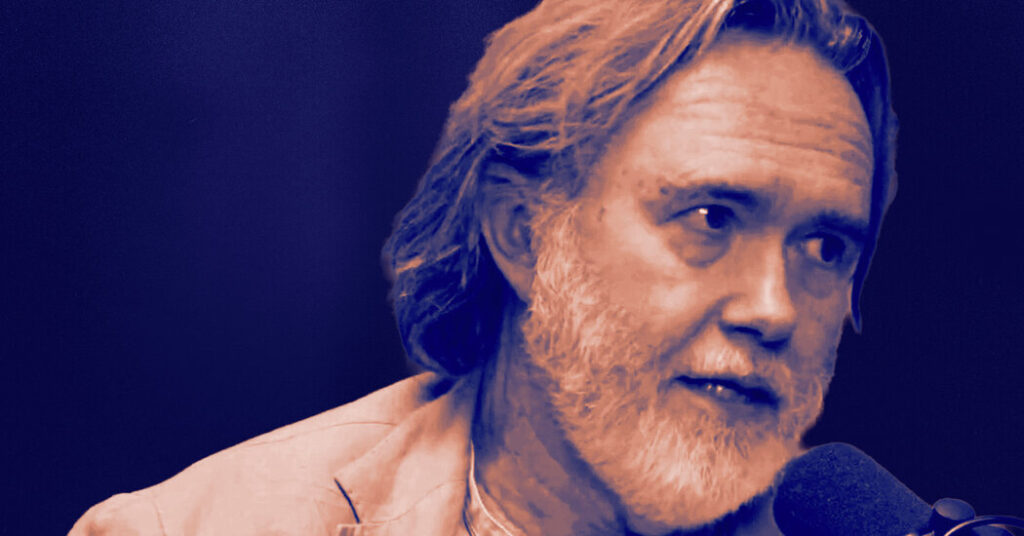
The work of Rod Dreher has a consistent theme: doom. He believes the collapse of Christianity has ushered civilizational decline in Europe, that we’ve traded our humanity for comfort, and he worries that totalitarianism is around the corner for the United States. “I’m worried about Weimar America,” he tells me. “It may not be Hitler 2.0. It may not be Stalin 2.0. It might be something all American, but it’s not going to be what we’re used to.” It’s best not to dismiss him; he’s been right before. We discuss how we got here and the dangers that still lie ahead when we grant godlike powers to our technology.
Below is an edited transcript of an episode of “Interesting Times.” We recommend listening to it in its original form for the full effect. You can do so using the player above or on the NYTimes app, Apple, Spotify, Amazon Music, YouTube, iHeartRadio or wherever you get your podcasts.
Ross Douthat: Rod Dreher, welcome to “Interesting Times.”
Rod Dreher: At last, Ross, you’ve scraped the bottom of the barrel.
Douthat: I’ve hit bottom …
Dreher: You’ve hit bottom! [Chuckles.]
Douthat: And I’ve found you. But it’s a pleasure to find you there because if someone were to write a history of religious conservatism in the 21st century, I think they could probably do it just by tracing your career.
Twenty years ago you were a Catholic convert having a crisis of faith brought on by reporting on the sex abuse crisis, and then you converted to Eastern Orthodoxy.
Your book “Crunchy Cons” anticipated the MAHA movement and the kind of convergence of crunchy left and religious right.
You wrote a book called “The Benedict Option” in the mid-2010s that crystallized a sense of Christian disillusionment with politics and disengagement with politics. Then, when Christians became enthusiastic about political possibilities after the election of Donald Trump, there you were, living and working in Viktor Orban’s Hungary.
And then your latest book, “Living in Wonder,” was about the return of the supernatural, and also about anxieties about an A.I. future.
You’ve covered a lot of ground, but always with a consistent theme.
Dreher: Which is?
Douthat: Doom. The decline of America, the decline of the West, maybe the apocalypse, the Book of Revelation.
Dreher: Yeah. Mama says: We in Revelations.
Douthat: That’s right. This is a touchstone. So we’re going to start with your most consistent form of pessimism, which is the idea that the decline of Christianity, the religion that both you and I share, will be bad for America, bad for everybody, bad for the world.
Talk to an audience that isn’t Christian, or is lukewarmly Christian. Why should people in that category worry about what comes after a Christian culture?
Dreher: Well, I would direct them to Tom Holland’s great book from a few years ago, “Dominion.”
Tom Holland, secular liberal English historian, set out to tell the story about how the Christian faith made the Western world. In the book, Tom says — and says it better than anybody I’ve seen — that everything that he valued as a secular liberal came out of Christianity and nothing else. He talks about the idea of equality, the equality of everyone before the law, human rights — all of these sorts of things that secular liberals take for granted, we wouldn’t have them if it weren’t for Christianity.
That is not a reason to convert to Christianity. But Ross, we have been living in the West on the fumes of Christianity for a long time, and now we’ve pretty much gotten to the bottom of it, and we can see the outlines of what a truly post-Christian society is like. If people think that it’s going to be this happy, clappy, new atheist, everyone’s nice, “we’re not bothered by God anymore,” they sure have another thing coming.
Nietzsche — I didn’t imagine we’d get to Nietzsche so soon in this, but—
Douthat: I did. I was anticipating Nietzsche high up in the conversation.
Dreher: Well, Friedrich Nietzsche famously said in the late 19th century, “God is dead and we have killed him.” Nietzsche didn’t believe in God. He was talking about the idea of the Christian God in Western civilization. Nietzsche was not a romantic about this. He saw that it would be very dark and difficult for humanity to find some sense of meaning if God were dead.
And he was right. We can’t make our own meaning. Nietzsche was not a Nazi, but the ideological convulsions that came in the 20th century with Soviet Communism, with Nazism in Germany, and so forth, all of them are products of the death of God.
Douthat: All right, so give me the outline of what you see happening now. We’re not living under Nazi rule. We’re not living under Communist rule. Those were, I think, in different ways, post-Christian experiments that led to tremendous human suffering and ultimately failed.
In Western Europe and the United States, we’re 70 or 80 years past peak totalitarianism. We’re less religious than we were before. We’re richer than we were before. People seem unhappy with the state of things. I think that’s pretty clear all over. What is the concrete loss or crisis right now in 2026?
Dreher: I think that we’re living through, at the bottom, a crisis of meaning. People don’t know why they should go on. We have been raised by consumerist culture — both the left and the right have a role to play in this — to believe that more freedom, more wealth is going to make us happy, and it hasn’t. It’s made us more miserable.
Look at the birth crisis, the fertility crisis. I know that concerns you a lot — me too. People just don’t seem to have any reason to go on.
I think it all ultimately goes back to a loss of a sense of transcendence. Losing the transcendent sense of life has been deadly for us spiritually, morally and aesthetically.
Douthat: Talk about aesthetics for a second before we get to politics.
Dreher: One of the most popular architects of the 20th century, Christopher Alexander, co-authored a book called “A Pattern Language,” talking about his study of what architecture thrives and what aspects of it make people feel good and feel connected to the whole. He found out that, through whatever culture it is, they all follow certain patterns that you can find in nature, and people have an intuitive positive response to it. Whereas with modern architecture, the genius architect comes in and he’s got this vision and he’s going to execute it, and people hate modern architecture.
Christopher Alexander said that it’s not an accident that we have lost a sense of organic-ness to the buildings we make and the art we create. We have come to believe that art and architecture is about expressing our individual will, not connecting to any higher truth nor allowing a higher truth to be refracted through ourselves — just imposing will.
I think we’ve reached a dead end. Over the course of the centuries, we lost that intuition and a sense of connection with truth that cannot be approached logically or through reason alone, but has to be approached through art, through beauty, through ritual, through religion.
This is our problem now. We have made ourselves miserable.
Douthat: So there’s a dystopia that comes out of this, of drift and meaninglessness and anomie, where people don’t have kids, they live in ugly buildings, they’re well-off enough, society is stable enough, but they’re deeply unhappy because they don’t think human life has transcendent meaning or a transcendent point.
But I think your assumption, which is a commonplace assumption that is maybe strongest on the political right — but not only on the right — is that that kind of scenario then leads to a desire to impose meaning through politics and to find in politics the narrative that’s been lost through a religious crisis.
One of your books was arguing that wokeness and progressive politics is itself a form of soft totalitarianism. Can you make that case to an audience that might think wokeness went too far, but would also think calling it totalitarian was weird or extreme?
Dreher: Sure. The idea for the book came to me in 2015, which was the woke era or only a couple of years into it, I would say. I don’t even know that we had that name for it then. I found out from a doctor in the Midwest, a cardiologist, who said: Look, my mother escaped from Communism. She spent several years in a Czech prison for being a Vatican spy, which is to say she refused the government’s order to stop going to Mass. She got out, came to America, and she said: Son, the things I’m seeing happen in America today, in 2015, remind me a lot of what it was like when Communism came to my home country.
That struck me as kind of crazy. But the more I started meeting, on my travels to conferences and things like that, with people who had come to America from the Soviet bloc, I would say: Hey, with speech codes and cancel culture and all that, does that remind you of what you left behind?
Every one of them said yes. And if you talked to them long enough, they would tell you how angry they were that Americans just didn’t see it.
So I started investigating this. What are the similarities between old school totalitarianism and what are the differences?
Basically, our idea of totalitarianism in America today is conditioned by the Soviet experience and from George Orwell’s “1984.” Well, we don’t have that. But guess what?
Douthat: We don’t have what?
Dreher: We don’t have a police state.
Douthat: Right. Yes.
Dreher: And we don’t have bread lines. We don’t have the secret police. We think it’s not totalitarianism. But look at the effect when people had to fear that they might lose their job because they were on the wrong side of the ruling ideology or they said the wrong thing, told the wrong joke, etc. That’s what totalitarianism is.
The more I dug deeply into it, I saw that wokeness is a pseudo-religion. It’s a way of imposing moral order on people and punishing the heretics.
I traveled throughout the former Soviet bloc, talking to Christians and others who had stayed behind and resisted Communism. The key moment for me came on a tram in Budapest. I was traveling with my interpreter, Anna, a Catholic woman then in her 30s, and we were between interviews.
She said: As a Catholic, I really struggle to talk to even my Catholic friends about the things happening in my life. For example, if I tell them that my husband and I have been arguing a lot lately, they’ll cut me off and say, “Oh, you’ve got to get a divorce. You’ve got to go back to work. You deserve to be happy.”
She said: I can’t make them understand. I love my husband, I love being married, but a happy life is not a life that’s without friction.
I said: Anna, it sounds like you’re fighting for your right to be unhappy.
She said: That’s it. Where did you get that?
I said: Chapter 17 of Huxley’s “Brave New World.”
And then it clicked for me: The totalitarianism we have is not the police state, pain, terror, cruelty of Orwell, but the therapeutic totalitarianism of Huxley, where they give you everything you want, all the drugs, the porn, the sex, the entertainment. Everything’s taken care of, but you just have to surrender your humanity.
The point is, this is the totalitarianism we have. We have created a world, and especially with the generation raised on digital culture, in which they cannot bear any friction. They see any friction as intolerable suffering, and they will surrender their liberties and even, I think, ultimately their humanity to escape that anxiety.
Douthat: But in Huxley, there is a world state. There is a controller, even if he’s gentle and kindly compared to the police state …
Dreher: Big Brother.
Douthat: Right, in “1984.” Huxley assumed that this kind of therapeutic control would be political control. And I think the case that there is a political element in this is stronger for Europe than the United States.
Say something about what you think the actual condition of free speech is in Western Europe.
Dreher: I lived four, almost five years in Hungary, traveled widely throughout Europe and the U.K., and it made me so grateful for the First Amendment to our Constitution that guarantees us freedom of speech.
In Europe, that doesn’t exist anywhere. The way I see it, broadly speaking, is the ruling class in all of these countries, in continental Europe and in the U.K., are so terrified of the migration problem and of civil wars and civil conflict by people — ordinary native-born Europeans complaining about things like rape gangs, mass migration, etc. — that they would rather shut down any debate on this and punish those who notice and complain.
At least in America, we can still complain about it.
Douthat: Yeah, if you look at the U.K. in particular, there is, I think, a trend that Americans would find surprising in the number of people who are arrested, investigated, fined, and imprisoned for stating strong opinions about immigration, crime, race, and so on, on social media.
It happens on both the further left and the further right. There was a sort of cause célèbre case recently where the U.K. banned Hasan Piker from entering the U.K. because they felt that he was sort of inciting antisemitism with his critiques of Israel.
So it seems to me that the European elite understands that it’s created a multicultural, multiracial society that is itself divided and kind of like a powder keg, and it’s using speech restrictions essentially to try and tamp things down all over.
But that is a little bit different from a totalitarianism that’s trying to force everybody to be an atheist, hedonist, nihilist empty pleasure seeker. It seems to me that it’s more motivated by fear than by any sort of idea of what the best society should be.
Dreher: Well, I’ll give you an example. Last night, I was having drinks with a friend from Germany, a Catholic who’s been an activist for many years. She was telling me about the AfD, the Alternative for Germany party. She said that the German government has gone so far to marginalize and demonize that party and its voters — and not just the German government, but the Catholic Church in Germany and so forth — because they see them as a second coming of the Nazis.
But this German woman said that the problem is that the crisis with migrants and migrant crime is becoming so overwhelming that people are becoming radicalized anyway because the established parties, the parties at the center, refuse to deal with the problem.
That’s happened in England. It’s happening in France right now. And eventually, God forbid, I think we’re going to see violence because they cannot use the mechanisms of the state, or the same ruling class that runs the churches and the media organizations and the universities. They can’t keep a lid on it forever.
Douthat: What kind of violence? We’re in the U.K. The U.K. has had a sequence of what you might call ethnic riots or race riots over the last few years, some of them involving debates over immigration. There have been conflicts between different immigrant groups. There have been riots by native populations, sometimes connected to high-profile crimes.
When you’re talking about violence, is that what you’re talking about? Just ongoing civil unrest?
Dreher: Yeah. Civil unrest, small acts of local terrorism — things like that. But if you follow David Betz, the civil war academic expert at King’s College London, he’s been warning for a couple of years that in all of the countries of Western Europe and the U.K., and even to some extent the U.S., the ingredients are there for an explosion. They’re just waiting for the spark.
He’s not saying this from any sort of crazy conspiracy theory point of view. He’s citing the literature from the academic study of civil wars. I think the core idea is that we no longer feel like we belong to the same society and that the ruling class is not going to defend the native population.
But that’s what frightens me. When people feel that they are living in a lawless situation or a situation of injustice, whatever color or religion they are, and that there’s no hope for this to be resolved through law, then we run the risk of civil unrest.
A lot of people try to tell me, “Oh, you just want this to happen.” No, I don’t. I don’t want this to happen. But it will happen if those in charge don’t take it seriously and act meaningfully to head it off at the pass.
Douthat: Why does immigration loom so large in this story? We started talking about de-Christianization and a crisis of meaning. Immigrants to both the U.S. and Western Europe tend to be more religious than native populations right now.
We were talking about purposelessness and drift a minute ago. I would say that in many cases, immigrants to the U.S. and Western Europe come with more purpose and drive and less drift, again, than native populations.
Why is immigration part of the crisis of de-Christianization to you, rather than either a neutral phenomenon or maybe a potential solution?
Dreher: In Europe, unlike the United States, a great deal of immigration into Europe has been from Islamic countries. And by and large — you don’t want to generalize, but by and large — the ones who have caused problems are young Muslim men who will not assimilate.
It is also true that European countries are much more difficult than the U.S. to assimilate into. Having lived in Europe, I was treated with nothing but kindness, but I’ll never be European.
That said, the problem with Islam in Europe is that Muslims, by and large, know what they believe, and they set themselves in an antagonistic place to the secularism of Europe. In fact, I’ve talked to Muslims who said: We would respect you more if you were Christian, if you were really Christian.
I think that what the religiosity of practicing Muslims has come to mean in Europe is it makes a lot of the secularists worried because they don’t have the same commitment that the Muslims do.
If we don’t recover Christianity in the West — in some meaningful way, not just a nominal way — then Islam will be the heir, because you can’t fight something with nothing.
This is the message that Michel Houellebecq famously articulated in his book “Submission.” It was wrongly perceived as an anti-Muslim book. It’s not. The enemy in that book is the malaise, the sort of layabout French secularist.
Douthat: Right. This is a dystopian novel in which Islam takes over France.
Dreher: It’s a peaceful takeover.
Douthat: Right. It’s a peaceful takeover. It’s a future French election where an Islamic party wins.
And I agree with you. You come into the novel imagining that the point is going to be that the Muslim society is terrible. But in fact, the dystopia in the novel is the secular society where nobody cares about anything anymore, and Islam is welcomed ultimately as a source of meaning.
Dreher: As a kind of solution.
Douthat: But would you, as a Christian, prefer an Islamic Europe to a secular Europe?
Dreher: You know, I’m an Eastern Orthodox convert of 20 years.
Douthat: Eastern Orthodoxy and Islam have had their differences.
Dreher: Yeah, they’ve had their problems. If you speak to Arab Christians or Christians who have lived under the Islamic yoke in centuries past, you can’t possibly say that you would prefer living under actual Islam to even the corruption and the malaise of the secular West today. But I hope we ——
Douthat: But don’t Muslims obey the First Commandment? Don’t Muslims honor God?
Dreher: Sure.
Douthat: Isn’t that, from a religious perspective, very, very important? I’m just trying to play it out —
Dreher: No, I know where you’re going. Well, whose God?
Douthat: Because I think the dilemmas of being part of a formerly dominant religious culture that has lost power and influence, which is generally where Christianity is in the Western world, means you’re always choosing between, which option am I going to take?
And it seems like, especially in European politics, you have Christians who are simultaneously saying: We hate the secular malaise, and we hate anti-Christian influence in the culture and all of these things, but we’re also terrified of an Islamic takeover.
Does that mean that you end up propping up the secular order? What do you actually do?
Dreher: To paraphrase T.S. Eliot: If you will not pay your respects to the God of the Bible, then you’d better be prepared to pay your respects to Allah.
What I mean by that is that Europe is going to become re-enchanted — I mean that in a sociological way — one way or the other, because this malaise cannot last.
What I tell people to do, what I would suggest they do, is rediscover our ancestral faith — not in a consumerist, therapeutic way, but in all of its transcendent majesty.
For example, last summer I went to the pilgrimage at Chartres, the cathedral in France. There’s 20,000 traditional Catholics. They take a three-day walking pilgrimage from the center of Paris to the cathedral in Chartres. They camp on the way, they pray, they sing hymns, they celebrate Mass. They were all so joyful, and not in any sort of weird “Jesus camp”-y way, but just very natural.
I was interviewing them. I said: So what brought you here?
It was all some version of the same story: Our parents’ generation gave us nothing to live on. We’re here to seek meaning. We’re here to seek purpose. We’re here to seek community and transcendence and, ultimately, God.
We’re not going to create utopia on Earth, whether it’s a Catholic utopia, Orthodox utopia, or Islamic utopia. It doesn’t exist, but we can create a better society than we have now.
And I think that Christian re-enchantment, which is the point of my last book, “Living in Wonder,” is something we have to do because we’re not going to re-Christianize the world by moralism and certainly not by politics. Viktor Orban’s Hungary is a perfect example of that.
Douthat: Let’s talk about Viktor Orban’s Hungary, since you brought it up. You wrote your most recent book, “Living in Wonder,” about the re-enchantment of the world. One of your most famous books, “The Benedict Option,” was about rebuilding Christian community in a secular age and not relying heavily on politics. I’m not going to say that it was a book about fleeing to the hills …
Dreher: Thank you!
Douthat: Because I know you hate that, but it was a book about stepping back from politics and focusing on religious institutions and communities.
In between those two books, you went and lived in Hungary. You were connected to a think tank funded by Viktor Orban’s government. You left after his defeat. What were you doing there?
Dreher: I had first gone to Hungary and to Central Europe in 2019 as I was traveling through that region researching “Live Not By Lies,” and I really liked it.
The only thing I knew about Viktor Orban was what I had read in the American media, that he was a far-right thug.
But I got to Hungary, and I was like: Wait a minute. This doesn’t seem quite right. What’s going on here?
I was invited back by the Danube Institute, the think tank to which you referred earlier, on a four-month fellowship in 2021.
During my first few weeks in Hungary, I thought: What are people talking about? This seems like such a normal place. It feels like Minneapolis in 1995 — it was beautiful, but it was safe. The streets were clean. There was street life.
And it was such a pleasure to me to welcome Americans and Brits to Budapest for the first time and watch the scales fall from their eyes. Whether or not they agreed with the Orban program or not, they saw that they had been lied to. This man is not a far-right thug. He’s incredibly intelligent and articulate.
But the thing that interested me as a conservative about him was to see if his experiment would work. He famously, or infamously ——
Douthat: What is the Orban program?
Dreher: He was elected in 2010 and had a 16-year run. In 2014, he infamously said that he was after creating an illiberal democracy ——
Douthat: A line that was then quoted ——
Dreher: A million times.
Douthat: On many occasions, yes. But for understandable reasons.
Dreher: Right. But he later clarified. He said: I mean a Christian democracy — which is to say: I reject liberalism as what it has come to mean in Europe, which is militant secularism, sexual permissiveness, etc.
He and the members of the Fidesz Party wrote a constitution, but they put in there the idea that the family — not the individual, but the family — is the building block of society, and the law should be there to support the family.
They also put into the Constitution that this nation was founded on Christianity. The Constitution was religiously tolerant. There was no place in Europe where Jews were safer today than in Budapest, but Christianity was the framework there, and they governed according to that. It was not religiously coercive at all, but the Orban government put a lot of money into subsidizing the creation of bigger families to turn the fertility crisis around.
Well, it didn’t work. And it didn’t work because it turns out the reason people aren’t having children only tangentially; has to do with not having enough money. I think it has more to do with religion and loss of religion.
Douthat: And the Orban program did not lead to a religious revival.
Dreher: Exactly. Hungary is mostly Catholic and Calvinist, but the churches there are moribund. I’m sorry to say it, but in the 16 years Orban was in power, they were pro-Christian to the extent that many of us American religious and political conservatives could only dream of, and they couldn’t turn it around.
Douthat: I’m not sure, though, it’s as simple as they tried to create a context for re-Christianization and it failed. It seems like part of what happened was that they created a governmental and party system that came to be widely seen as oppressive and corrupt.
For instance, the Orban government did not eliminate the free press in Hungary. It didn’t make it impossible to issue criticism of the government. But it used a lot of licensing rules and government pressure to consolidate control of media institutions in the hands of Orban’s friends and allies.
So I agree with you that he wasn’t a dictator, not least because dictators are not normally removed from power in democratic elections. But would you agree that he or his government abused their powers in a way that, to use your own language, is soft authoritarianism?
Dreher: I’ll concede that you have something of a point. You can’t deny that the Orban system was corrupt. In fact, when I first arrived in Central Europe in 2019, just traveling through the area, I had lunch with an American diplomat who had spent his career in each of those countries.
He said: Look, the thing you have to keep in mind is you’re a conservative journalist. You’re going to come here and be tempted to see what you want to see. Liberal journalists do the same thing. The thing that none of you American journalists really understand is that corruption is the name of the game in all of these post-Communist countries. When there’s elections and things shift from left to right, it just changes who the beneficiaries of corruption are.
I think that’s a fair criticism, and I think—
Douthat: But it isn’t just corruption. Let’s say there was corruption in the way that allies of the Orban government took over various institutions. That’s corruption, sure. People are making money off state contracts and so on. But it’s also actual oppression if the effects of it are to reduce the power of people to criticize the government freely.
I’m just saying it goes a bit beyond people self-enriching themselves. It goes into actual questions of: How free is this society? How free of a society was Hungary under Orban really?
Dreher: But it’s interesting you ask that. In my first fellowship there in 2021, I went to see an academic, Peter Kreko, who is a really good man. Very liberal, one of the leading opponents of the Orban government. I went to ask him to help me understand, from the opposition point of view, why you’re all against Orban.
He said: Well there’s this, there’s that. I’m pro-L.G.B.T. This government is not — and he went on and on.
He said: At the end of the day, I can stand in my classroom at my university, denounce the government, and nothing will happen to me.
I said: Peter, that’s really interesting you say that. I believe you. But in many American universities, if you said something that offended the political views of certain privileged students, they could bring a case against you. You would have to fight for your job, and you could lose your job — and he didn’t realize that.
I’m not saying this as a defense of Orban, but what I’m saying is there’s a lot more freedom there than you seem to realize.
Douthat: This just seems like a recurring dilemma in situations where you start out in what you feel to be a marginal position and then you attain political power.
You say: OK, well the other side had a cartel, and that was bad — but the temptation to create a new cartel becomes very powerful, very quickly.
Dreher: OK, yeah. But do —
Douthat: I mean, just on the university question, the Viktor Orban government, in fact, closed a university — or migrated it out of Hungary. And it was a university funded by George Soros that was clearly hostile to the values that the Orban government had.
But it wasn’t like: Oh, Viktor Orban is standing up for free speech in Hungarian universities.
Dreher: OK, but here’s something interesting about that — and that troubles me, too, as an American who believes in academic freedom.
What I came to understand when I was there is that Hungary is a nation of 10 million people — very small. What George Soros wanted to do and tried to do was establish a university that would be the training ground for the new Hungarian elite in Soros’ internationalist ideas — pro-migration, social liberalism, etc. Viktor Orban regarded this as an assault on Hungary’s sovereignty, even though Soros was born in Hungary.
And I don’t like what Orban did with C.E.U. [Central European University] — which, by the way, the oldest Dreher son just graduated from C.E.U. in Vienna. I’m very proud of him.
Douthat: Congratulations to him.
Dreher: Yeah. But he’s on the left. We got to pray for this guy.
But seriously, I can understand why [Orban] did it because it’s not like the United States where it’s a huge country. In Hungary, if the elites are all educated at the same place, according to the same ideology, I can understand why he did it.
Douthat: Doesn’t the Orban experience show that you don’t have to be a dictator to be authoritarian?
Dreher: The term “authoritarian” is heavily loaded. Viktor Orban governed with great authority. He was the man. At the same time, when you compare him to the countries in Western Europe where the authority is more systematic than personal, as in Orban’s Hungary, I don’t see a heck of a lot of difference, to be honest.
We have to remember that Orban won four elections. He had the mandate of the people. The Hungarians are not the same as the French or the Swedes or the Spanish. Orban said: We don’t want you all to be Hungarian. You be you, let us be us.
But the European Union was not willing to settle for that. And I think this has an analogy of what Donald Trump has ——
Douthat: Good, tell me the analogy to Donald Trump.
Dreher: The analogy is that, with the second Trump administration, I think he followed the Viktor Orban playbook, whether consciously or not, in sending DOGE after U.S.A.I.D., going after the universities, and things like that.
Prior to Trump, the Republicans were always so soft. They were terrified of touching the universities. They presided over allowing our universities, our leading universities, to become woke madrassas. That’s maybe a little bit of an overstatement, but not much of one.
At the same time, when the Democrats were in power, they would use the government’s power, under Title IX or whatever, to push progressivism on the universities. Trump realized that we on the right were fighting with one hand behind our back.
I would love to live in a classical liberal world where the government did not get involved with the universities, and the universities were left alone to govern themselves. But look at what has happened in my lifetime and yours. You’ve seen faculties go from being predominantly liberal to being almost wholly liberal.
At some point, the people who actually vote and whose money supports universities through federal funding, don’t they get a say? How does one respond to that?
Douthat: I respond to it first by saying there are things that the Trump administration has done regarding universities that I think are completely reasonable and, in fact, have been secretly welcomed by people in universities themselves.
The best things the Trump administration has done have been different and less extreme than some of the things that Orban did in Hungary.
But there’s also a parallel here. You told a story about Hungary where you said: OK, Orban tried to establish a political basis for a Christian revival, push back against wokeness and progressive authoritarianism, but it ended up not working. And the Hungarian public voted him out of office, there was no Christian revival, and by the way, along the way, his government became very corrupt.
The Trump administration is very corrupt right now.
Dreher: I don’t disagree with that.
Douthat: It’s quite corrupt. It’s quite unpopular. I had Vice President Vance on this program and asked him to describe what is most Christian about the Trump administration, and people can go watch that episode and make their own assessment of his answer. But I don’t think the Trump administration is profoundly Christian in its public engagement, except that it does things like put out social media posts celebrating the Feast of the Immaculate Conception or something like that.
Isn’t the Trump administration, in an American way, repeating things that ultimately came to grief in Hungary?
Dreher: That has occurred to me. The reason Orban lost was primarily because the economy was stagnant for the last four years after Covid. People were a lot richer under Orban, the ordinary Hungarian, than they were under the Socialist predecessor.
But when that gravy train stopped, suddenly people started looking around like: Wait, why am I struggling to pay my bills when the nepo-babies of oligarchs are driving around in Maseratis?
That came back to bite them, and I think it’s going to happen in America, too.
I’ve been back in the U.S. for almost a month now. Ross, it has blown my mind how expensive the cost of living is. I moved to Birmingham, Ala., which is deep Trump-landia. All people talk about is how expensive life is.
I was talking with an American friend last night here at the conference who also lives in a very conservative part of the country that went heavily for Trump. He said they’re now starting to see signs pop up on people’s lawns saying: This was not my idea of America First.
Douthat: What about deeper problems on the right beyond corruption and the cost of living? What are you worried about that might come after Trump that is maybe a mirror of soft totalitarianism on the left?
Dreher: I’m worried about Weimar America. That’s the title of the next book I’m working on. The first thing people say when they hear that is, “Oh, is this a ‘Trump is Hitler’ book?” No, Trump barely figures in this book.
When we hear Weimar, we think of the film “Cabaret” and corruption, and we think it all ended up in Nazism. But that is a superficial understanding of it.
We have created in America today, perhaps throughout the West, the psychosocial conditions of Weimar without having suffered the traumas that Germany did — losing the First World War, hyperinflation, and the Great Depression.
This also goes back to Hannah Arendt and her famous 1951 book, “The Origins of Totalitarianism.” She tried to explain how it was that right-wing totalitarianism in Germany and a left-wing version in Russia rose, and she said social atomization is by far the most important factor.
We have done this with our young. Not only that, but the loss of trust in institutions, a feeling of wanting to tear it all down, there’s nothing for me there — it’s all here. It made me fear that we are one economic crash away from something very ugly. It may not be Hitler 2.0. It may not be Stalin 2.0. It might be something all American, but it’s not going to be what we’re used to.
People of my generation and yours really don’t understand what’s happening. One of the things that shocked me about my historical research is that as late as 1928, the Nazi Party was still a fringe movement in Germany. It got only 2.6 percent in that year’s elections. The next year, 1929, comes the Great Depression, which hit Germany much harder than America. In 1930, the Nazis went from 2.6 percent to 18 percent. Two years after that, they even doubled.
Which was the demographic group that ran toward the Nazis? Educated middle-class men in their 20s, because these were men who had been raised in the chaos of Weimar Germany. They were too young to have fought in the war. They were raised in the chaos. They saw their parents lose everything in hyperinflation. They saw how fragile their own futures were, and they saw no future for themselves.
After the Great Depression hit, that’s when they gave up any belief in liberal democracy and the centrist powers. Many of them went to the Communists, but there were far more right-wingers in Germany at that time than there were left-wingers, and I think this could be the risk that we’re running today.
I don’t conclude this book by saying, “Therefore, we’re going to have an American Nazism,” but we’re going to have something —
Douthat: Your description is conditional on the Great Depression or some kind of similar crisis. And we’re talking about pessimism as a mood. The Orban government re-Christianization ideas ended in corruption and defeat. You don’t seem entirely enthusiastic about the arc of the second Trump administration.
But then you leap to, “Well, if this doesn’t work, totalitarianism is right around the corner.” But couldn’t it just not keep working for a long time? I look at someone like [Nick] Fuentes and he seems like a creature of a particular kind of internet hothouse and has a certain kind of power there.
It just seems to me like you’d really have to have a profound social transformation for him to escape from that hothouse and become a kind of Hitlerian figure.
Dreher: I think Fuentes is too ridiculous to become a real Hitlerian figure, but he’s a symptom.
Your comment makes me think of a conversation I recently had with a friend down South. He’s a religious conservative in his 50s. His son is in his early 20s, raised in a prosperous household, had all the advantages of being upper middle class, religiously and politically conservative. And he’s gone off the far-right deep end into antisemitism.
His dad is like — and so many of my friends are like this with their kids: What happened to you?
Well, it’s all from online doom scrolling. That’s it. These young people have come to believe they have no agency, that the sense of anxiety they feel about their lives, about whether or not they’ll have a job, have a partner, have a family, is all somebody else’s fault, which is a lie.
Now, there are structural problems — we need to take care of that — but it’s almost like a drug they take. The sense of powerlessness is a sense of feeling powerful through victimization, which is exactly what we saw on the left.
And what makes me worry, Ross, is Dario … What’s the guy from Anthropic?
Douthat: Amodei.
Dreher: Dario Amodei had prophesied that within five years, half the white-collar jobs will be taken by A.I. Well, that seems pretty dire, but I think it —
Douthat: It’s a prophecy. They don’t always come true.
Dreher: They don’t. Please, let’s not. But if that happens, there’ll be nothing that will radicalize the middle class both to the left and to the right more than something like that.
I don’t know what Christianity has to say in those cases, not because Christianity in theory has nothing to say, but I think about what Dietrich Bonhoeffer’s criticism of the German churches were during the rise of the Nazis. He said they were all about comfort. They’re what Bonhoeffer called “cheap grace.”
I think that accurately describes a lot of American religion today — Catholic, Protestant and even Orthodox.
Douthat: But it seems like you also have forms of religion, especially online mediated religion, that are reaching for intensity or strong commitment.
But how do you separate that reach, which I think you’re in favor of, from the doomscroll reach, to the apocalyptic? Strong religion and apocalyptic sensibility often go together. Christianity and antisemitism have often gone together.
Dreher: Alas, yeah.
Here’s what I think you’re getting at. We’re seeing in the Eastern Orthodox parishes in America the rise of the so-called orthobros, which are young men in their 20s who’ve been drawn to Orthodoxy by online apologetics.
They get there, and they come in with their head full of all kinds of misogyny, maybe antisemitism, racism, and the priests have to deprogram and say, “Hey, that’s not what we’re about.” I’m told that some Reformed congregations are dealing with this, and some traditional Catholic congregations are, too.
The key thing, though, is not to condemn these men outright. A lot of them really are looking for some way to live better, more healthy, masculine lives, but they don’t know what to do because the institutions in their lives — their fathers, other institutions — are telling them they’re no good, they’re the problem, and the churches have no real answer for them.
Douthat: Talk about your own personal experience trying to get away from the realm of politics. Around the time you wrote “The Benedict Option,” you had yourself moved with your family back home to Louisiana, where you were from. You had left the liberal, secular realms of Philadelphia and Washington, D.C., and you were essentially trying to live out a narrative of your own life in which you could build a Christian culture in a kind of rooted environment.
Dreher: In an organic way.
Douthat: Right. And it didn’t succeed.
Dreher: It didn’t succeed, and I’ve written extensively about this in my book, “The Little Way of Ruthie Leming,” which is about my dead sister. She died of cancer.
Douthat: And you moved back to help take care of her while she was dying of cancer.
Dreher: Yeah. Of her family. We moved back after she died. My wife and I wanted to, as you say, establish a rootedness there.
I mean, I’m a city guy. I like city life. But we wanted, as an act of love, to go back and move to the country to be with family, raise our kids there, and it didn’t work. It didn’t work because we were rejected by my family there.
Douthat: For being a snobbish cosmopolitan.
Dreher: Basically.
Douthat: Yeah.
Dreher: And it’s a really tragic thing because my father, the strong patriarch, one of the men I respect most in the world, he had watched his daughter, who was his favorite child — I don’t say that with any hostility, but she was —
Douthat: No hostility?
Dreher: No, I don’t, because she was the son he never had. He named me after himself, and he wanted me to be an athlete, a hunter, a good ol’ boy, and all that. And I just had my head in a book and wanted to go to the movies and go to the city.
But my sister, two years younger, was all of that. She was a homecoming queen who really did know how to skin a buck and run a trotline. She married her high school sweetheart. They built a house across the gravel road from my mom and dad, and all was bliss.
My wife and I saw, from Philadelphia, as she was dying, the goodness of this small town — St. Francisville, La. — and we decided we wanted that for ourselves and our kids.
We moved back, and the people of St. Francisville were fine to us. It was a beautiful town. We helped start a literary festival, Walker Percy Weekend. But I had a problem with my family.
I think about it a lot. My dad died in 2015. I think that he was a man of strong will — not strong faith, but strong will — and he thought that if you just do the right thing, follow the code, only good things would happen.
He expected me to fail by leaving the family, by moving away. My sister did everything right and died early of lung cancer, though she never smoked a day in her life.
I think my dad and my mom, without even knowing what was happening, all struggled with that: Why is he alive? He did everything wrong — not that they wished me dead, but I think that was part of it.
It led to me getting chronically ill for four years from chronic mononucleosis, stress-induced, and it led to the collapse of my marriage. It was horrible.
Douthat: And it’s one reason you ended up in Hungary.
Dreher: That’s right.
Douthat: It wasn’t just the charms of the Orban regime. It was that you were fleeing a personal disaster.
Dreher: Yeah, a personal disaster. My older son went with me to Hungary to flee the collapse of divorce. And without being too personal, I wouldn’t have chosen to leave America, but the circumstances into which we were thrown, my son and I saw no better alternative.
Douthat: Do you think that you are like your father insofar as when you write and think about politics and religion, you are looking for a system or a theory that if you followed it, would just lead automatically to the revival of Christianity?
Dreher: I think that’s probably accurate of me 15, 20 years ago. But the crash and burn of my family, the moving back — that cracked me.
Let me back up even further, Ross. As you brought up at the beginning, in 2002, I began writing about the abuse scandal as a faithful right-wing, paid-up triumphalist Catholic. Three years later, my faith was absolutely shattered by all the things I had learned, and I just couldn’t believe it anymore. It wasn’t a matter of, ah, I found the flaw in the logic. I just was exhausted by the fear and the anger.
We ended up becoming Eastern Orthodox, not because we thought Orthodoxy was free of problems — no religion is — but when I became an Orthodox, I was a very different sort of Christian. I’d been so intellectually arrogant as a Catholic, and that’s not on the Catholic Church. That’s on me.
I was 100 percent in favor of the Iraq War. I was in New York as a journalist on 9/11, saw the South Tower fall with my own eyes, believed every word that came out of George W. Bush’s mouth, and I only realized years later what a fool I had been because I wanted someone to suffer.
I bring all this up not to drag it out, but just to say that the idols I had made for myself — the Republican Party, the conservative movement, the Catholic Church, my family, and my father most of all — all failed. And so what am I left with now?
Douthat: As a student of your work, I feel like one answer is that you came into professional life with a certain pessimism, but maybe you’re left with a deeper pessimism, where it’s like one thing after another fails, and what is left is Weimar America and the abyss of totalitarianism.
But the other alternative is that the Rod Dreher story is a kind of Augustinian story about a man trying to find a home in the City of Man and not finding a home, and ending up as a kind of pilgrim.
Dreher: Wayfarer.
Douthat: A wayfarer.
Dreher: As Walker Percy would say.
Douthat: Right. You’ve written in public about all of your personal stories and struggles. I think this is one reason why there’s a world of liberals and progressives and non-Christians who don’t like you at all.
Dreher: There’s an actual [subreddit]!
Douthat: But you’ve also been profiled in The Atlantic and The New Yorker. There’s a world of fascination. But I think that the sense of the man who is loved by God and therefore is always seeing systems collapse around him — that seems to be part of it.
Dreher: Yeah. At the risk of sounding overly pious, the one thing I’ve been thrown back on is Jesus Christ and my faith in Jesus Christ, a man of sorrows and suffering.
The most important lesson I learned from interviewing all of the Christians who stayed behind in the Soviet sphere and resisted: None of them believed they would live to see the end of Communism. They suffered because it was the right thing to do, and because they were suffering for the truth.
All of them testified to me — and this is in “Live Not by Lies” — that, “If you in the West,” they said, “don’t recover the ability to suffer well, then you’re not going to make it.”
Side note, I think one reason why I tend to be very pessimistic, but not joyless, is because I’m from Louisiana. “The hurricane’s coming! Oh, God, batten down the hatches, then get out the gumbo pot, ice down the beer, let’s have a party.” That’s actually how I live, and I think that’s one reason that liberals are fascinated with me — they expect me to be grim, and I’m just not. I’m more Chestertonian.
Douthat: OK. Say something prophetic for me before we go, since I introduced you as a prophet. Earlier you brought up A.I., and in your book, “Living in Wonder,” there’s a lot of optimistic writing about re-enchantment and spiritual experience and encounter with God, but there’s also a lot of material about what you might call dark re-enchantment. And you think there is dark re-enchantment associated with technology right now. Say what you mean by that.
Dreher: What I mean by that is that people are going to be so desperate for transcendence, but they want it easy, and people will turn to A.I. to create what they consider to be enchanting experiences. But it’ll be false enchantment.
In the same way, on a parallel track, they’ll start turning more and more to the occult. We’re seeing this happen now. And if I can give a shout-out to The New York Times —
Douthat: Please.
Dreher: You don’t hear that often from me, but the Times did this incredible 20- to 30-minute discussion a few weeks back between a 66-year-old twice-divorced woman and her grown son. It’s a dialogue, and the son is really worried about Mom.
He says: Mom, I think you’re losing touch with reality — because Mom has an A.I. boyfriend, Max.
And Mom basically says at one point: Listen, I know he’s fake, but he makes me happy. He makes me feel good. If he makes me feel good and he’s not hurting you, why do you care?
I think that’s where the dark enchantment happens, when people will prefer something they know is false to the anxiety and the messiness of real life. I think this is going to be the greatest temptation facing our society in the next 10 years.
Douthat: There’s a lot of people who think this, but you think this in a religious frame, where you think there is a demonic element to this.
Dreher: Yeah, I think it’s demonic. I’m not saying A.I. is demonic—
Douthat: Yes, you are. I’ve read your work.
Dreher: No, I —
Douthat: No, you are saying that.
Dreher: OK, but no, I mean —
Douthat: You can take ownership.
Dreher: But here’s the thing. It’s so weird to … I don’t want people to misunderstand. I mean, I check facts on Grok. I don’t think I’m consorting with demons. But I do believe that —
Douthat: That’s how they get you.
Dreher: Ah, well. Yeah.
Douthat: It starts with the fact-checking.
Dreher: Yeah. It’s like, “I use a Ouija board to check facts.”
Douthat: I mean, we’ve checked facts with a Ouija board on this show as a rule. But go on.
Dreher: [Chuckles.] No, but I believe that there is a world of the demonic. I’m well acquainted with exorcists and spiritual warfare, and if you know any exorcists and have spent time with them, you know how real this stuff is. I believe that A.I. is going to be used as a vector for the demonic. It’s not to say every instance of A.I. is demonic, but I believe that people will come to see it as an oracle.
It’s already happening now — people granting it godlike powers. An academic from Virginia told me: Oh, the situation with A.I. is worse than you realize. My students are using it as a personal concierge.
I’m like: What are you talking about?
She said: They ask it what they should wear to school that day — and she’s, like, 30 years old. She said: What worries me is they’re just offloading all of their thought, even trivial forms of thinking, to the machine. They’re merging man with the machine.
Now, I’m a much more cheerful person than Paul Kingsnorth is, but he ain’t wrong about the great danger of merging our humanity with the machine so that our humanity is effaced, and A.I. is the chief way of doing that because it’s so human-like.
Douthat: We had Paul Kingsnorth on this program, and I think his view of A.I. is quite similar to your view of A.I. You’re both open to the possibility that it’s a way of expressing demonic influence. You’re both open to the possibility that it’s a form of Antichrist. And you’re both open to the possibility that we’re living through the end of the modern world, if not the end of the world.
I know you a bit better than I know Kingsnorth, but Kingsnorth is the guy who successfully goes off the grid and comes back as the austere prophet. And you’re the guy who’s issuing warnings about the apocalypse while living life, enjoying whatever remains of civilization.
Dreher: Yeah. The world might be ending, but always make sure we have ice for our drinks.
Douthat: Yes, but also maybe it’s not ending. Terrible things in your life can just happen through illness or your family seeming to reject you or your marriage breaking down or you have to move to Hungary. But also, life can be lived happily and with great interest and enjoyment.
And this could continue. The apocalypse is always happening, maybe, but we’re always living through it.
Dreher: There’s always an apocalypse for somebody. We’re all going to die someday.
One of my favorite poets, W.H. Auden, has this great line: “Stagger onward rejoicing.” That’s how I try to live. That’s how I want to live. We stagger on, but life is good. God is good. God loves us. Jesus Christ rose from the dead. Hallelujah.
And if that makes me sound like a pious old country preacher, well, I do come from the South, and I do love Flannery O’Connor, but I really believe this.
Douthat: All right. Rod Dreher, thanks for joining me.
Dreher: My pleasure.
Thoughts? Email us at [email protected].
The Times is committed to publishing a diversity of letters to the editor. We’d like to hear what you think about this or any of our articles. Here are some tips. And here’s our email: [email protected].
Follow the New York Times Opinion section on Facebook, Instagram, TikTok, Bluesky, WhatsApp and Threads.