

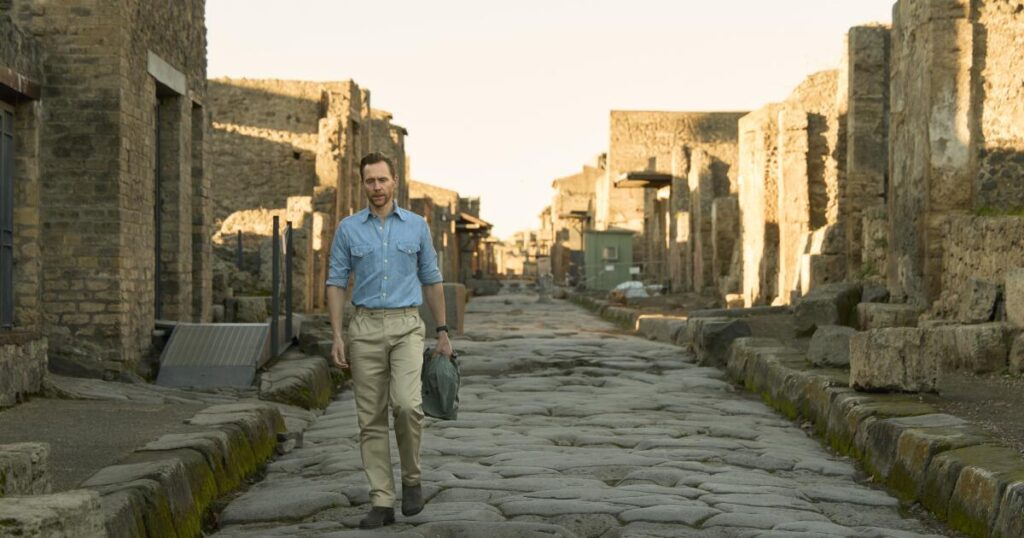
In the fall of 1990, I found myself with a small band of touring musicians on a day off between Naples and Rome, in Pompeii. The world is full of amazing places, but this is one I got to see, and so it is my particular most amazing place. And because this was in the fall and well before the explosion of international tourism, we had the place virtually to ourselves. There is nothing quite like being (nearly) alone among the bones of a dead city.
Tom Hiddleston, the actor, first visited Pompeii in 1998, when he was 17, and found it similarly unforgettable, because “in Pompeii you can time travel.” (He’s not wrong.) He visited it again, after a fashion, for a few minutes in the first season of “Loki,” and he’s back now, walking the ancient empty streets, not too dead for dreaming, with a chimerical documentary, “Pompeii: Out of Time With Tom Hiddleston,” premiering Wednesday on Nat Geo before streaming Thursday on Hulu and Disney+.
As the title suggests, “Out of Time” is less about the living city than the dying one, with a sliver of hope carved out of the ash, rubble and pyroclastic surge. The conceit is that recent scholarship — welcome, Steven Tuck (whose latest book is “Escape From Pompeii”) and his amazing spreadsheet — has been able to identify citizens of Pompeii who turned up elsewhere after Vesuvius blew. In order to bring their story to life, says Hiddleston, “I need to combine the historical evidence with what I do as an actor, I need to imagine it.” Hiddleston, who studied classics in college, for which he credits his trip to Pompeii, and so speaks a little Latin, is puckishly identified in a title as “amateur classicist.”
The documentary focuses on three “real Romans,” asking whether they might have been among the survivors. (The host takes it personally.) In Pompeii, there are Avianius, a teenager apprenticed to a blacksmith, and Julia Felix, a rare female businesswoman who runs a kind of spa cum entertainment center for the well-to-do. Hiddleston, mistranslating the painted sign outside her door, comically “mistakes” her for a Julius, leading to a lesson, from Caitie Barrett (“helpful archeologist and National Geographic Explorer”) on women, property and self-determination in old Pompeii. And in Herculaneum, Pompeii’s better-preserved, lesser-celebrated, posher sister buried city, the possessions of a praetorian guard found on what had been a beach — a sword, a belt and a money clip — give rise to an evacuation scenario: “Experienced sailors prepare the boats,” cries the imagined soldier. “Rich lady, I need a head count! Do we have any doctors? Everyone is getting off this beach!”
It’s an odd mix of styles, a sometimes hokey meta-nonfictional film, in which Hiddleston most always seems to be acting, even in his interviews, as he pretends to learn things he knows already or paces before a board covered with index cards, as in a writers room — that will prove less than a metaphor — fleshing out characters, musing to himself or addressing the audience. (“I’ve got to find a way of tracking that rescue mission.” “Do we have ourselves a classic redemption story?”) He sets a timer on his watch, counting down to the eruption (“One. More. Hour”). With Pompeii’s sun blacked out, he stumbles around in the dark with a flashlight. It comes across as at once a little artificial and sincerely felt.
Up on the rim of Vesuvius, he discusses volcano facts with Chris Jackson (“helpful geoscientist”). Seeking to get inside the minds of his subjects, he declares, “I have to go further still, draw in evidence from disciplines beyond history,” and meets with “disaster psychologist” Sarita Robinson, latter dubbed “survival psychologist,” who’ll teach him about the amygdala and the “fight or flight” — but also the “freeze” — response.
The re-created history, which is where many historical documentaries fail, looks good, and the scenes the writers conjure up are well done, if verging sometimes on melodrama. The Avianius scenes can play a little like a first-century after-school special (“You’re not my dad! You’re just some blacksmith!”), but as Julia Felix, Lubna Azabal projects an attractive matter-of-factness. Do any of them get away? Spoilers!
“This is all a little goofy,” I thought more than once watching “Out of Time.” Which isn’t to say I didn’t enjoy it greatly.