

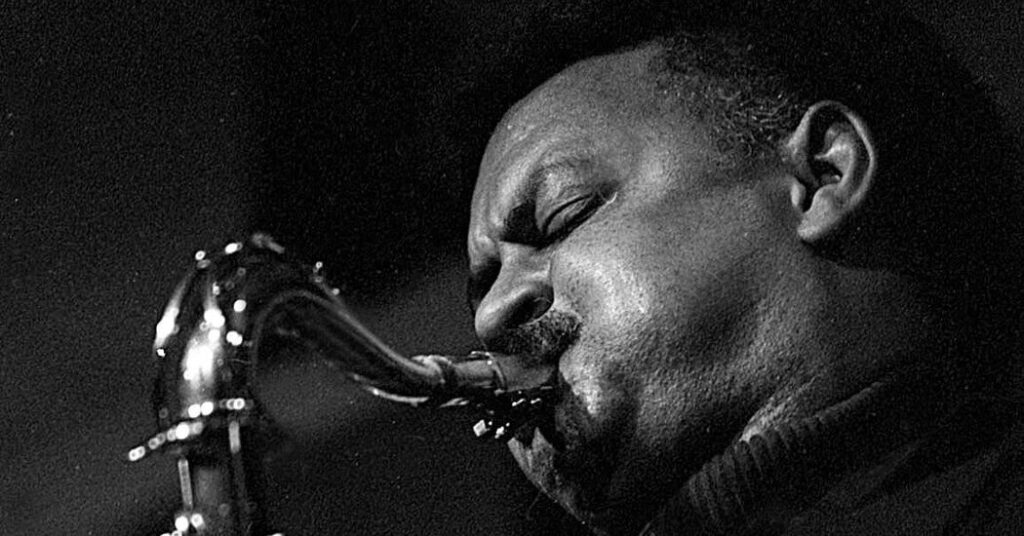
Plas Johnson, a Hollywood studio musician whose loping tenor saxophone in the opening credits of the 1963 film “The Pink Panther” brought a playful bounce to one of the most recognizable movie themes of all time, died on Wednesday at his home in Los Angeles. He was 94.
His children Eric Johnson and Stephanie Oliver confirmed the death, and said their father had performed at his retirement community as recently as a month earlier.
Mr. Johnson had an ample list of credits as varied as 1950s rock ’n’ roll hits, TV theme songs and recording dates with superstars. But the work that stood out was the theme of “The Pink Panther,” written by Henry Mancini for the slapstick detective comedy directed by Blake Edwards and starring Peter Sellers as the pompous and bumbling French police inspector Jacques Clouseau.
Thirty seconds into the animated credit sequence, featuring a monocled pink panther, Mr. Johnson’s saxophone plays a 16-bar theme that is, all at once, slinky, seductive and mysterious, with a mischievous touch of humor. Later in the piece, Mr. Johnson kicks into a swinging solo — improvised in the studio — before the playful opening theme returns.
Mr. Mancini and Mr. Johnson had previously worked together on Mr. Mancini’s gritty theme for “Peter Gunn,” a noirish TV detective drama that premiered in 1958. The full album, “The Music From ‘Peter Gunn,’” won the first-ever Grammy Award for album of the year.
As he was composing the music for “The Pink Panther,” Mr. Mancini wrote the piece with Mr. Johnson in mind. “I nearly always precast my players and write for them and around them, and Plas had the sound and the style I wanted,” he recalled in his 1989 book “Did They Mention the Music?” written with the jazz journalist Gene Lees.
The recording session took place at 8 a.m. on a cold winter’s day. “We only did two takes, I think,” Mr. Johnson told The Modesto Bee in 2007. “When we finished, everyone applauded, even the string players. And that’s saying something.”
He added, “They never applaud for anything.”
Released as a single, the “Pink Panther” theme became a Top 10 hit in the adult contemporary category and won three Grammys, including for best instrumental arrangement. Years later, Mr. Johnson began to play the tune in his nightclub appearances.
“I sometimes get people coming up and telling me that I sound just like the original version,” he told The Long Beach Press-Telegram in 2005, “and their eyes get real big when I tell them that was me on the original. They never knew who it was that did it, and they always get that look of recognition when they realize it.”
Plas John Johnson Jr. was born in Donaldsonville, La., west of New Orleans, on July 21, 1931. His first name, which rhymes with “jazz,” derives from the French word “plaisant,” meaning pleasant or agreeable. Plas was the middle of three children in a musical family.
“My mother, Grace, played piano and sang,” he told The Bee. “My dad, Plas Sr., played alto sax. They hustled work everywhere we lived. We would travel up and down the bayou on weekends. They would play wherever they could, in bars and restaurants, dances.”
Mr. Johnson was 12 when his father bought him a soprano saxophone and gave him rudimentary lessons. He soon progressed to the larger alto, tenor and baritone saxophones, later adding the clarinet and flute. He and his older brother, Ray, a pianist, and their younger sister, Gwen, a singer, often performed together.
As a teenager, he performed in New Orleans, where he played blues, Dixieland and bebop, and excelled at the intricate, fast-paced bebop style pioneered by Charlie Parker in the 1940s. In 1951, he joined the touring band of Charles Brown, a popular R&B singer, before being drafted into the Army, for which he played in a military band in California.
He settled in Los Angeles in the mid-1950s and became one of the first Black musicians to establish a foothold in the busy West Coast film- and recording-studio scene.
On any given day he was called on to play rhythm-and-blues, support the silky strings of an orchestra or knock out a hard-hitting solo for a rock tune. He became a mainstay of the Wrecking Crew, an ad hoc group of musicians known for their ability to adapt to any style of music.
Mr. Johnson was part of studio ensembles that recorded theme songs of TV shows like “The Monkees,” “Mannix” and “The Odd Couple.” He backed singers as diverse as Barbra Streisand, Frank Sinatra, Frank Zappa, Dr. John, Elton John, Ella Fitzgerald and Marvin Gaye.
A versatile reed player, Mr. Johnson supplied the piccolo solo on the 1958 hit by Bobby Day, “Rockin’ Robin”; appeared on “Pet Sounds,” the Beach Boys’ classic album from 1966; and a flute solo to Nicolette Larson’s Top 10 hit in 1979, “Lotta Love.” At night, he played with small groups in jazz clubs and released more than a dozen albums under his own name.
He also spent 15 years in the band of the TV talk-show host Merv Griffin and was a member of jazz bands led by Frank Capp and Gene Harris. In 2006, he recorded a new version of the theme for a film remake starring Steve Martin as Clouseau.
Mr. Johnson was featured in the 2008 documentary “The Wrecking Crew,” about the acclaimed but largely anonymous Los Angeles studio musicians. In later years, he focused on jazz, applying “his warm and furry tone to a set of variations combining fast-fingered ornamentation with driving swing phrases,” the critic Don Heckman wrote in a review of one of his performances for The Los Angeles Times.
Mr. Johnson’s first marriage, to Elizabeth (Blinkenberg) Johnson, ended in divorce. In addition to his son Eric and daughter Stephanie, he is survived by Philip Nunn, another child with his wife of 60 years, Carol Johnson, who also survives him; three children from his first marriage, Cheryl Johnson, David Johnson and Denise Hurley; eight grandchildren; and 12 great-grandchildren.
In his years in the studios, Mr. Johnson became known for his ability to punch up a tune with a sparkling solo that might last for only a few seconds. It was the product, he told The San Francisco Chronicle in 2007, of “years on the road in clubs, learning about 5,000 tunes, playing behind singers and stripteasers, and for dancers. People got up and danced, or rocked in their chairs. That was your applause.”