

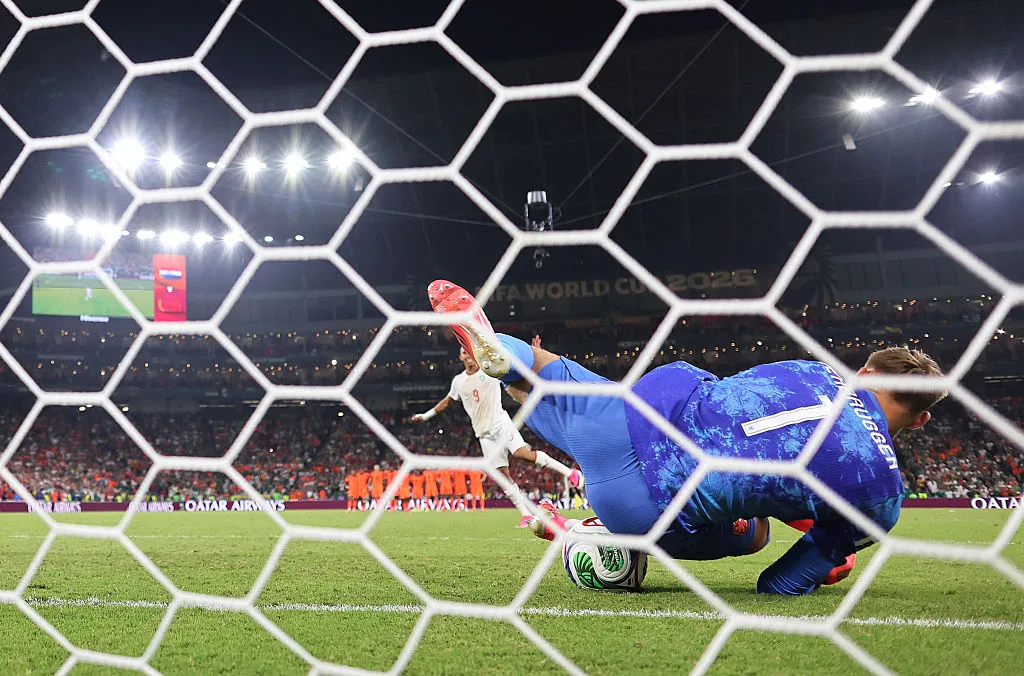
In a World Cup, some of the most important matches are decided by a penalty shootout. When that moment comes, the captains want to win the coin toss to decide the order of the kicks. The reason is an old belief: that regardless of the skill of the shooter and the goalkeeper, the team that takes the first penalty kick is more likely to win. Most soccer players take this for granted, but the reasons behind this apparent advantage remain a subject of scientific debate.n
While much of the strategic thinking around penalty kicks focuses on the order in which the players kick, it’s also important to note the psychological pressures as well. During this year’s World Cup, two of the first four round-of-32 matches—Paraguay’s win over Germany and Morocco’s defeat of the Netherlands—have been decided by these highly tense shootouts.
For years, the prevailing explanation was psychological. According to this hypothesis, the team that takes the first penalty kick plays with less pressure, while the second team must constantly respond to avoid falling behind on the scoreboard. That emotional burden ultimately affects the players’ performance. A study published in 2010 in the American Economic Review became the benchmark on the subject, reporting that teams that started the shootout won nearly 60 percent of the time, compared to 40 percent for those who took their penalty kicks second.
However, as databases grew and more researchers began studying the phenomenon, that advantage began to diminish. Most subsequent studies do not dispute that psychological pressure exists on the team that shoots second; what they question is whether that pressure is sufficient to produce much of a difference in the probability of winning a shootout.
2026 FIFA World Cup
Here’s WIRED’s complete guide to the 2026 FIFA World Cup.
Studies published in 2012, 2019, 2023, 2024, and 2025 progressively reduced the estimated size of the advantage. The most comprehensive analysis to date, based on nearly 7,000 penalty shootouts and 74,000 shots, found no evidence that the team taking the first shot wins more often than the team taking the second. Furthermore, the authors concluded that, if any advantage exists, it would be less than 1.8 percentage points—a much smaller difference than the much-discussed 60-40 split.
A new group of researchers believes this question has been framed incorrectly. A recent study published in Football Studies suggests that, rather than asking whether there is an advantage to taking the first penalty kick, we should explain where that advantage might come from when it does occur. Their hypothesis holds that pressure remains the decisive factor but that not all high-pressure situations are the same. The key lies in distinguishing between penalty kicks where a miss immediately eliminates the team and those where a goal secures the victory.
The study states that current soccer rules do not distribute moments of maximum pressure equally. The team that takes the second penalty kick faces situations where a miss means immediate elimination much more frequently, while opportunities to score and win are distributed differently as the shootout progresses.
The researchers found that penalty kicks where a goal immediately secured victory were successful 89.1 percent of the time. In contrast, when a miss meant immediate elimination, the success rate dropped to 60.4 percent. More importantly, they discovered that, once elimination and victory penalties were taken into account, whether a team took the first or second penalty no longer explained a significant portion of the observed performance. According to the authors, the apparent advantage of the first team does not stem from the order of the kicks but rather from the type of psychological situations that order creates.
The authors argue that these differences could have strategic implications. If some players handle extreme pressure better than others, it might be advisable to save them for those high-stakes penalty kicks rather than placing them at the beginning of the shootout.
Like any model, the study simplifies reality. It does not account for factors such as the goalkeeper’s strategy, the interaction between the goalkeeper and the shooter, the influence of the crowd, accumulated fatigue, or the individual psychological characteristics of each player. The authors themselves acknowledge that these variables will need to be incorporated into future research. Even so, the study does delve into one of the most dramatic moments in sports: how psychological pressure can sway the outcome of a penalty shootout and, in doing so, determine who lifts the World Cup and who returns home empty-handed.
This article originally appeared on WIRED en Español and has been translated from Spanish.