

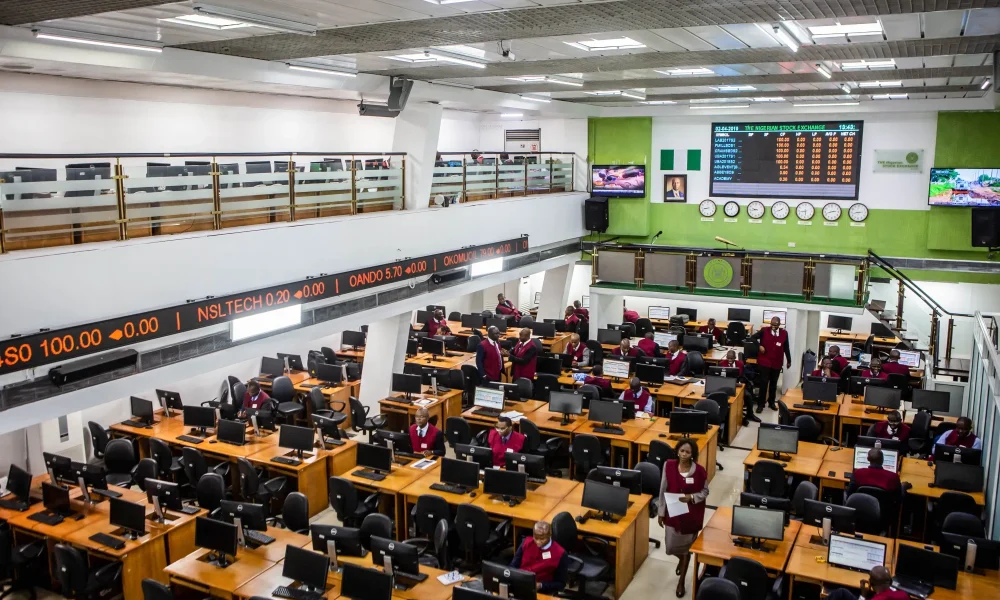
The Nigerian stock market recorded its steepest monthly loss in history in June 2026, with investors losing an estimated N13.29 trillion in market value following a broad-based selloff that ended a five-month rally on the Nigerian Exchange (NGX).
Market figures showed that the benchmark All-Share Index (ASI) declined by 8.28 per cent during the month, marking its sharpest monthly drop since President Bola Tinubu assumed office. Consequently, the market’s year-to-date return fell sharply from over 60 per cent at the end of May to 47.43 per cent.
The sustained selling pressure reduced the market capitalisation of listed equities from N160.5 trillion at the close of May to N147.2 trillion by the end of June, erasing N13.29 trillion in shareholder value within a single month.
Despite the historic correction, the market remains significantly above its opening level for the year, having gained more than N40 trillion since January, underscoring the resilience of the broader market following months of strong investor confidence driven by ongoing economic reforms.
The June decline marked a dramatic turnaround after one of the strongest rallies in recent history.
Between January and May, the NGX added nearly N60 trillion in market value, with April emerging as one of the exchange’s best-performing months, delivering a 20.36 per cent return—the highest monthly gain since May 2009.
Although the market still advanced by 3.24 per cent in May, analysts observed weakening market breadth, signalling that the prolonged rally might be losing momentum.
READ ALSO: Airtel Africa sparks market rally as NGX extends recovery for third straight session
Those concerns materialised in June as investors intensified profit-taking across virtually all sectors of the market.
Unlike previous corrections that were limited to specific sectors, the June downturn was widespread, with all 20 NGX indices closing the month in negative territory, including the All-Share Index, NGX 30 Index and NGX Premium Index.
Premium Board stocks—including United Bank for Africa (UBA), Access Holdings, First HoldCo, Zenith Bank, MTN Nigeria, Seplat Energy, Lafarge Africa and Dangote Cement—collectively lost approximately N8.2 trillion in market capitalisation during the month.
Similarly, the market’s trillion-naira companies, popularly known as SWOOTs (Stocks Worth Over One Trillion Naira), recorded combined losses estimated at N11.6 trillion.
The only notable exception was Airtel Africa, whose strong share price appreciation added more than N4 trillion to its market value.
Analysts noted that without Airtel Africa’s impressive performance, total market losses in June could have approached N16 trillion.
The magnitude of the decline surpassed previous records. For comparison, the entire Nigerian stock market was valued at about N13.6 trillion during the COVID-19 market crash in March 2020—roughly equivalent to the amount wiped off investors’ wealth in June alone.
The previous record monthly loss stood at N6.5 trillion, recorded in November 2025, making June’s decline more than twice as severe in value terms.
Market analysts attributed the correction primarily to widespread profit-taking following the market’s exceptional rally over the past five months.
They explained that many investors decided to lock in gains after equities delivered strong returns during the first half of the year.
Dividend qualification adjustments also contributed to weaker prices as investors sold shares after qualifying for dividend payments from several blue-chip companies.
Analysts further noted that rising yields in Nigeria’s fixed-income market encouraged institutional investors to shift funds from equities into government securities, where higher interest rates offered attractive returns with lower investment risk.
In addition, liquidity movements linked to the ongoing Dangote Group private placement were said to have temporarily reduced funds available for equity investments, adding to selling pressure.
Despite the historic setback, market analysts maintain that the broader outlook for Nigerian equities remains positive, noting that the market still posted a robust first-half performance and continues to trade significantly above its level at the beginning of the year.