


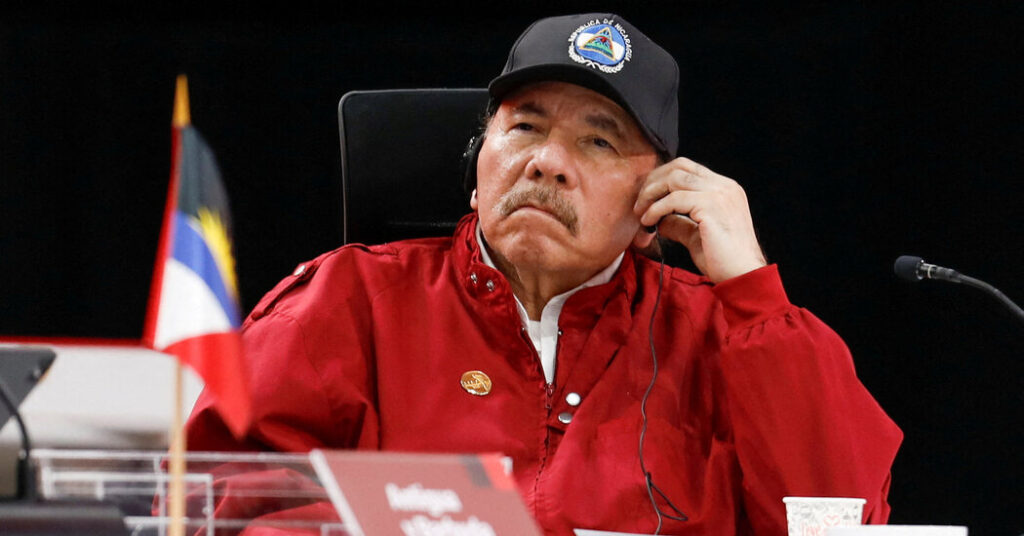
President Daniel Ortega of Nicaragua said on Sunday that he would abolish his nation’s elections, a blatant move to further strengthen his and his wife’s authoritarian grip on the nation of seven million.
“There will never be elections here again,” Mr. Ortega, 80, said at a government rally marking the 47th anniversary of his leftist movement’s revolution, to a smattering of applause. He then accused his opponents of trying to use elections “to seize the government, to seize power.”
The pronouncement was an explicit end to any pretense that Nicaragua still had a democracy.
Mr. Ortega and his wife and co-president, Rosario Murillo, have exerted complete control over the Central American nation for years. Their government has rigged elections; dismantled institutions; killed protesters; targeted dissidents; and jailed critics, journalists, religious figures, opposition politicians and even longtime loyalists, according to human-rights groups and the United Nations.
Nicaragua had been expected to hold a presidential vote next year, a year later than promised after the nation’s Congress, which is controlled by Mr. Ortega and Ms. Murillo, extended the co-presidents’ term, but that is now in doubt.
“Ortega buried Nicaraguan democracy a long time ago,” said Félix Maradiaga, a former 2021 presidential candidate who was arrested by the Ortega-Murillo government, forced out of the race and then exiled to the United States in 2023. “This is simply a statement that unequivocally shows how the mask of a certain legality he had been trying to wear has fallen off.”
Mr. Maradiaga said the international community should no longer hope that change in Nicaragua could come through elections. He said he believed that the Ortega-Murillo government may still hold an “electoral charade” with other allied political parties.
“As long as Daniel Ortega controls the Nicaraguan state, Nicaragua cannot have free elections,” said Mr. Maradiaga, who runs an opposition party called Path to Change that includes exiles abroad but also operates in secret in Nicaragua.
International groups, in addition to the United States and the European Union, widely described the last general election, in 2021, as a farce after the government detained would-be candidates and repressed any dissent. Mr. Ortega’s government said he won 76 percent of the vote.
Mr. Ortega, a former guerrilla fighter, has led Nicaragua for roughly 30 years, including during the 1980s after his leftist coalition, known as the Sandinistas, led a revolution and took control from a dictatorship.
He lost elections in the 1990s, but then was re-elected in 2007 and has held power since. After widespread protests challenged his government in 2018, he has become increasingly authoritarian, acting to crush any dissent and effectively banning opposition parties.
Mr. Ortega’s speech on Sunday was also a rare public appearance for the leader. He has largely disappeared from sight in recent years, going months at times without showing his face.
His wife has become the face of the government after Nicaragua’s Congress amended the Constitution last year, making her co-president and solidifying their power over the nation’s institutions, including the military and courts.
Mr. Ortega appeared frail on Sunday, speaking slowly and sitting down for most of the event. He repeated many of his frequent talking points, criticizing opponents of his government as U.S.-sponsored agents. He said that his government would pass new laws “that put up a wall, a blockade against the coup plotters, against the sellouts.”
Since President Nicolás Maduro of Venezuela was captured by U.S. forces in January and the Trump administration has increased pressure on Cuba — two Latin American countries allied with Nicaragua — experts have said that the Ortega-Murillo government has been operating with heightened paranoia.
Mr. Maradiaga, the former candidate, said Mr. Ortega’s latest threats were “not words of strength, but words of fear.”
Despite Mr. Ortega controlling Nicaragua’s branches of government and the electoral process, Mr. Maradiaga said, Mr. Ortega still had “great fear that he hasn’t managed to completely dismantle the opposition.” And that, Mr. Maradiaga said, also included discontent within Mr. Ortega’s own party, pointing to arrests of some longtime loyalists last year.