

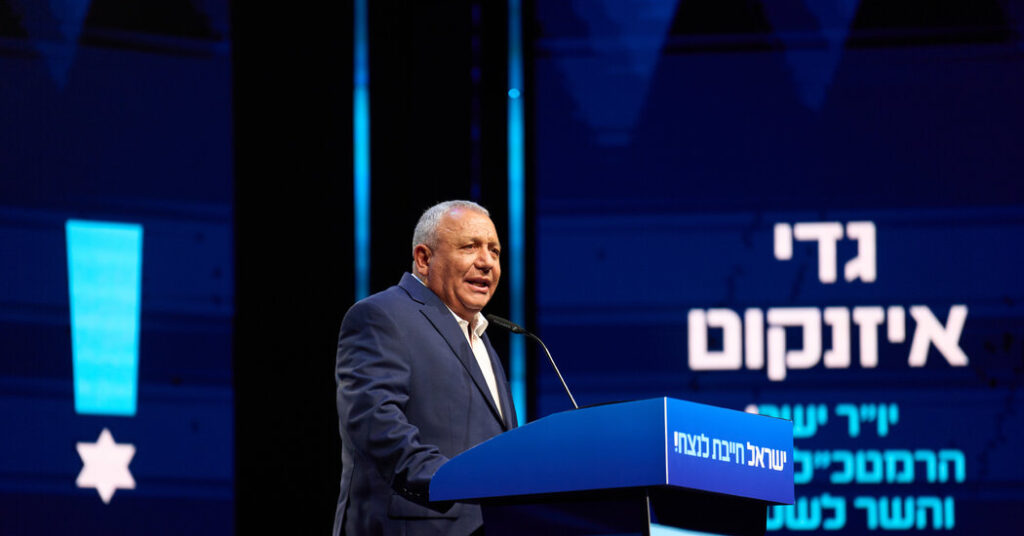
At first glance, it was the latest in a long line of anti-Arab campaign ads from Prime Minister Benjamin Netanyahu of Israel.
An A.I.-generated video that Mr. Netanyahu posted Monday night showed his leading rival in the upcoming election, Gadi Eisenkot, rushing through an idyllic meadow past the outstretched arms of a young man wearing a T-shirt saying “Israeli unity,” to instead embrace Mansour Abbas, the Arab-Israeli lawmaker who heads an Islamic party.
The point, which Mr. Netanyahu and his right-wing Likud party have driven home in at least a dozen other ads since June as Mr. Eisenkot has surged in the polls, was visceral and obvious.
It is aimed at Jewish voters who — whether traumatized by the 2023 Hamas-led attack on Israel, concerned about national security, or just plain racist — cannot abide the thought of their next government relying even partly on the support of an Arab political party to form a ruling coalition.
But this ad was different in one crucial way.
The young man in the video who reaches out in vain to embrace Mr. Eisenkot bears a striking resemblance to the candidate’s 25-year-old son, Gal, who was killed in the recent Gaza war. He died in a tunnel explosion in Gaza in December 2023 while serving as a reservist in an army commando unit.
Which lends an entirely different meaning to the expression on the face of the A.I.-generated Eisenkot, and to the Elysian field that provides the ad’s setting.
Before he retired from the military and entered politics, Mr. Eisenkot, 66, was Israel’s highest-ranking general, the chief of staff of the Israel Defense Forces, and an enormously popular one at that. Thousands attended his son’s funeral, including Mr. Netanyahu, and countless more watched on television as Mr. Eisenkot broke down repeatedly in delivering the eulogy.
The ad drew widespread expressions of disgust and outrage on Tuesday, including from several bereaved relatives of others killed in the Gaza war — so much so that by day’s end on Tuesday, Mr. Netanyahu’s team had doctored the ad.
Among the critics was Gil Dickmann, whose grandmother was killed on Oct. 7, the day of the Hamas-led attack on Israel, and whose cousin was taken captive and later killed in Gaza.
Mr. Dickmann called it appalling and unbelievable that Mr. Netanyahu, who he said “was in charge on Oct. 7 and in all this failed war, allows himself to mock in this despicable way a mourning father like Gadi Eisenkot.”
And Einav Zangauker, whose son Matan spent two years held hostage in Gaza, assailed what she called the prime minister’s “incitement machine.”
“When the video started playing and I saw Gadi running with open arms, the thought crossed my mind that, from the other side, we’d see his late son Gal running into his father’s arms,” Ms. Zangauker wrote on X. “A hug like that would have warmed the heart. But what was I thinking? This is Netanyahu.”
Ms. Zangauker was a Netanyahu voter, she said, until the war turned her against him.
Mr. Eisenkot, whose party is running neck and neck with Mr. Netanyahu’s ahead of the Oct. 27 election and is ahead in some polls, declined to comment. But others in his Yashar party (Hebrew for “straight” or “honest”) spoke out.
“There’s no bottom to the pit the Likud is willing to sink into,” Matan Kahana, a right-wing former lawmaker running on Mr. Eisenkot’s slate, said in a radio interview.
A spokesman for Likud, Gil Levi, denied that the young man in the ad resembled Mr. Eisenkot’s son or that the ad was intended to invoke him in any way. He said that left-wing opponents of Mr. Netanyahu had invented this “to distract from the message of the ad — that Gadi Eisenkot is going to build a government with terror supporters.”
Demonizing Arab parties is a longtime Netanyahu strategy that exploits the fact that the centrist and left-wing parties often fall short of winning a majority in Parliament without the support of Arab factions, whose constituents make up roughly a fifth of the population.
But the criticism was not confined to the political left.
Limor Livnat, who was once the highest-ranking woman in Likud before quitting the party in 2021, scolded the prime minister for running “a video like that on a rival whose son fell in the war you managed and failed at.”
Mr. Dickmann, 34, of Tel Aviv, who is studying psychology, said he believed that the new Netanyahu ad was working exactly as it was intended.
“They’re trying to make you think, ‘Did they mean it or not?’ And to make us talk about it, so it goes viral,” he said. “But I can’t believe that no one around Netanyahu was able to say, ‘Do you think it might resemble the son?’ And if they didn’t, that means they’re so disconnected from reality that he’s even more dangerous.”
Mr. Netanyahu has been accused before of crossing lines of political propriety.
In 2019, he apologized for and pulled from circulation a campaign ad that briefly used the graves of Israeli soldiers killed in battle as a backdrop.
On Tuesday, he did neither, but he did show that he had registered the criticism.
Decrying what he called a “shocking attempt by extremists online” to misconstrue his earlier video, he released a new version of the ad. It shows a young woman wearing the “Israeli unity” T-shirt and looking forlorn as Mr. Eisenkot spurns her embrace.