

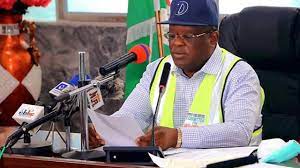
Minister of Works, Engr. David Umahi, Thursday evening, analysed President Bola Ahmed Tinubu’s Legacy Projects in different parts of the country, saying the president is determined to improve the livelihoods of Nigerians through infrastructure.
Addressing the press at the Federal Ministry of Works headquarters in Mabushi, Abuja, Umahi said that President Tinubu is working round the clock to leave legacies for Nigerians and should be appreciated, supported and reelected in 2027.
He said the President Tinubu’s legacy highway projects are designed to connect every region of the country in order to stimulate economic growth and transform national transportation.
Lagos-Calabar Coastal Highway
While giving a comprehensive update on the Lagos-Calabar Coastal Highway, Umahi said the project and other legacy projects are being executed in phases with due consideration for engineering standards, sustainability and available funding.
He said the Lagos-Calabar Coastal Highway has been officially named the “President Bola Ahmed Tinubu Highway”, in recognition of the President’s vision and commitment to actualising a project that had remained unrealised for decades.
The Minister said Section One of the Lagos-Calabar Coastal Highway stretches from Victoria Island to the Lekki Deep Seaport and covers 70.4 kilometres as a dual carriageway with a central rail corridor and is progressing steadily.
He said Section Two of the project, extending about 55 kilometres from Eleko Junction to the Ondo State boundary, is approximately 50 per cent completed and is expected to be substantially completed by November, this year.
Umahi revealed that several bridges currently under construction form part of the procurement for that section.
The Minister said the project incorporated advanced engineering designs, including bridge spans of up to 80 metres, significantly larger than conventional bridge spans, to accommodate heavy industrial traffic.
Furthermore, Umahi said Section Three, covering Akwa Ibom and Cross River States, has reached about 80 per cent completion, while Section Four, extending towards Ondo State, covers 82 kilometres and is about 20 per cent completed.
“Another 180-kilometre section has already been awarded and construction commenced, despite mobilisation payments yet to be made,” he said.
Flooding, procurement allegations
Umahi also responded to criticism that the Coastal Highway has worsened flooding in Lagos, saying technical investigations carried out by officials of the ministry completely disproved the allegation.
He said a joint inspection conducted on July 4 and 5 established that the highway is acting as a protective barrier against Atlantic Ocean surges rather than causing flooding, adding that the real challenge affects communities located on the southern side of the highway, which remain directly exposed to the Atlantic Ocean.
While recalling his experience as a young engineer working in Lagos around 2002, Umahi said Victoria Island was once routinely submerged during heavy rainfall, forcing businesses to shut down and residents to abandon their homes.
He lauded President Tinubu, who was then Governor of Lagos State, for initiating the land reclamation project that eventually produced Eko Atlantic City,
He said the same engineering expertise is now being deployed on the Lagos-Calabar Coastal Highway.
While responding to allegations surrounding the contract award, Umahi insisted that the procurement complied fully with the Public Procurement Act.
He said Nigerian procurement law recognises three procurement methods open to competitive bidding, restricted tendering and special procurement.
Minister Umahi said the Coastal Highway qualified for special procurement because of the specialised coastal engineering technology required for the project.
The Minister said Hitech Construction Company remains the only indigenous contractor with proven experience in reclaiming land from the Atlantic Ocean and deploying the engineering solutions needed to withstand severe ocean surges.
He revealed that during construction, powerful ocean surges threatened sections already completed, but engineers successfully stabilised the highway using the same technology previously deployed at Eko Atlantic.
He added that both the Bureau of Public Procurement (BPP) and the Federal Executive Council (FEC) approved the procurement process, adding that international financiers independently assessed the project and concluded it represented value for money.
The minister said funding requests for Sections One and Two were oversubscribed by more than $100 million, describing it as strong evidence of global investor confidence in the project.
Sokoto-Badagry Super Highway
On the Sokoto-Badagry Super Highway, Umahi described the project as another transformational legacy project, saying one 120-kilometre section is approximately 70 per cent completed, another 82-kilometre section has reached about 40 per cent completion, while a further 162.35-kilometre stretch has exceeded 80 per cent completion.
He said, once the remaining sections are procured, Nigeria will witness the completion of one of Africa’s largest highway corridors that will improve economic activities.
He explained that all of the legacy highways are being developed as part of an integrated national transportation network.
Umahi also revealed plans for Africa’s first underwater tunnel, linked by a 21-kilometre approach road and approximately 20 kilometres of underwater construction before connecting to Victoria Island.
The Minister said the coastal highway will seamlessly connect with the Trans-Nigeria Highway and existing corridors leading to Abuja, Apapa and other major economic centres, adding that ongoing projects linking Sokoto, Kano and other northern states will also integrate into the national network, creating continuous transport corridors across the country.
Trans-Nigeria Highway
Minister Umahi revealed that work has commenced on the Trans-Nigeria Highway, with construction already underway on the first section.
He said the corridor will link Bayelsa, Enugu, Kogi, Abuja and several other states, reducing travel time and improving the movement of goods and services, adding that the Fourth Legacy Highway will pass through Akwanga, Jos, Bauchi, Gombe and Taraba States.
He said President Tinubu has approved an additional 800 kilometres for the project, thereby increasing its total length to approximately 1,100 kilometres.
Umahi said there was a revival of a major bridge project in Taraba State that was originally awarded in 2008 but abandoned, saying the project will significantly improve connectivity between Taraba and Plateau States.
He listed additional strategic road projects among recently approved projects to include the reconstruction of sections of the Lagos-Ibadan Expressway using continuously reinforced concrete pavement, which is expected to last between 50 and 100 years.
He said there are additional strategic road projects across the South-East and continued expansion of national highway corridors linking major commercial and agricultural centres.
Abuja-Kaduna-Zaria-Kano Road
Speaking on the Abuja-Kaduna-Zaria-Kano Road, Umahi said solar-powered street lighting is being installed on sections of the highway.
“The first 180-kilometre section has been completed. Another 102 kilometres is under reconstruction using reinforced concrete pavement. Solar-powered street lighting is being installed on sections of the highway. The project is valued at approximately ₦502 billion, with over 80 per cent of the contract value already paid,” he said.
On technology transfer
Umahi said the President Tinubu administration has introduced a comprehensive technology-transfer programme to ensure Nigerian engineers acquire modern construction skills.
He said the initiative will strengthen indigenous engineering capacity and enable local firms to execute similar large-scale projects in the future.
“Young engineers from all states of the federation, he said, are being recruited for specialised training under ongoing projects, while contractors are required to transfer technology, technical knowledge and equipment to Nigerian professionals,” he said.
Acknowledging the growing impact of climate change, Umahi said ongoing projects now incorporate higher embankments, improved drainage systems, reinforced concrete pavement and enhanced flood-control measures to reduce erosion and protect highways from flooding.
Umahi revealed the development of service corridors along major highways to accommodate filling stations, emergency response facilities, logistics centres, rest areas and other commercial infrastructure that will stimulate economic activities.
The Minister expressed appreciation to President Bola Ahmed Tinubu for his unwavering support for infrastructure development, maintaining that the administration remains committed to delivering durable, climate-resilient and economically transformative highways that will connect communities, promote national integration and accelerate Nigeria’s economic development.