

The authorities in Mexico said on Wednesday that they were investigating whether the U.S. government had lied about its role in capturing the notorious drug lord Ismael “El Mayo” Zambada García, whose secretive transfer to the United States in 2024 remains a source of tension between the two countries.
The Mexican attorney general’s office said Wednesday that it was investigating a recent report by the online news site Pie de Nota that connected the Federal Bureau of Investigation to El Mayo’s arrest in Mexico. The report included a statement that it attributed to the F.B.I. claiming that its special agents had “carried out the arrest and transfer of one of the United States government’s top targets.”
U.S. officials have long maintained that American agents played no role in the transfer and that they took custody of Mr. Zambada García, a founder of the Sinaloa cartel, only after he arrived in the United States. The F.B.I. did not immediately respond to a request for comment on Wednesday. Ken Salazar, who was the U.S. ambassador to Mexico at the time of El Mayo’s capture but is no longer in government, reiterated comments from 2024 that the arrest was “not our operation.”
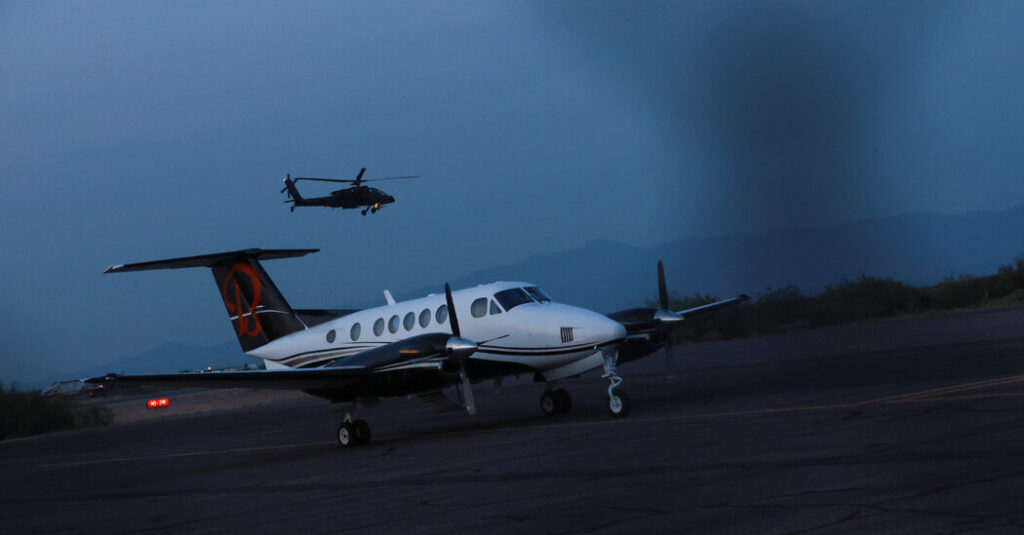
At the heart of the disagreement is whether the F.B.I., or any other U.S. agency, played an operational role inside Mexico during Mr. Zambada García’s capture, a potential violation of Mexican sovereignty and a red-button issue in the current strained relationship between Mexico and the United States. In a stunning betrayal, Mr. Zambada García arrived in the United States in July 2024 after one of his partners, Joaquín Guzmán López — a son of the drug lord known as El Chapo — lured him onto a small plane under false pretenses before flying him to an airport outside El Paso.
The Mexican government has said that it was unaware of the whole operation and has repeatedly petitioned the United States for more information about the role it played. On Wednesday, officials argued that the news report, along with evidence they had recently gathered, suggested that the F.B.I. had orchestrated or helped execute the capture before Mr. Zambada García left Mexican territory.
“If the recent information is confirmed,” the attorney general of Mexico, Ernestina Godoy Ramos, said in a news conference on Wednesday, it would constitute “a series of violations of Mexican and international law, an agreement made outside the bounds of the law and a lie told by a U.S. diplomat.”
The latest dispute comes as relations between the United States and Mexico have grown increasingly strained. President Trump has pressured Mexico to do more to combat the cartels, including arresting and extraditing politicians accused of aiding criminal organizations and further curbing the flow of drugs into the United States. Mr. Trump has also repeatedly vowed to pursue unilateral military action on Mexican soil to dismantle the cartels, a prospect President Claudia Sheinbaum has firmly rejected, citing Mexican sovereignty.
Mr. Salazar, the former ambassador, has publicly maintained since El Mayo’s capture that no U.S. agency or personnel participated in the bewildering operation. Referring to public statements that he and then-Attorney General Merrick Garland made in July 2024, Mr. Salazar wrote on social media on Wednesday, “We communicated to the Mexican government that it was not our plane, not our pilot, and not our operation.” He did not rule out the possibility that U.S. agencies had supported the operation in other ways.
The plane on which Mr. Zambada García and Mr. Guzmán López arrived in the United States, a Beechcraft King Air, was recently lent by the F.B.I. to the War Eagles Air Museum in Santa Teresa, N.M., for two years, according to Tomas Peralta, the museum’s interim director. A short text displayed beside the aircraft describes the F.B.I.’s role in the operation that led to the arrests, referring to it by the code name “Operation Air Kings.”
With the names of two agents redacted, the display says that an F.B.I. assistant special agent in charge and a supervisory special agent “successfully executed a highly complex, secretive and daring arrest of two of the world’s most wanted fugitives.” Mr. Peralta told The New York Times that the text was based on an account provided by the F.B.I., without providing further details.
At the news conference on Wednesday, Ms. Godoy Ramos said that Mexican officials had traveled to F.B.I. offices in El Paso in August 2024 to review evidence and had later inspected the aircraft at the Santa Teresa airport, but that they had not been allowed to carry out “the investigative steps required for such a case” or given the information they requested, including the identity of the pilot. The U.S. authorities, she added, had provided “false or inaccurate identifying information regarding the aircraft.”
David Shortell contributed reporting from Mexico City.