

By Samuel Akpan
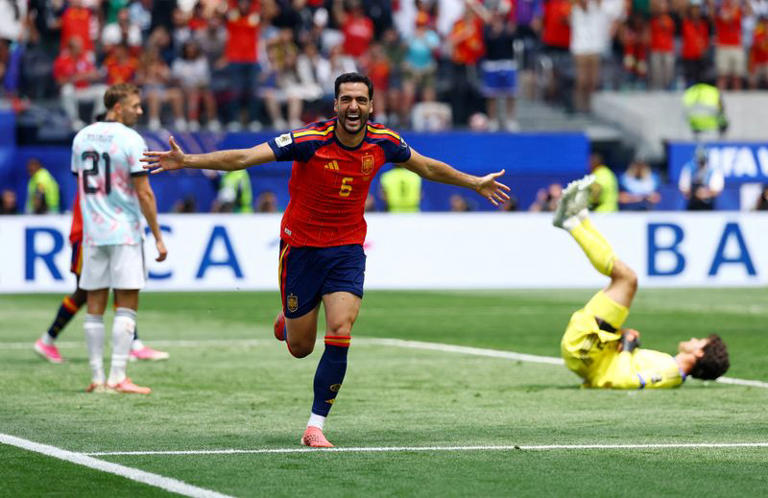
Mikel Merino once more came to Spain’s rescue with an 88th-minute strike that sealed a dramatic 2-1 win over Belgium, sending Spain into a semi-final clash with France in the ongoing World Cup.
The Arsenal midfielder had delivered a similar late blow days earlier, netting in the 91st minute to knock Portugal and Cristiano Ronaldo out of the competition during the round of 16.
These interventions have made him one of the tournament’s standout performers.
Spain started strongly under coach Luis de la Fuente, controlling possession and keeping Belgium pinned in their own territory.
The breakthrough arrived in the 30th minute through Paris Saint-Germain’s Fabian Ruiz, who calmly converted a flowing team attack to give his side the lead.
Belgium hit back in the 41st minute when Charles De Ketelaere scored from Timothy Castagne’s assist to make it 1-1.
The equaliser revived the Red Devils’ hopes. Spain’s Pau Cubarsi was then booked for a late challenge as the match intensified.
After the break, the game became a tight tactical contest. Spain continued to hold most of the ball but Belgium defended solidly and looked threatening on quick transitions.
Extra time seemed a real possibility as the minutes ticked away.
Kevin De Bruyne picked up a yellow card in the 85th minute as frustration grew within the Belgian ranks.
Three minutes later, however, Merino found room in the penalty area and slotted the ball home to restore Spain’s advantage at 2-1.
Persecondnews reports that Merino perfectly illustrated his specialised impact role.
He entered as a substitute in the 86th minute with the score at 1-1 and extra time looming.
Just two minutes later, he reacted first to a loose ball inside the six-yard box after Pau Cubarsí’s long-range shot was spilled by substitute goalkeeper Senne Lammens.
Merino’s repeated success as a super-sub highlights a deliberate tactical deployment: fresh legs, sharp anticipation, and the composure to exploit chaos in the final third when opponents are tiring or reorganising.
His foundational profile is that of a left-footed box-to-box midfielder (No. 8), most comfortable on the left side of a three-man midfield in de la Fuente’s fluid 4-3-3 or variations.
He excels at progressive passing, line-breaking balls with his favoured left foot, and making well-timed forward runs to support attacks or arrive in the penalty area.
His 188 cm frame and elite aerial ability add a physical dimension often missing from more technical Spanish midfields.
What elevates Merino is his multi-role fluidity, he can drop into a deeper pivot to control tempo and shield the defence, operate as a classic No. 8 connecting phases, or even push into advanced areas to exploit half-spaces.
This adaptability lets de la Fuente tweak shape mid-match or introduce him late without disrupting rhythm.
At Arsenal under Mikel Arteta, the same versatility has seen him thrive both in central midfield and as an emergency false nine, where his link-up play, aerial dominance, and intelligent movement drag defenders and create space for teammates.
Against compact, resilient defences like Belgium’s — who sat deep, defended resolutely, and looked dangerous on counters — Merino’s late introduction serves a specific purpose.
Spain’s 68% possession dominance and right-sided overloads (involving players like Lamine Yamal and Pedro Porro) had created pressure but struggled for a breakthrough.
Merino’s arrival injects directness, physicality, and a goal threat that forces opponents to react, often turning sustained pressure into decisive moments through anticipation rather than prolonged build-up.