

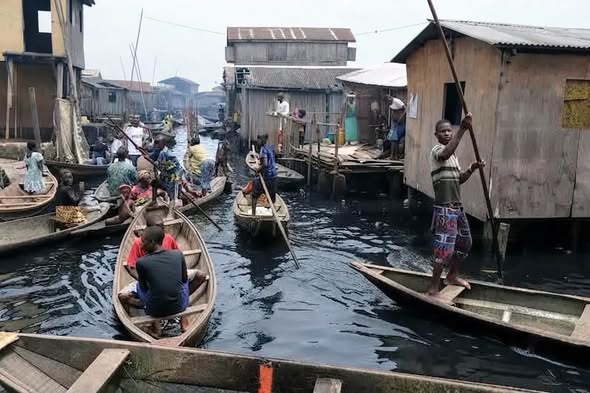
Makoko, one of Lagos’ most distinctive waterfront settlements, continues to attract global attention for its unique stilt houses, vibrant fishing culture and resilient community, even as experts call for greater investment in infrastructure, environmental protection and inclusive urban development.
Located on the Lagos Lagoon along the mainland axis of Lagos State, directly beneath and across the Third Mainland Bridge, Makoko is one of Nigeria’s largest informal waterfront communities.
Popularly described as the “Venice of Africa,” the settlement comprises a combination of land-based homes and an expansive section of wooden houses constructed on stilts above the lagoon.
Residents navigate the community almost exclusively by canoe, using the waterways as streets to access homes, schools, markets and places of worship.
The community is predominantly inhabited by the Egun people, whose ancestors migrated from Badagry and neighbouring Benin Republic several generations ago. Fishing remains the primary source of livelihood, while many residents also engage in fish processing, petty trading, boat making and other informal economic activities.
Despite its economic vibrancy and rich cultural heritage, Makoko faces numerous challenges, including inadequate sanitation, poor access to healthcare, limited educational facilities, environmental degradation and periodic threats of demolition arising from urban development policies.
READ ALSO: Makoko Invasion: Group demands justice, set to defy Sanwo-olu’s order if…
Urban planning experts say Makoko represents one of the clearest examples of the need for inclusive city planning that balances environmental sustainability with the protection of vulnerable communities.
An urban development analyst, Dr. Adebayo Ojo, said Makoko’s location and informal status have often placed it at the centre of debates over Lagos’ rapid urbanisation.
“Makoko demonstrates both the ingenuity of local communities and the shortcomings of urban planning. Rather than viewing the settlement solely as an illegal development, governments should recognise its economic contributions and pursue upgrading programmes that improve living standards without displacing residents,” he said.
According to him, investments in sanitation, flood resilience, potable water, healthcare and education would significantly improve public health outcomes while preserving the community’s unique identity.
Environmental experts also warn that climate change and rising sea levels pose increasing risks to waterfront communities such as Makoko.
Environmental scientist, Prof. Funmi Adewale, noted that increasing coastal flooding, water pollution and erosion threaten both livelihoods and infrastructure within the settlement.
“Communities like Makoko are among the most vulnerable to climate-related hazards. Long-term adaptation strategies should include improved drainage systems, waste management, flood-resistant housing and ecosystem restoration,” she said.
Economists have also highlighted Makoko’s contribution to Lagos’ informal economy through fisheries, transportation, wood processing and local commerce.
Development economist Dr. Ibrahim Salisu said the community remains an important economic hub despite operating largely outside the formal sector.
“Thousands of families depend on fishing and related businesses in Makoko. Formal recognition, financial inclusion and access to microcredit could unlock greater economic opportunities while improving tax compliance and local development,” he explained.
Beyond its economic significance, Makoko has become an internationally recognised cultural landmark.
Its stilt architecture, extensive waterways and traditional lifestyle have attracted researchers, architects, photographers and tourists from around the world. The community has frequently featured in documentaries and international exhibitions focusing on urban resilience, indigenous architecture and informal settlements.
Residents have also developed community-led initiatives aimed at improving education and social services, including schools built on floating platforms designed to withstand seasonal flooding.
Makoko is believed to have been established more than a century ago by Egun fishermen who migrated from present-day Badagry and parts of the Republic of Benin in search of abundant fishing grounds along the Lagos Lagoon.
Over the decades, the settlement expanded into both land and water sections, with thousands of homes supported by wooden stilts driven into the lagoon floor.
Transportation within the floating section relies almost entirely on canoes, while fishing continues to serve as the backbone of the local economy.
The community has periodically faced demolition exercises and disputes over land ownership as Lagos pursues urban renewal and waterfront redevelopment projects.
These actions have generated debate among policymakers, urban planners and human rights organisations over the need to balance environmental management, economic development and the rights of long-established communities.
As Lagos continues its transformation into a megacity, experts maintain that Makoko’s future will depend on policies that combine infrastructure investment, climate resilience, environmental protection and community participation, ensuring that development efforts improve living conditions without erasing the settlement’s unique history and cultural identity.