

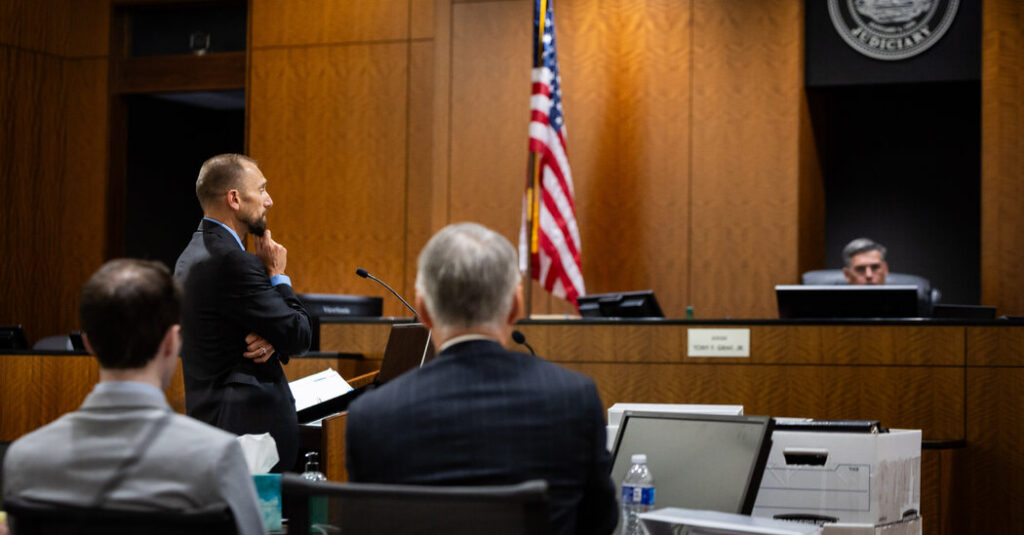
A weeklong hearing in Utah to determine whether the man accused of assassinating Charlie Kirk will face a murder trial ended on Friday after the testimony of several investigators and forensic experts, the viewing of witness videos and a review of physical evidence.
One person in the case whose voice was not heard: the defendant himself.
The lawyers for the accused, Tyler Robinson, 23, said as the hearing wrapped up that they wanted to note, for the record, that they had advised Mr. Robinson of his right to testify, and that he had taken their advice not to.
“Is that correct, Mr. Robinson?” asked Judge Tony Graf, who is overseeing the case in a Utah district court. Seated at the defense table wearing a light colored jacket, Mr. Robinson nodded.
It was a quiet ending to the weeklong preliminary examination, a unique step for felony cases in Utah. The hearing brought several new revelations about the evidence that investigators have collected against Mr. Robinson, who has not entered a plea. He is accused of aggravated murder in last year’s killing of Mr. Kirk, a conservative activist, and faces a possible death penalty.
Among the key evidence was a video interview with the defendant’s former romantic partner, photographs of the bullets prosecutors say were left at the crime scene and several confessions that they say Mr. Robinson made to friends.
But it will be nearly two more months before the judge actually decides whether prosecutors have met their burden of probable cause to take Mr. Robinson to trial. The case is widely expected to proceed, but the preliminary examination has forced each side to reveal a bit about its potential trial strategies.
Prosecutors have said that Mr. Robinson carried out the killing with a rifle at Utah Valley University last September, firing from a rooftop more than 400 feet away from Mr. Kirk and striking him in the neck as he spoke to a large crowd.
Judge Graf has ordered each side to submit legal briefs over the next month. Then lawyers for the prosecution and the defense will make their final arguments in court on Sept. 1. Finally, Judge Graf will make his decision.
On Friday, the judge denied a renewed request from defense lawyers to ban cameras from the courtroom, after a livestream of the hearing on Thursday inadvertently captured a note that prosecutors say Mr. Robinson left behind on the day of the shooting, despite the judge’s order that it not be shown.
That note was among several pieces of new evidence that prosecutors entered into evidence this week. Mr. Robinson’s former partner, Lance Twiggs, said in a video interview that Mr. Robinson had left it under his keyboard in their shared apartment and had told Mr. Twiggs to look there after the shooting.
“I left the house this morning on a mission,” the note read. “I am likely dead, or facing a lengthy prison sentence. I had the opportunity to take out Charlie Kirk, and I took it. I don’t know if I will/have succeeded, but I had hoped to make it home to you.”
The note continued, “I wish we could have lived in a world where this was not necessary.”
In a statement after the proceedings concluded on Friday, Mr. Kirk’s family said that the hearing had been “an important step forward.” Mr. Kirk’s widow, Erika, and his parents attended the proceedings throughout the week.
A lawyer for the Kirk family filed a motion on Friday urging the judge to make his decision at the earliest date possible, on Sept. 1, after the parties make their final arguments. “A prompt determination is imperative in the interest of justice,” wrote the lawyer, Jeffrey Neiman, who noted that the anniversary of the shooting is approaching, on Sept. 10.
Prosecutors have said that Mr. Robinson carried out the shooting because of Mr. Kirk’s political views, though they have not specified which ones.
Mr. Robinson’s mother told the police that her son had moved to the left politically before the shooting, and had become “more pro-gay and trans-rights oriented.” Mr. Kirk routinely condemned gender transition, and Mr. Kirk’s former partner, Mr. Twiggs, had at one time transitioned to identify as a woman.
Mr. Twiggs told prosecutors in the video interview played in court that he had never heard Mr. Robinson discuss Mr. Kirk before the shooting.
Prosecutors say Mr. Robinson climbed to the top of a building on campus and fired a single fatal bullet before jumping down to the grass and stashing the rifle, wrapped in a towel, in bushes near campus. DNA was left on the towel, as well as a screwdriver on the roof, and testimony from prosecution witnesses indicated it was tied to Mr. Robinson.
For their part, Mr. Robinson’s lawyers sought to cast doubt on the DNA and other evidence — suggesting through their cross-examination that it could have been someone else on the roof — went in depth on how officials conducted their DNA analysis.
Robert Draper and Jack Healy contributed reporting from Provo, Utah.