

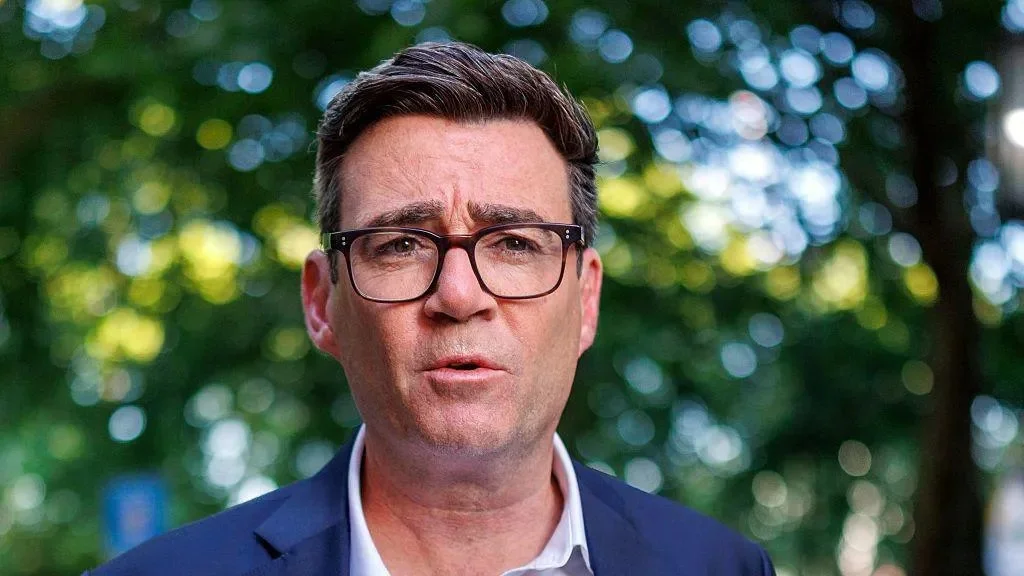
Andy Burnham has taken office as Britain’s new prime minister, assuming leadership amid deep political and economic uncertainty as he seeks to end years of instability and restore public confidence in government.
The 56-year-old, widely known as the “King of the North” for his long tenure as Mayor of Greater Manchester, assumed office unopposed after Keir Starmer agreed to step down last month following a string of election setbacks, policy reversals and political controversies.
Both Burnham and Starmer belong to the governing Labour Party. Under Britain’s parliamentary system, a ruling party can replace its leader—and, by extension, the prime minister—without holding a general election.
Burnham formally assumed office on Monday after completing the constitutional handover at Buckingham Palace, where King Charles III invited him to form a government following Starmer’s resignation.
Although Burnham inherits power from a fellow Labour leader, he has promised sweeping reforms to revive the country’s fortunes.
However, even before taking office, he was already facing pressure over the composition of his first Cabinet.
The new prime minister also takes office with a daunting agenda, including tackling Britain’s cost-of-living crisis, reforming the struggling National Health Service (NHS), addressing divisions over immigration and relations with Europe, and countering the growing popularity of the right-wing Reform UK party led by Nigel Farage.
While Burnham’s emergence as prime minister had been widely expected for weeks, his political journey has been far from straightforward.
Once a senior Westminster figure, he left national politics to serve as Mayor of Greater Manchester before returning to Parliament through a decisive by-election victory that paved the way for his elevation to the country’s top office.
Monday’s transition followed Britain’s well-established constitutional process.
After replacing Starmer as Labour leader, Burnham awaited the formal transfer of power as Starmer delivered a farewell address outside 10 Downing Street, where he defended his government’s record, citing economic growth and lower net migration.
“My work is done,” Starmer said, adding that serving as prime minister had been “the privilege of my life.” He also pledged his full support for Burnham.
Starmer then travelled to Buckingham Palace to formally tender his resignation to King Charles III. Shortly afterwards, Burnham met the monarch, who invited him to form a government in a constitutional ceremony traditionally known as “kissing hands,” despite no actual hand-kissing taking place.
Burnham is expected to return to Downing Street to deliver his first address as prime minister, outlining his vision for the country.
He has pledged to “pass power from the authorities to ordinary people” and build “a new politics,” arguing that Britain must confront long-neglected challenges.
“Let’s have the courage to fix the big things that politics has neglected,” Burnham said after winning the Labour leadership on Friday, promising to reverse what he described as the “wrong turns” Britain began taking in the 1980s when “political power was centralised and economic power was privatised.”
Beyond domestic challenges, Burnham will also have to manage Britain’s relationship with U.S. President Donald Trump.