

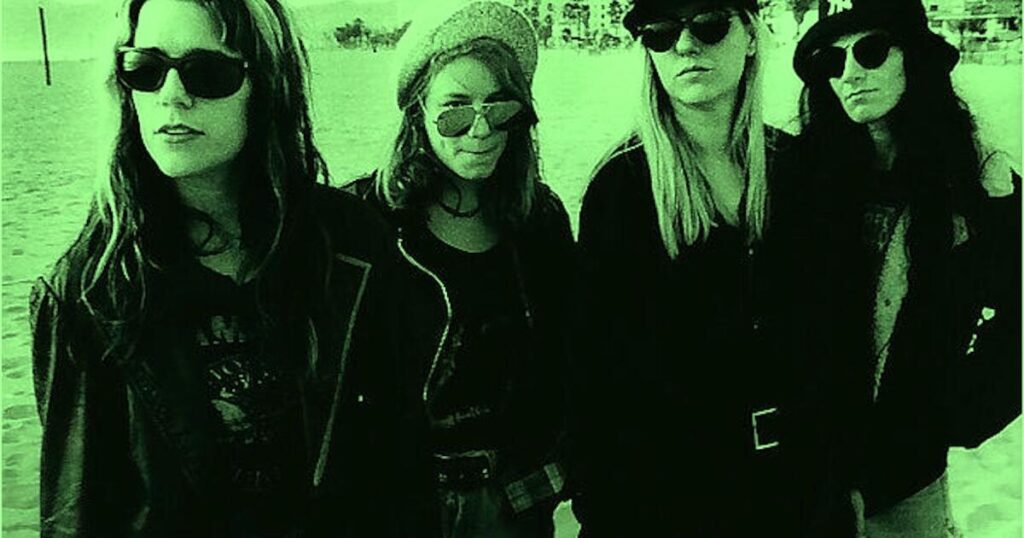
Jennifer Finch, bassist for the influential Los Angeles rock band L7, has died. She was 59.
Finch died of “an aggressive form of brain cancer,” according to a statement from the band.
“We are shattered by the loss of our beloved bandmate, sister and friend Jennifer Finch, whose fierce spirit, humor and boundless creativity helped shape L7 and changed all of our lives forever,” the group said in its statement. “Jennifer was a true original who lived entirely on her own terms, and the impact she made on music, art and everyone lucky enough to know her cannot be measured. We love her beyond words and will carry her with us always. Rest in power our dear friend.”
Finch was receiving ongoing treatment for brain cancer, and just last week backed out of the band’s planned final tour. The group said those dates were “planned along with Jennifer when all four of us were in good health and spirits,” and Finch had asked the band to continue the shows while she sought treatment.
Finch, raised in Los Angeles, was an outspoken and ambitious fixture of ‘90s rock. She briefly performed in a band with Courtney Love pre-Hole and Babes In Toyland’s Kat Bjelland, and once dated Dave Grohl. But she came to prominence in L7, a foundational act in the alt-rock scene of the ‘90s.
Formed in 1985 by guitarists and singers Suzi Gardner and Donita Sparks, drummer Dee Plakas and Finch, they made a fast impact on L.A.’s punk scene, which was growing out of the hyper-masculine hardcore era of the ‘80s. Alongside Hole and Sleater-Kinney, L7 helped usher in the riot grrl wave of confrontational, female-led rock acts onto charts and festival bills.
“Rock ‘n’ roll was invented and became popular because of its rebellious nature,” Finch told the Times in 1993. “But the world has seen every form of rebellion–from throwing TVs out the windows to heroin abuse to just the guy in the leather jacket with greased-back hair–and the rebel image is becoming tired and burnt out. So (the press) is finding new interest in women who (rebel), creating a whole new aspect.”
“The unfortunate thing is that journalists are trying to create a genre out of gender, which trivializes it,” she added. “That’s extremely ignorant, because it bypasses the uniqueness between the groups.”
Bolstered by Finch’s ferocious basslines, hit single “Pretend We’re Dead” received significant airplay on alternative rock stations and became the group’s signature song, along with the biting anti-war anthem “Wargasm.” Finch wrote several songs across the group’s catalog, including the scabrous single “Everglade.” L7 went on hiatus in 2001, but reunited in 2014.
Finch was a talented photographer, whose intimate shots of SoCal bands lent an air of tragic grit to an ascendant punk and rock scene. “The irony is not lost on me when I’m driving from my house just blocks from where I grew up, and I’m heading to the L.A. Weekly to publish pictures of us as kids hanging out and shooting up, 20 years ago,” she told L.A. Weekly in 2006.” It feels weird but strangely hopeful. That was a totally unique time and it defined who we are, so then maybe it’s not a bad thing to be nostalgic about.”
Beyond L7, her song with OtherStarpeople, “Then There’s None,” appeared on the beloved “Office Space” soundtrack, and founded the punk band The Shocker in 2002. She acted in John Waters’ dark comedy “Serial Mom” as a member of the fictional band Camel Lips.
L7’s last album, “Scatter the Rats,” was released in 2019, and its final tour, “The Last Hurrah,” is booked to kick off in San Diego on Oct. 6.
L7 and Finch’s family opened a GoFundMe to support her medical care, saying “We love her, and we want her to feel the full strength of the community that has loved and supported her for so many years.” Information on surviving family was not immediately available.