

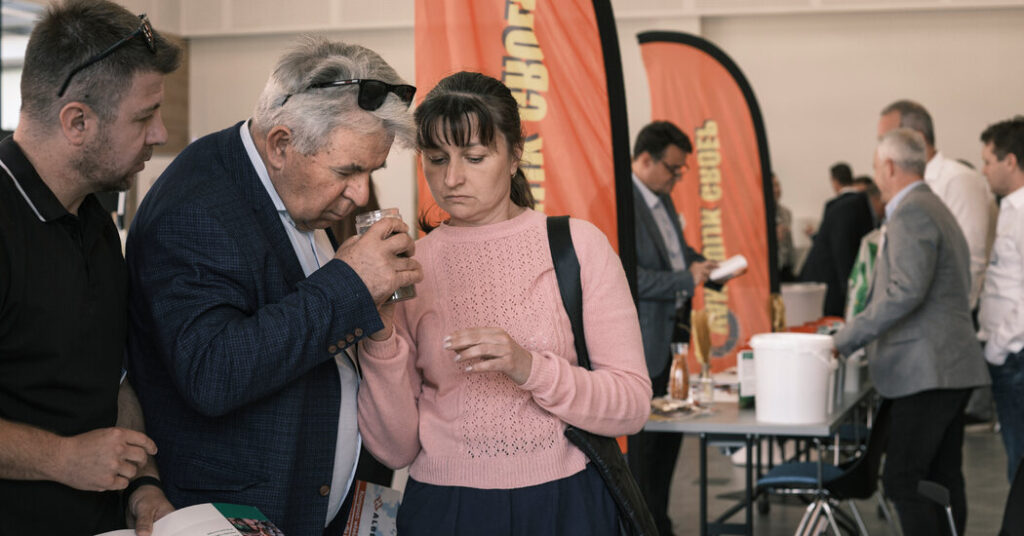
The prospective buyers eyeballed, sniffed and ran their fingers through the merchandise. There were lectures, a happy hour and a speed-dating session between customers and sellers, complete with demonstrations and take-home samples.
The product? Manure from Dutch cows and pigs, muck that farmers in the Netherlands are newly desperate to sell.
The offbeat market, in Minikowo, Poland, attracted Dutch salesman and more than a dozen Polish agricultural suppliers and farm representatives on a recent sunny afternoon. The day stood as an example of how businesses in Europe and around the world are contending this year with overlapping challenges of climate change, increased environmental regulation, a green transition and global conflict.
Earlier this year, stricter European Union regulations fully kicked in to limit the amount of manure Dutch farmers can spread on their fields, because the nitrogen-laden runoff it produces might leach into waterways and pollute them. Given the limitations, Dutch farms now produce more animal waste than their farmers can use.
That has prodded the Dutch to try to market their manure in countries like Germany, France and Poland, which are further away from hitting their nitrogen allowance.
The Dutch push to make manure a hotter product got an unexpected boost from the conflict in the Middle East. After Israel and the United States attacked Iran in February and shipping traffic effectively stopped through the Strait of Hormuz, global prices for both artificial mineral fertilizer and the fuel necessary to produce it soared.
The jumps left many farmers across Europe looking for alternatives.
Though prices for nitrogen fertilizers eased in the wake of a preliminary peace deal, the situation in the strait remains volatile. And repeated global shocks might leave farmers in places like Minikowo convinced that they should use made-in-Europe, natural backups in addition to imported fertilizers.
The Dutch are hoping they’ll look toward the nation’s manure.
“Manure smells, everybody knows,” Tomasz Piechota, a professor in the Department of Agronomy at the Poznan University of Life Sciences, told the assembled crowd at the manure “matchmaking” event in Poland. “My grandmother taught me, all the time, that it was the smell of money.”
The conflict in the Middle East “certainly doesn’t hinder the cause” of selling manure, said Jouke Knol, the organizer of the event and a counselor for agriculture at the Dutch Embassy in Warsaw.
Even before this year, Dutch officials have been attacking their figurative mountain of unwanted manure from multiple angles.
They are first trying to make manure more usable at home. Renure, a cutting-edge product that comes from processed manure and is less damaging for the environment, was recently approved for use.
The European Union has also been considering paving the way for the use of other processed manure products — digestates, semiliquid byproducts that are not as harmful for the environment. Allowing them could relieve pressure on farmers who are looking for artificial fertilizer alternatives because of the higher prices.
Manure isn’t a perfect substitute for man-made mineral fertilizer, but using it can allow farmers to spread less of the manufactured kind.
“If the prices for mineral fertilizers go up, farmers are likely to look for substitute products,” said Harm Smit, a project leader for emission reduction and manure valuation at Wageningen Livestock Research, part of a university in the Netherlands.
The Dutch are also trying to produce less manure. The government has been buying out farmers in environmentally sensitive areas. Fewer cows equals less cow refuse.
The quickest solution is to increase manure exports. Last year, the Dutch government appointed a “manure ambassador,” Raymond Knops, who traveled Europe peddling the product.
Exports to Belgium and Germany are up notably, but prices are so low that farmers aren’t yet making money and are still paying to offload their manure. With so much of it unusable in the Netherlands, the cost of doing so has jumped.
Still, many manure sellers do not think that the Polish market is ready to start taking Dutch manure en masse — yet. The event in Minikowo drew fewer interested buyers than organizers had originally hoped, and some attendees sounded skeptical. It costs a lot to transport manure, which is wet and heavy compared with mineral fertilizers, for a long distance.
Others were more hopeful. In Minikowo, Tim Alders was representing his Dutch manure processing company, Vlako.
He had with him a large empty jar packed with his product. He had also brought plastic cups with twist-on lids (the kind one might use for a urine sample) filled with take-home samples.
Standing by his display table, Mr. Alders explained that he already exports to France and Germany. He often also sends a few trucks of the natural fertilizer to Poland, which is farther away and thus has tougher economics as an export market.
“With Poland, it’s always geopolitical, or emotional,” he said of his demand. “Most of the time, it’s that the price of chemical fertilizers is going up.”
Mr. Knol, the organizer, was also hopeful. The geopolitics, he said, will make “processed manure from the Netherlands more attractive.”