


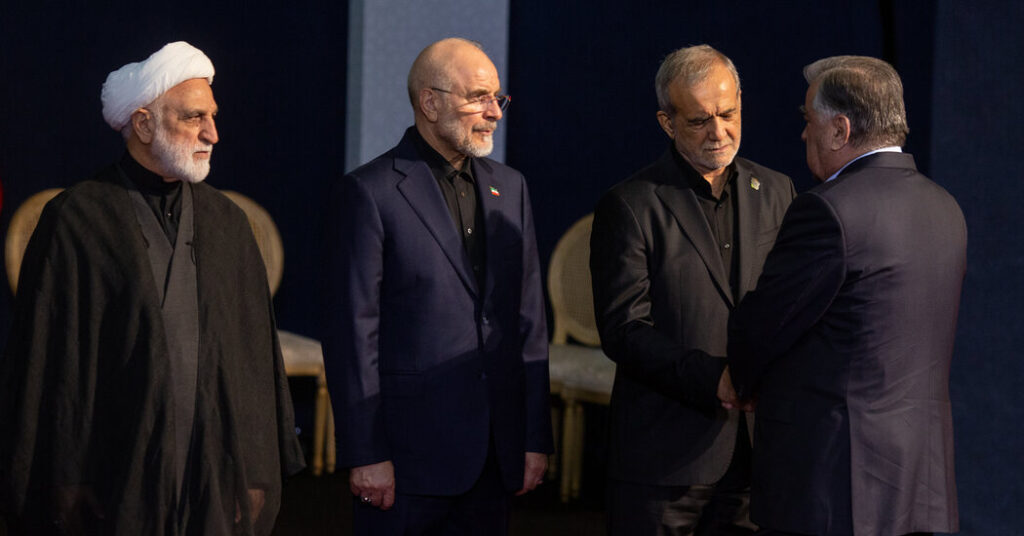
Iran’s lead negotiator, Brig. Gen. Mohammad Bagher Ghalibaf, on Wednesday signaled that the door to negotiations with the United States was not closed, despite a return to fighting this week between the sides.
Mr. Ghalibaf, a powerful figure who is considered a pragmatic conservative in Iran, issued a lengthy statement on Wednesday that struck a defiant tone, saying Iran would defend itself on the battlefield and at the negotiating table alike.
“We must also use the tools of diplomacy and negotiations to achieve and realize our national interests,” he said.
Mr. Ghalibaf’s address to the nation, carried out by state television and media, was his first public statement following days of intense American airstrikes on Iran targeting military sites and critical infrastructure including a railroad and seaports, sowing destruction around the country. Iran has retaliated by launching ballistic missile and drone attacks toward American military bases in the Middle East.
Both Tehran and Washington have declared the cease-fire to be over and the memorandum of understanding, a 14-point cease-fire agreement signed by both countries, as dead. Both sides have asserted control over the Strait of Hormuz, the waterway critical to shipping oil and gas, with Iran saying the strait is closed and the U.S. military restarting a naval blockade on Iran’s southern shores.
Nonetheless, Mr. Ghalibaf appeared to be extending an olive branch of sorts.
“We must create coordination between the military and diplomatic tracks, and we must fear neither war nor negotiations. War and negotiations are two methods of protecting the national interest,” said Mr. Ghalibaf. He added, “negotiations at this stage do not amount to capitulation.”
Analysts said Mr. Ghalibaf’s statement was aimed at two audiences: Leaders abroad, concerned about the war spiraling out of control and its effects on the global economy; and Iranians at home, divided over whether Tehran should re-engage in talks with Washington or return to full war.
For weeks, those divisions and bitter infighting among Iran’s conservatives have consumed Iran’s political circles. Not long before Mr. Ghalibaf issued his statement on Wednesday, Iran’s foreign ministry spokesman had said that Iran had no intention to return to talks.
Hard-liners in Iran have called for a return to war and revenge against the United States. At the funeral last week of the slain supreme leader, Ayatollah Ali Khamenei, crowds of mourners carried a red flag, symbolic of revenge, and threatened to kill President Trump.
The pragmatic faction, though, has maintained that a deal reached through diplomacy would ultimately bring Iran stability and economic relief.
Mr. Ghalibaf acknowledged that he himself had been a target of hard-liner attacks for leading negotiations, but he said he did it for the “advancement of Iran,” and with the guidance of the new supreme leader, Ayatollah Mojtaba Khamenei. Ayatollah Khamenei’s absence from the public has created a void at the top of leadership and allowed divisions to fester.
Mr. Ghalibaf also said that Iran’s national security depends on maintaining its control over the Strait of Hormuz, and accused the United States of violating the agreement by trying to take this control away in letting ships pass from the Oman side of the waterway.
“Ghalibaf’s message did two things: It emphasized the importance of maintaining Iran’s claim to the strait by force if necessary, and it left the door open to negotiations,” said Gregory Brew, a senior analyst for Iran at the Eurasia Group, a geopolitical risk firm. “As he’s done in the past, Ghalibaf is trying to unite the battlefield and the negotiating table, endorsing continued resistance to the U.S. while arguing that resolution to the conflict — and securing lasting wins — will require dialogue.”
Shirin Hakim contributed reporting from Cairo.