

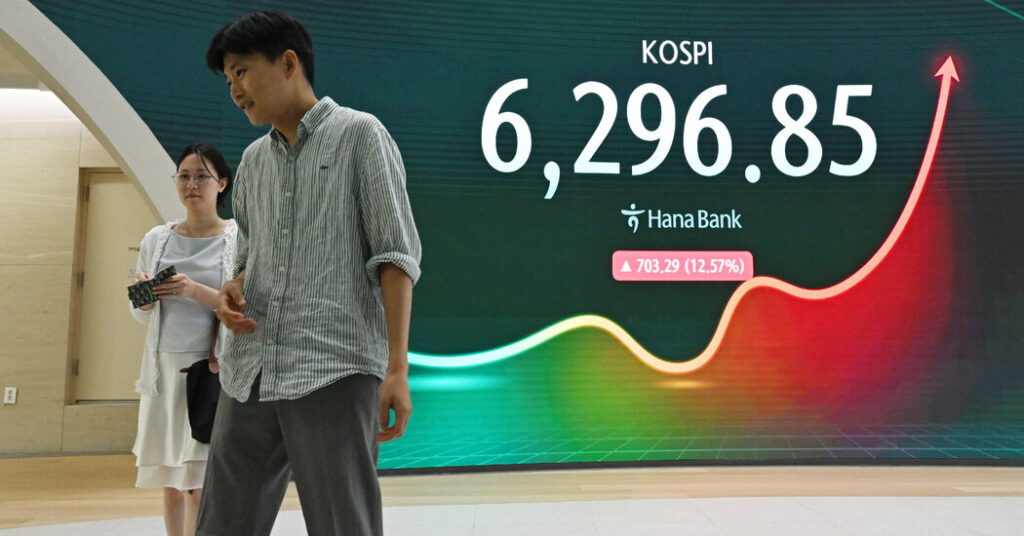
These days, South Korea’s stock market can only be described as wild.
The country’s benchmark KOSPI was up 15 percent on Friday afternoon after jumping as much as 17 percent earlier in the day. The record surge comes after a volatile week marked by huge price swings that triggered mandatory pauses in trading on Tuesday and Wednesday to give the market a breather during a sharp sell-off.
Before Friday’s rally, the South Korean market had tumbled on growing concerns that the enormous spending — expected to top $1 trillion over this year and the next — to build out artificial intelligence systems had been overdone. As the prime beneficiaries of that investment, South Korea’s memory chip makers Samsung Electronics and SK Hynix were at risk if major technology companies decided to splurge less on A.I. infrastructure.
For people still searching for rational explanations, the KOSPI’s rise on Friday came on the heels of comments from Microsoft and Amazon that they plan to continue spending more on building computing capacity for A.I. despite already staggering outlays. In addition, new regulatory measures from the South Korean government aimed at easing market volatility kicked in Friday, lifting hopes that better days lay ahead for the KOSPI, which had fallen about 25 percent in the last month.
Despite the recent pullback, the KOSPI remains one of the world’s best-performing stock markets this year, up nearly 50 percent.
“The KOSPI has been trading like a meme stock or crypto,” said Khoon Goh, head of Asia research at ANZ, an Australian banking group. “It’s not normal behavior for a major index.”
The whipsaw in the KOSPI, now trading above 6,400, is driven mainly by Samsung and SK Hynix, the world’s leading manufacturers of memory chips that are essential to building A.I. technology.
Shares of Samsung rose 21 percent on Friday in Seoul, while SK Hynix rose 24 percent. The stock prices of both companies had dropped sharply over the last month, even as they reported record profits and revenue in the recent quarter.
Mr. Goh said the recent sell-off on the KOSPI was fueled in part by retail investors who had borrowed heavily to take a position in the two companies. When the share prices started falling, they were forced to sell, accelerating the downturn.
Now that the more speculative buyers have cleared out, Mr. Goh said, foreign investors and others are returning to the South Korean market — seeing an opportunity to buy still promising shares on the cheap.