

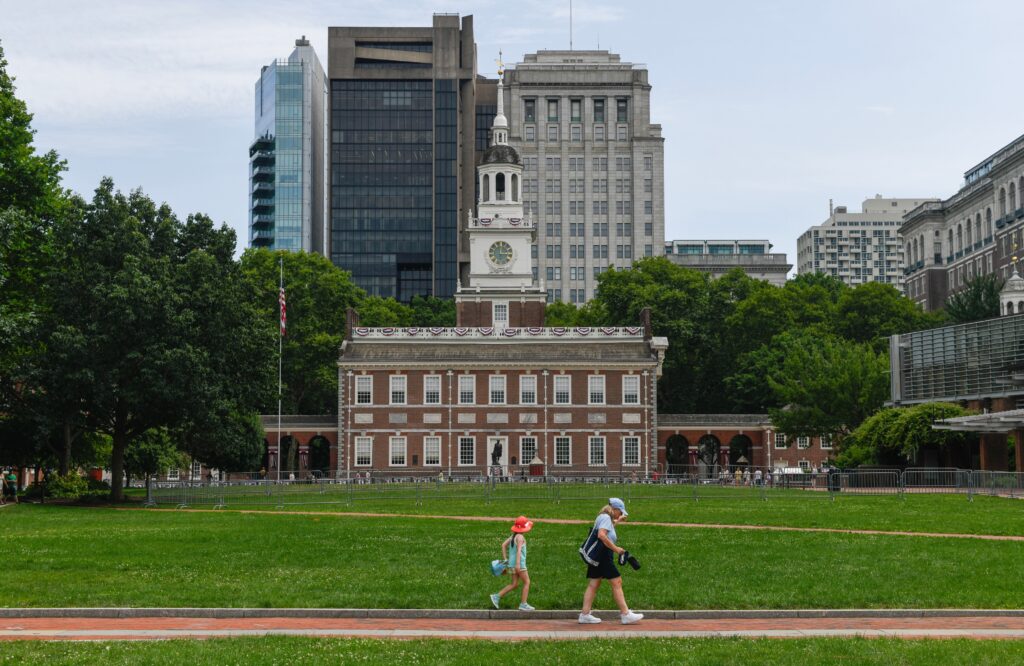
Thanks to Thomas Jefferson, we know that July 4, 1776, was a pleasant day in Philadelphia with temperatures that topped out in the mid-70s.
Two hundred and fifty years later, visitors who descend on the city to celebrate the signing of the Declaration of Independence — and to watch a World Cup match on July 4 — will find a far more sweltering reality.
A dangerous heat dome over the Eastern United States for the next several days is forecast to send temperatures into the triple digits, break records across multiple states and pose health risks for tens of millions of Americans.
In the Philadelphia area, the National Weather Service has warned that daily heat indexes could be as high as 110 degrees through Sunday. “This is not the kind of heat event we see every year,” the service wrote in an update this week, adding that the region could experience its hottest stretch since July 2011.
Of any city in the path of the furnace-like blast, Philadelphia might be the most prepared. The onetime capital of the nation, home to Independence Hall and the Liberty Bell, has long had one of the country’s most robust heat-response programs.
“We are a fairly well-oiled machine when it comes to monitoring the weather and making the decision to declare a heat health emergency,” said Palak Raval-Nelson, the city’s health commissioner. She said officials spent years planning for the America 250 and World Cup crowds.
Behind those extensive preparations lies the memory of a deadly heat wave decades ago, and the lessons learned that started Philadelphia on its current path. The early interventions developed in its aftermath are still part of the city’s regular heat protocols.
A brutal stretch of heat in the summer of 1993 killed 118 people in Philadelphia, a tally higher than in other cities that were grappling with similar conditions. Many of the victims were among the city’s most vulnerable — poor, elderly or infirm. Some had no access to air conditioning and were found with their windows closed, the stifling heat probably worsening any health conditions.
In the wake of that disaster, officials dug deeper into what went wrong. At the time, deaths were typically considered heat-related only when there were documented signs of hyperthermia — defined as a core body temperature of 105 degrees or higher.
But Philadelphia’s then-medical examiner, Haresh Mirchandani, expanded the definition of heat deaths to include those for which heat was a contributing factor, resulting in a more accurate picture of the heat wave’s toll.
“It was a turning point,” recalled Laurence Kalkstein, a climatologist and heat-mortality expert who worked with Philadelphia on developing a novel approach that would eventually be emulated by numerous cities.
The 1993 heat wave led to a litany of changes in Philadelphia, aimed at raising awareness and reducing risk among those residents most imperiled by urban heat.
The city set up a mass-notification system to alert residents when the mercury spikes and conditions pose serious health risks. Officials designated cooling centers, mobilized a network of block captains to check on neighbors, launched a public awareness campaign and set up an emergency heat hotline.
One early study found that the early-warning system saved at least 117 lives in the first several years of the program and that the benefits far outweighed the costs.
“Philadelphia led the pack,” said Kalkstein, who still works on heat-related policies in the United States and abroad.
One measure of the success of such interventions, he said, is that even as global warming has worsened extreme heat events in recent decades, fatalities in places such as Philadelphia have not trended higher.
“You would think because of climate change, heat-related deaths would be going up,” he said. “That’s not what we are finding.”
Raval-Nelson said the preparations have been even more extensive ahead of the World Cup and America 250 celebrations, which are expected to draw huge crowds to the city.
For example, she said the free FIFA Fan Festival on Lemon Hill will have cooling tents, water filling stations, ample shade and medical stations. Organizers also have reduced the festival’s hours because of the forecast for crippling heat.
Many of the same precautions — misting fans, free water stations, medical tents, extra shade — have been set up throughout the city, Raval-Nelson said, adding that Philadelphia also has “an elaborate network” of pools and spray parks where people can cool off.
In addition, officials recently conducted the latest workshop for block captains on how to look out for residents. That can be especially key in neighborhoods such as Hunting Park, a predominantly Black and Hispanic enclave where surface temperatures can reach far higher than those in Whiter, shadier suburbs.
As this week’s heat dome descends, Raval-Nelson said she hopes the range of actions Philadelphia has taken will lead to a safer holiday throughout the city where the Founding Fathers enjoyed a much more mild July 4.
“We want everyone to celebrate safely,” she said. “Practice makes perfect, and we’ve been practicing this.”