

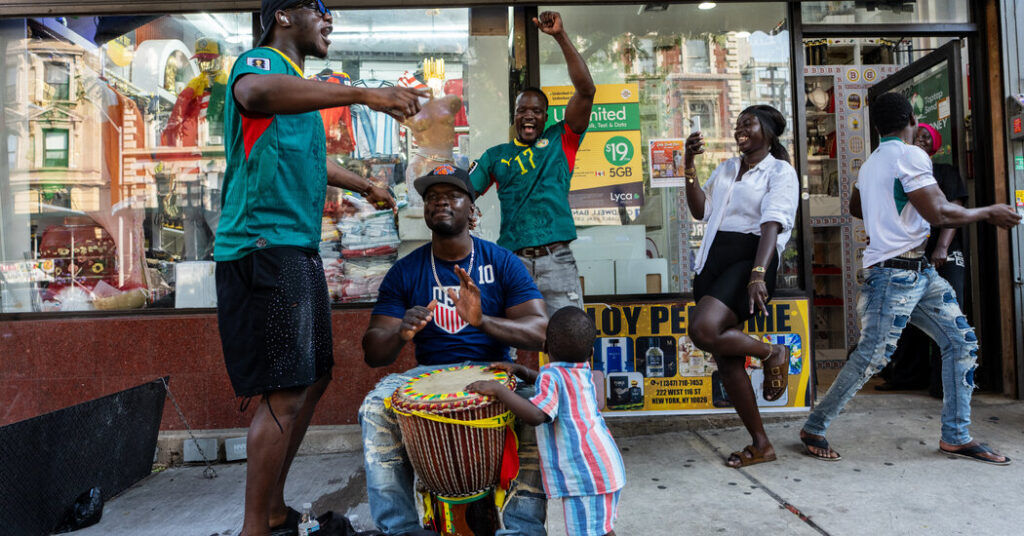
It was looking to be a big night in Little Senegal.
Police officers were setting up metal barricades along West 116th Street in Harlem and mustering in groups on Wednesday afternoon in the expectation of a victory celebration should Senegal win its World Cup match against Belgium.
As the game was winding down, with Senegal leading 2-0 and only five minutes left on the clock, the celebrations were nearing a climax.
The drumming along West 116th Street, which had begun hours before the game even started, grew stronger as the team scored against Belgium.
When Senegal took control by scoring again to take a 2-0 lead, a roar erupted along 116th Street. A young man began beat out a celebratory rhythm on a trash can, and a crowd around him began singing.
“SEN-ay-gal! SEN-ay-gal!”
An M116 bus passed, and the driver honked along to the beat.
On Wednesday, Little Senegal, home to the largest concentration of Senegalese Americans in the country, became a place of celebration even before the game. The Senegalese flag — green, yellow, and red with a star in the center — was draped seemingly everywhere. Young men in the team’s green jerseys gathered on a steaming sidewalk and sang Senegalese songs in Wolof.
As the Lions of Teranga, as their team is known, moved closer to victory, Little Senegal oozed with optimism.
“We have the talent, we have the spirit — this can really be our year,” said Mamegor Gueye, who runs a beauty supply shop on 116th Street where, wearing a Senegal jersey, he watched the game along with his two young daughters, Mbene and Betty, on a small computer tablet propped up on a rack of combs.
The entire neighborhood seemed to be watching, packed into restaurants, barbershops and hair-braiding salons, and clothing stores selling the long colorful robes known as boubous.
Then, in the 86th minute, Belgium scored. Every person in the barbershop groaned.
Presumably, so did the fans at Le Baobab Gouygui, a Senegalese restaurant so crowded that wait staff could barely move among tables to serve plates of thieboudienne, a national dish of fish and rice.
Not three minutes later, another Belgium goal. On the sidewalk, the groans turned to accusations.
“We were up 2-0!” a large man lamented loudly. “What happened?”
The game moved to a tense overtime, though the drummers never faltered.
“I’m keeping hope alive,” said Arnaud Mendy, a Senegalese immigrant who kept pounding out the beat.
Then, with almost no time left, Belgium was awarded a penalty kick. This was the final deflation.
Even before the penalty was taken, the Senegalese fans knew what would happen — Belgium would make its miraculous comeback and the Lions of Teranga would be out of the World Cup — and they began filtering out of viewing spots, their heads bowed. Mr. Mendy’s drumming faded and stopped.
Fans stood in groups on the sidewalk staring at replays on their phones, still in shock.
“No one can believe it,” said Yacine Jutta, a Senegalese immigrant sitting in front of a clothing shop. She described the penalty as a bad call but added: “We never should have been in extra time. It’s our own fault for allowing two goals in the last few minutes after leading most of the game.”
At the beauty shop after the match, Mr. Gueye greeted shoppers and acquaintances, his arms outstretched in disbelief.
“We never should have let them back in the game,” he said.