

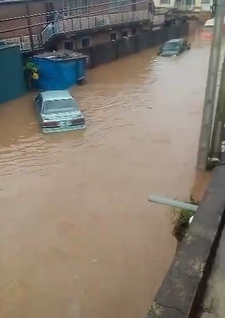
Recurring floods have become a familiar reality for Lagos residents, with heavy rainfall often leaving homes submerged, property destroyed, roads impassable, and thousands of commuters stranded across the commercial city’s highways whenever the skies open.
The disaster, which recurs every rainy season, has become one of the greatest fears of many Lagos residents, particularly those living in flood-prone communities, where anxiety rises after every dark cloud over possible destruction that could follow the weather.
Despite years of government interventions and promises to improve drainage infrastructure, both primary and secondary drainage channels remain uncleared, and many are filled with waste indiscriminately dumped by residents along the road.
Beyond the upscale neighbourhoods in Lagos Island, flooding has spread to communities that were once considered safe during the rainy season, including Gbagada, Iyana Ipaja, Ikorodu Road, Ikeja, Maryland, Mushin, Ogudu, Oshodi, Agege, Alimosho and Obalende.
To residents of these communities, the once-safe havens have become waterfronts, with their roads and homes taken over by floods often.
The latest episode, triggered by days of persistent rainfall between June 28 and June 30, once again exposed the city’s vulnerability as a steady downpour transformed the bustling commercial capital into Africa’s Venice.
For many residents, the two days of relentless rainfall brought life almost to a standstill as floodwaters overwhelmed major roads, leaving several communities virtually inaccessible.
The disruption also took a heavy toll on businesses, with many shop owners unable to operate after water submerged their environment, forcing economic activities to a halt.
Schools recorded low attendance in several communities as parents kept their children at home to avoid being swept away by the flood, while many workers had little choice but to brave the flood to report for duty.
In the videos seen by The Guild correspondent, the flood not only took over roads and streets, but also found its way into homes, destroying furniture, household appliances, electronics, as well as other valuable property.
It was learnt that vehicles were being swept away by the flood current while debris littered major roads.
Some of the business premises monitored across Lagos Island were seen to have been submerged as residents struggled to salvage what was left of their belongings before the water level rose further.
Days after the flood, many residents were still counting their losses, disposing of water-damaged belongings and cleaning mud from their homes.
During a visit to some of the affected streets in Shogunle, Oshodi-Isolo Local Government Area, residents were seen scooping water from their homes while trying to salvage what remained of their belongings. Beds, furniture, books and important documents were spread outside in the hope that the sun would eventually emerge to dry them.
 Beyond the destruction of homes and businesses, the flooding also disrupted electricity supply across parts of Lagos after rising floodwaters submerged critical power facilities, forcing the Transmission Company of Nigeria (TCN) to declare force majeure on two major transmission substations serving the state.
The disruption followed severe flooding at the Oworonshoki 132/33kV and Lekki 330/132kV Transmission Substations, where rising water levels threatened key power installations and hampered electricity transmission to several parts of Lagos.
Confirming the incident on Wednesday, TCN’s General Manager, Public Affairs, Ndidi Mbah, disclosed that all protection and control cables connected to the affected transformers had been completely submerged, making power restoration impossible until the floodwaters recede and the facilities are declared safe for operation.
While many residents were still battling the impact of the flooding, the Lagos State Government announced a series of emergency measures aimed at mitigating future occurrences, including the immediate dredging and maintenance of 28 primary drainage channels across the state.
The approval, granted by Governor Babajide Sanwo-Olu, is expected to accelerate ongoing flood control efforts as Lagos prepares for more rainfall during the peak of the rainy season.
The intervention came as the state government appealed to residents to remain calm, assuring them that comprehensive measures were being implemented to address the immediate impact of the flooding while strengthening the state’s flood management infrastructure.
The Commissioner for the Environment and Water Resources, Tokunbo Wahab, who announced the measures on Wednesday, attributed the widespread flooding to unusually intense rainfall recorded over the past two weeks, describing the downpours as an extreme weather event that generated an exceptionally high volume of stormwater within a short period.
According to him, the unprecedented rainfall overwhelmed drainage infrastructure in several locations, resulting in temporary flooding across Victoria Island, Lekki, Ikeja, Gbagada, Mushin, Mafoluku and other parts of Lagos.
Wahab explained that the phenomenon was not peculiar to Lagos, noting that several cities across Africa and North America had experienced similar incidents during the same period as a result of increasingly extreme weather patterns.
He, however, stressed that Lagos faces a more complex challenge because of its unique coastal geography, extensive network of lagoons, rivers, creeks and tidal water bodies, all of which significantly influence the discharge of stormwater into the Atlantic Ocean.
Despite the situation, the commissioner assured residents that government agencies were closely monitoring drainage infrastructure, flood-prone communities and critical water channels across the state, while emergency response teams had been deployed to affected areas to accelerate the recession of floodwaters and provide the necessary support to victims.
He added that the government would continue to implement both immediate and long-term measures aimed at improving drainage infrastructure, reducing flood risks and strengthening the state’s resilience against the growing impact of climate-related extreme weather events.