

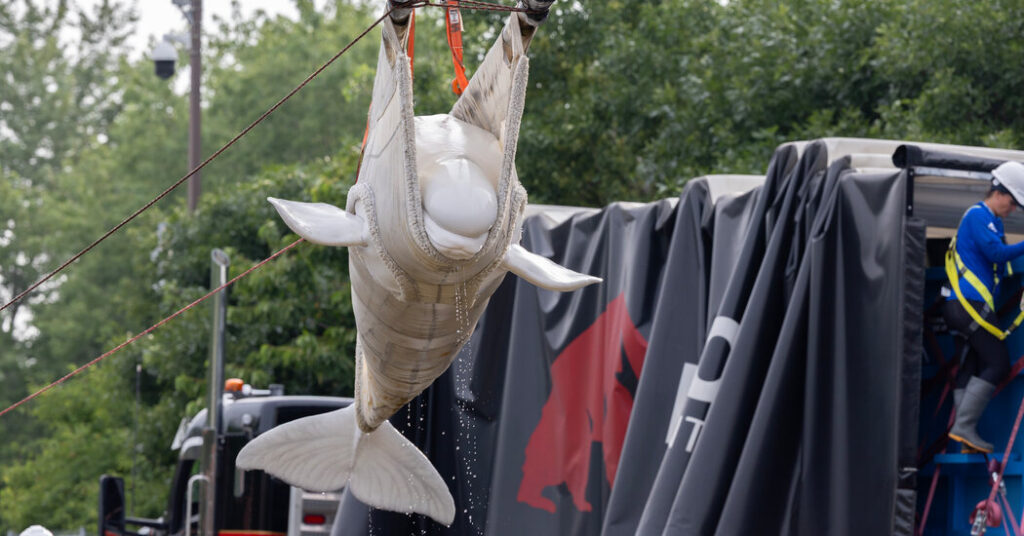
There is nothing normal about moving a beluga whale.
First, you have to find a cargo plane that can accommodate the whale and at least one, if not more, attendants per whale.
Then, there are the foam- and rubber-lined container boxes, specific to the whale’s size and weight, and large enough to hold the whale and the stretcher that it will rest on.
There’s also the matter of the crane that will hoist the whale from its enclosure into the box, onto a waiting truck that will cart it off to the airport.
Now, repeat that for 30 whales.
Aquariums across the United States and Spain are working to relocate these 30 whales from a shuttered aquarium in Canada.
Six made their way out of Canada last week on the first transfer flight — four to the Shedd Aquarium in Chicago and two to SeaWorld San Antonio — with 24 more expected to be transported in the coming weeks.
Georgia Aquarium in Atlanta, SeaWorld San Diego and Oceanogràfic València in Spain will also receive belugas. The Mystic Aquarium in Connecticut is helping with the transports.
Dan Ashe, the president and chief executive of the Association of Zoos and Aquariums, called the rescues “unprecedented.”
“It’s a rescue like other rescues in that you have animals that are potentially in compromised positions and need specialized care,” he said. “But 30 beluga whales? I’m not aware of anything on that scale.”
The animals are coming from Marineland, an aquatic park in Niagara Falls, Ontario, which closed to the public in 2024 after dwindling ticket sales and accusations of animal abuse, which it has denied.
The animals have remained in the care of the aquarium’s staff members, some of whom have worked with the animals for decades.
Planning for the transfers started in January, when veterinarians and marine mammal specialists from the U.S. facilities visited Marineland for an initial assessment.
Todd Robeck, vice president for conservation and animal health at SeaWorld Parks and Entertainment, said the whales were found to be in good health, despite a leaky facility. The whales, ages 8 to 30, ranged from 1,000 pounds to 3,000 pounds and from 12 feet to 16 feet long.
A group of experts from participating aquariums worked with Marineland’s staff to get to know the whales — their medical history, their personalities, their social pods — and assess how they would get along with existing whales at the aquariums.
It took weeks to book a charter flight, a Boeing 777 cargo plane with Qatar Airways. “You can’t go onto a website and pick a route,” Dr. Robeck noted.
Three trucks were booked to bring the six whales to and from the airports. Permits were obtained, and the same group of experts returned a week before the planned departure with all the necessary equipment.
Then, everything had to be timed perfectly to limit disruptions to the whales. About eight to 10 people were in the water at Marineland to help corral them onto stretchers.
The whales were then lifted by a crane and placed in their secure transport boxes and given anti-anxiety medicine for the trip ahead. Once all the whales were loaded, the police escorted them and their human rescuers to the airport, allowing them to make one uninterrupted trip and eliminate stops during which the water might slosh around.
Staff members monitored the water temperature and the whales’ breathing and skin, ladling water over them to make sure they stayed wet and cold.
“They’re floating in water a bit and the stretcher is floating in the water and so sometimes they get out of position,” Dr. Robeck said. “You physically have to get in there and kind of move around a bit to get them back so they’re more comfortable.”
In Chicago, customs agents boarded the planes to inspect the equipment and animals and check the passports of the human caregivers. The four Chicago-bound whales were offloaded, and the two other whales continued on to San Antonio.
From Marineland to San Antonio, the entire process took about 15 hours.
“Who isn’t mystified by a beluga?” asked Charlie Jacobsma, the director of animal behavior and training at Shedd Aquarium, who described belugas as feeling “like a hot dog and a marshmallow combined.”
Belugas, which are known as the canary of the sea because of their constant vocalization, are very expressive, Mr. Jacobsma said.
This is not the first time these organizations have worked together on a rescue mission. The teams transferred two beluga whales from Kharkiv, Ukraine, to the aquarium in Valencia in 2024.
A confluence of circumstances preceded these rescues.
Marineland, once a popular tourist destination, asked the federal government for financial help and approval to export the animals to a theme park in China. Canada initially denied the request until Marineland threatened to euthanize the whales.
The government endorsed the transfers to the United States in January and to Spain in June.
Canada banned the breeding of captive whales and dolphins for entertainment purposes in 2019 “to ensure that the current generation is the last one to suffer in tiny tanks,” said Kaitlyn Mitchell, the director of legal advocacy at Animal Justice, an animal law group in Canada.
The group had hoped that Marineland would transfer some of the belugas to a sanctuary in Canada that is still under construction.
The “least worst option” would be transferring them to the United States, with conditions that restricted further breeding, but that does not appear to be a stipulation, she said.
“This is taking a problem that existed in Canada and allowing that problem to continue in another jurisdiction,” she said.
Kayley Galassini, the director of public relations for Shedd Aquarium, said breeding was not the aquarium’s focus. “Right now, our entire focus is on helping the rescued belugas settle in safely,” she said.
Marineland did not respond to a request for comment.
It was not immediately clear how much the rescues would cost, but Mr. Ashe said Marineland, the Canadian government and the receiving aquariums were all splitting the bill. SeaWorld said it expected the cost to be in the millions.
Dr. Robeck at SeaWorld said while the teams learned much about the whales ahead of their moves, “there are still many gaps in our knowledge about the health, well-being and overall condition of the whales,” including the fact that they “are preparing for the possibility that some of these whales may require specialized or even critical care upon arrival.”
SeaWorld San Antonio is expected to receive 11 more belugas, for a total of 13 from the rescue. Shedd Aquarium will take a total of 10. SeaWorld San Diego is expected to receive three and Georgia Aquarium will get two. Oceanogràfic València, the largest aquarium in Europe, will get two, pending permits.
With its new additions, Shedd Aquarium’s total count of belugas will rise to 18. The aquarium said that its 3-million-gallon, 30-foot-deep habitat can accommodate them all.
So far, the newly arrived whales, Acadia, Lillooet, Osiris and Sierra, are doing very well at Shedd.
“They are just rubbing at each other constantly and getting affiliated with each other,” Mr. Jacobsma said. “We’re seeing so many positive signs that really keeps us very cautiously optimistic about how they’re doing and how they are progressing here.”