
Xi Jinping, pioneering venture capitalist

When CXMT listed on July 27th, the Chinese government experienced what Silicon Valley types call “a sudden wealth event”. The computer-memory chipmaker raised 57.9bn yuan ($8.6bn) at 8.66 yuan per share in a blockbuster initial public offering. Shares in CXMT closed after its first day of trading on Shanghai’s STAR Market at 49 yuan, an increase of 470%, valuing the firm at a hulking 3.3trn yuan. That makes CXMT China’s most valuable company listed on the mainland, and its IPO the largest in Asia this year. Good news for CXMT’s largest equity owner, and its earliest investor: the Chinese government.

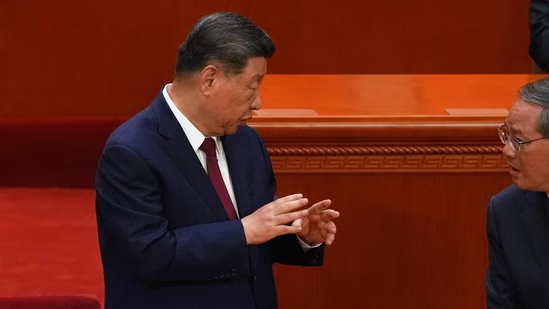
Chinese President Xi Jinping, left, gestures to Chinese Premier Li Qiang during a ceremony to mark the 105th anniversary of the founding of the Chinese Communist Party at the Great Hall of the People in Beijing, Wednesday, July 1, 2026. (AP Photo/Ng Han Guan) (AP Photo/Ng Han Guan)

Xi Jinping, China’s president, has emerged in recent years as the country’s most important venture capitalist. He has bet big on the Chinese economy becoming a high-tech powerhouse, pouring state cash into green energy, electric vehicles and semiconductor manufacturing. His administration has backed firms making batteries, drones and even flying cars. By late 2024 his government had committed some 12trn yuan across more than 2,000 state-backed vehicles known as guidance funds. He is credited with steely patience and impressive foresight: the first big infusions of cash into China’s innovation machine happened a decade ago, about as long as the life cycle of a typical VC fund.

CXMT is his most successful bet yet. The company was co-founded by the government in 2016. It is a product of the so-called Hefei model, named after the eastern Chinese city where it was developed. Under the model, the state becomes an early-stage equity partner in strategic tech businesses rather than picking winners among existing firms. Such investments are remaking China’s economy: before this week the most valuable firm listed in the mainland was a stodgy bank. They are also part of a state effort to erode foreign dominance in high-tech sectors, thereby making China more self-reliant.

Indeed, CXMT is challenging a small group of leading foreign firms. Together Micron, SK Hynix and Samsung account for more than 90% of the global market for DRAM, the memory used in smartphones and laptops. Each has surpassed $1trn in market capitalisation this year owing to insatiable demand from AI companies. CXMT broke into the industry in 2019 when it licensed memory-tech patents from a German company. For now, the firm supplies only 8% of the DRAM market, but its share looks set to grow as American tech giants, including Apple, contemplate buying Chinese chips in order to keep a lid on the cost of their consumer devices.

The state’s investment in CXMT is also delivering a vast financial windfall. According to our analysis of IPO documents filed with the STAR Market, helped by the use of AI tools, some 15 state-linked investors directly own 36% of the firm. The government’s exposure is much higher when state holdings in private funds are included. The direct holdings amount to a position worth 1.1trn yuan on paper after dilution, and using basic assumptions probably represents a more than 40 times return on invested capital. One of CXMT’s earliest state backers, ChangXin Integrated, now holds shares worth 345bn. Any Silicon Valley VC would be delighted with such returns.

But CXMT is only one of the government’s bets, and others are going less well. Elsewhere in its portfolio, the state finds itself in a position no VC wants to be in—without an exit strategy. The state became a VC of last resort in recent years as private funds, including those from America, pulled back from funding startups following a nervy government crackdown on the tech sector starting in 2020. State-linked investors supplied nine-tenths of the capital committed to private-equity markets last year, according to South China Morning Post and Zerone, a Chinese data provider. The scale of its guidance funds suggests the state will need more CXMTs to cover failed bets elsewhere.

Such funds are also prone to corruption. In 2022 police accused officials in charge of China’s main semiconductor fund, worth 343bn yuan, of pilfering state assets; its disbursements had to be paused. Corruption makes even squeaky clean government officials difficult owners. Losing money on a reasonable investment leaves them vulnerable to allegations of impropriety—leading them to treat equity investments more like loans, including by imposing onerous conditions on startup founders.

Even if China VC had more star firms and less graft, it lacks buyers with deep pockets. Private investors in China appear not to have the funds to buy successful firms from the government. The STAR 50 Index has fallen by 16% since the start of the month, prompting concern that investors were pulling out cash to buy CXMT stock. State-backed funds pumped $9bn into public markets to halt the slide. Many of CXMT’s largest investors face a three-year wait before they can offload their shares. Fortunately for Mr Xi, like many VCs, he gets to mark the value of his own portfolio assets. And they will presumably be scored on political benchmarks, not financial ones.