


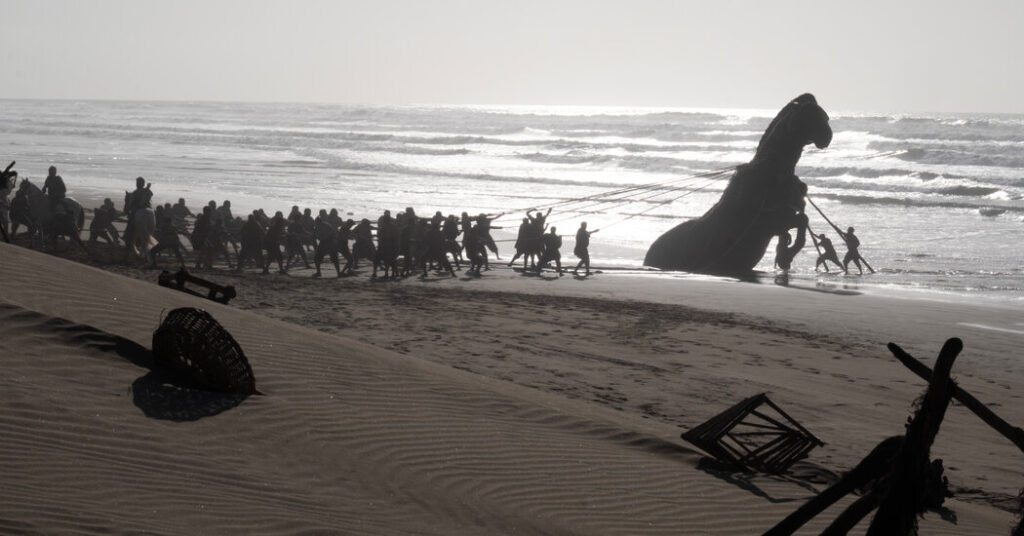
Christopher Nolan’s “The Odyssey” drew criticism in Greece in the weeks leading up to the film’s release, particularly over the casting of the Black actor Lupita Nyong’o as Helen of Troy, amid a broader debate about how one of the world’s most enduring myths should be retold.
But after movie-goers saw the film over its opening weekend in Greece, where Homer’s epic remains deeply embedded in cultural identity, the response appeared to be largely enthusiastic.
As crowds left cinemas in Athens after three hours of the IMAX-filmed epic on Friday night, many said they were excited that a work written nearly three millenniums ago had inspired a major global production, bringing to the screen scenes they first encountered in the classroom.
“I was captivated,” said Costas Anastassiadis, 55. “It took me back 45 years, when we were reading the story at school.”
Despite the film’s scale and technological ambition, he said the effects had served rather than overshadowed the story. “This hero doesn’t need graphics or C.G.I.,” he said. “The text transcends everything.”
On Nolan’s decision to cast Nyong’o as Helen of Troy, Anastassiadis said he felt it “strengthened the universality” of Homer’s work. Others dismissed the debate — in which lawmakers traded shots over several months — as overblown, noting that the actress was only onscreen for a few minutes.
Critics in Greece were mixed in their reviews of the film, which took in about $264.1 million worldwide over its opening weekend. The leading Kathimerini daily said that Nolan had met a Homeric challenge, “fusing an epic that has echoed across the centuries with postmodern artistic sensibilities.” Athinorama, a leading Greek culture and entertainment publication, praised the film’s visual ambition but argued that it shied away from the philosophical and narrative complexity of Homer’s original.
Evgenia Makrygianni, an associate professor of Ancient Greek literature at the University of Athens, said “The Odyssey” remained closely linked to modern Greek identity through the Homeric idea of “nostos” — the longing for home and return that drives Odysseus’s journey.
“It connects with Greece’s own historical experiences — war, exile, economic hardship and migration,” she said. “Odysseus symbolizes resilience, determination and the strength to persevere through adversity.”
Classical works remain alive because each generation finds new meanings in them, Makrygianni added, with contemporary creators reinterpreting Odysseus as a traveler, an immigrant, someone seeking to belong. “Homer himself does not change — his readers do,” she said.
At the Athens screening, viewers seemed to largely accept the absence of Greek actors, accustomed to foreign performers assuming Greek roles in major productions like “300” and “Troy.” For some, the stronger connection came through the landscapes: The sea, light and rugged terrain of Greece, where Nolan filmed parts of the movie, made Homer’s world feel instantly recognizable.
Some were impressed by Nolan’s portrayal of Odysseus not simply as a cunning hero, but as a man transformed by war and forced to confront its consequences.
Vangelis Dravopoulos, 17, said the film gave him a new perspective on the poem he had studied three years earlier. “It was amazing to see all the scenes — the Cyclops, the giants,” he said. “At school, the focus was on the hubris of Odysseus and his perseverance. In the film, he realized what he’d done wrong.”
His friend Stylianos Koginis, also 17, welcomed Nolan putting his own stamp on the story. “That’s what cinema should be,” he said, adding, “The spirit of Odysseus was there.” He said he was particularly struck that Athena, who accompanies Odysseus on his journey, was played by Zendaya, who also played a young woman executed during the battle of Troy. “It wasn’t the goddess accompanying him, it was his regrets,” Koginis said.
Not all viewers believed that Nolan’s production captured the complexity of Homer’s poem.
Christina Georgiou, 36, said the film was visually striking but lacked depth. “It was very Hollywood, with drawn-out battle scenes and over-the-top costumes,” she said. “Basically, it glossed over the richness and turned an epic into a morality tale.”
Beyond questions of artistic interpretation, the film also attracted political criticism before its release, particularly from the far right. Reports that Greece had supported the production with subsidies of more than 6 million euros, about $6.9 million, prompted objections from the nationalist Niki party, which argued that public funds had been used to support a “woke” reinterpretation of Greek heritage.
Culture Minister Lina Mendoni rejected the criticism, telling Lifo magazine that “it is not the state’s role to dictate to a creator how they should artistically interpret a work or a myth.”
Makrygianni, the classics professor, said the controversy surrounding the film was proof of Homer’s enduring relevance. “When a work continues to provoke discussion about who has the right to tell its story and how its heroes should be portrayed,” she said, “it still carries profound symbolic power.”
For Vangelis, the student, the film was an emotional reminder of the continuing significance of one of Greece’s defining works. “I feel proud that all this happened in our country,” he said, “and that people are still talking about ‘The Odyssey’ thousands of years later.”