

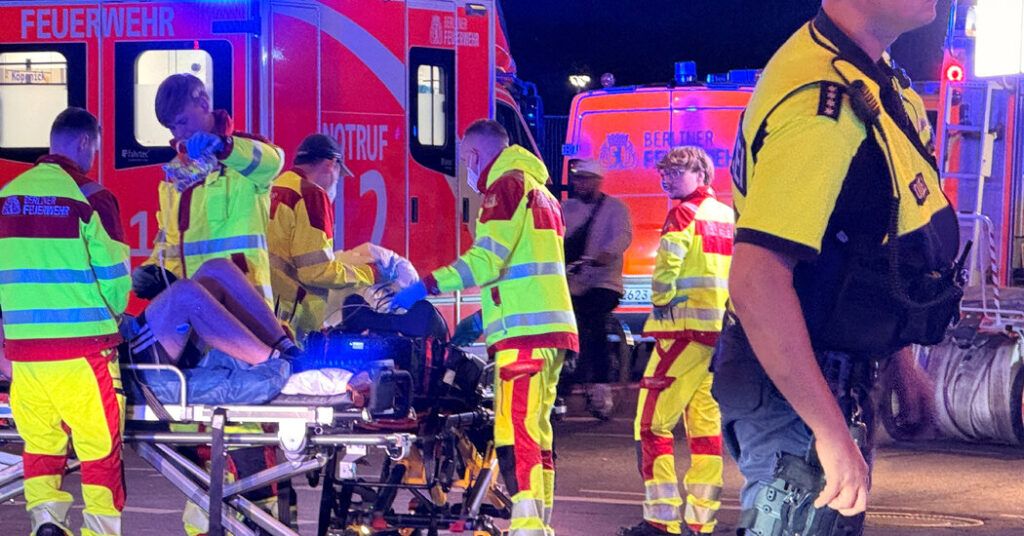
The day after an attacker killed a woman and injured 29 people on the edge of a Berlin gay Pride celebration last weekend, the leader of the far-right Alternative for Germany party in the city issued a scathing news release. It said nothing about gay rights, focusing instead on the assailant, who authorities said had once tried to join the Islamic State terrorist group.
“Protect Berliners from violent Islamists!” the statement began.
The crux of the statement — and what it left out — encapsulated the political opportunity and the peril that the party, known as the AfD, faces in its response to the Berlin attacks.
Researchers say the AfD has succeeded, particularly in local elections, at framing acts of violence in terms that advance its core political narrative: that outsiders are destroying Germany from within. Most analysts predict that messaging could boost the AfD this fall in closely watched local elections in Berlin and in two eastern states, Saxony-Anhalt and Mecklenburg-Vorpommern, where the party is currently leading in the polls.
But that effort could be tempered or reversed, they cautioned, by pushback from a gay community that increasingly fears for its safety after a recent increase in what authorities call “anti-queer” crimes committed by far-right perpetrators.
The Pride attack “will help the AfD” politically, said Kai Arzheimer, a politics professor at the University of Mainz in western Germany. But, he cautioned, “it’s not perfect from their point of view, because of the target of the attack.”
AfD platforms call for banning Pride flags on public buildings, and its members sought in previous years to counterprogram some Pride festivals with their own summer celebrations.
“The instrumentalization of the rainbow agenda during so-called Pride Month must stop,” Beatrix von Storch, an AfD leader in Parliament, wrote last year in a news release supporting a Hungarian ban on Pride parades. She added, “Political correctness and woke ideology attack the family, consisting of man and woman, as the fundamental unit of society.”
Leaders in Berlin’s gay community have repeatedly criticized those stances. “We are very afraid that the right-wing movement is going to take over control,” Alfonso Pantisano, Berlin’s L.G.B.T.Q. affairs commissioner and a center-left Social Democrat, said in an interview. “And we know that they have nothing good in mind when it comes to our community.”
In Berlin, AfD leaders have said they do not oppose gay rights or Pride events. Kristin Brinker, the AfD leader in Berlin who released the statement calling for Berlin’s protection “from violent Islamists,” said in an interview that the party had never spoken out against Pride celebrations “anywhere.”
“We ourselves have, within the party and in my caucus, a great many gay people — a great many people who live different lifestyles,” she said. “That’s completely OK, absolutely fine. Nobody here says otherwise — quite the opposite, in fact.”
Already, the AfD’s response to the attack is shaking up German politics, as its centrist rivals echo some of the party’s rhetoric on immigration.
Since the attack, the center-right Christian Democrats, who lead the federal government coalition, have promised tougher measures to combat terrorism and detain people who are accused of harboring extremist Islamist views.
Sven Schulze, a Christian Democrat and the governor of Saxony-Anhalt, told a radio interviewer on Tuesday that he supported efforts to kick German citizens out of the country if they harbor extremist views and a desire to kill Germans — a position similar to the AfD’s. The man accused of committing the Pride attack was a 21-year-old of Lebanese descent who was born in Germany. He was shot and killed by the police on Sunday evening.
“We simply can’t allow people to live here who don’t accept our culture, who — as was the case with the attacker — claim to have been born in Germany and hold a German passport, yet still reject us as a country,” Mr. Schulze said, adding, “I don’t want people like that living here in Germany.”
In Berlin, the AfD’s opponents have taken the opposite tack: accusing it of exploiting a tragedy against a community it has no affinity for.
“For the AfD to now portray itself as a defender of a free and self-determined life is cynical,” Werner Graf, the Green Party candidate for Berlin mayor, said in an email. “It stands against everything that queer people took to the streets for” at the Pride celebration on Saturday.
The AfD remains a pariah for Germany’s mainstream political parties, which refuse to work with it. Federal intelligence services have labeled it as a suspected right-wing extremist group.
Despite that, the AfD has surged to become Germany’s most popular political party, polling averages show, partly by relentlessly promising to reverse economic decline, support heterosexual family structures and oppose large-scale immigration, particularly from predominantly Muslim countries. It could win an outright majority in Saxony-Anhalt this fall and appears poised for a strong showing in Berlin.
Nationally, the face of the party is Alice Weidel, its 2025 chancellor candidate, who is married to a woman. But the party’s platform, including in Berlin’s election, where polls show that the AfD is roughly tied with several mainstream parties at around 20 percent each, calls for defining families as a man and a woman with children.
Nationally, the AfD wants to deport large numbers of migrants and strip others of their citizenship, plans that other parties say violate Germany’s Constitution.
Germany has seen a string of terror attacks in public spaces in recent years, some committed by immigrants. Research suggests they have helped the AfD in local elections.
An academic economics paper published last year by researchers at Goethe University Frankfurt, in western Germany, found that in German communities that have experienced terror attacks since 2010, the AfD has gained 4.5 percentage points in ensuing local elections. (The researchers arrived at that number by comparing areas that experienced successful attacks with ones where an attack was planned but did not succeed.)
One of the researchers, Navid Sabet, said the results surprised them. The AfD’s gains did not depend on an attack being committed by immigrants, Dr. Sabet said in an interview. The party also gained when the attacks were committed by far-right assailants who targeted immigrants because in both cases voters became more focused on security issues.
“The AfD uses these attacks as a selling point for itself,” he said.
Other researchers agreed that the attacks were likely to reframe the national conversation ahead of the state elections, at least partly moving away from kitchen table issues like higher fuel prices caused by the war in Iran.
Voters increasingly trust the AfD on security issues, where previously they had looked to the center-right Christian Democrats, the party of Chancellor Friedrich Merz, said Ursula Münch, the director of the Academy for Civic Education in Tutzing, in southern Germany.
Mainstream conservatives “were the typical parties of security issues,” Dr. Münch said, adding, “That has changed.”
A lot of people say that the mainstream isn’t “radical enough,” she said, and that they want to see something else.
Tatiana Firsova contributed reporting.