

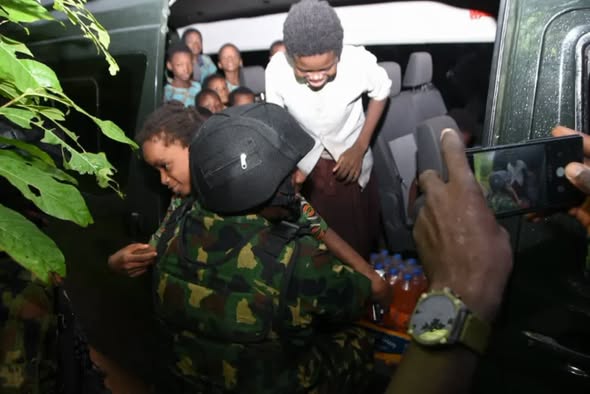
Fresh details have emerged on why the Federal Government declined to negotiate with the terrorists who abducted pupils and teachers in Oriire Local Government Area of Oyo State, despite the victims spending more than 50 days in captivity.
A security expert and former operative of the Department of State Services (DSS), Dr. Seyi Adetayo, said the government’s decision was influenced by the nature of the terrorist group involved and its principal demand, which he described as unacceptable because of its potential national and international security implications.
Speaking during an interview on TVC News, Adetayo disclosed that the abductors were allegedly linked to an Al-Qaeda-affiliated terrorist organisation and had demanded the release of one of their detained leaders in exchange for the hostages.
According to him, security authorities rejected the request, arguing that releasing a senior terrorist figure could embolden the group, strengthen its operations and undermine Nigeria’s counter-terrorism efforts.
“We are talking about a leader of an international terrorist group; you don’t just release people like that,” Adetayo said.
He explained that the government’s refusal to accede to the demand left security agencies with only one viable option—to rescue the captives through a coordinated military operation.
“When they said that, the only option was to rescue,” he added.
READ ALSO: Army unveils details of operation that rescued 44 abducted Oyo pupils, teachers (Video)
Adetayo commended the Federal Government for maintaining its position, saying that yielding to the terrorists’ demand could have jeopardised Nigeria’s cooperation with international intelligence and security partners while encouraging similar hostage-taking incidents in the future.
The former DSS operative also dismissed suggestions that the abduction was carried out in response to Oyo State Governor Seyi Makinde’s declaration of presidential ambition.
According to him, international terrorist organisations typically spend several months planning major operations, making it unlikely that the attack was an immediate reaction to any political development.
“No, international terrorist organisations don’t plan operations within a day or two; it can take them up to six months,” he said.
Adetayo further claimed that the terrorists deliberately targeted the South-West because of the region’s strong media presence, believing that the abduction of schoolchildren would generate widespread national and international attention.
He said the rescue mission involved a coordinated effort by several security agencies, including the DSS, the Nigerian Navy Special Operations Squad, the Nigerian Air Force Special Operations Unit and the Defence Intelligence Agency, alongside other security formations.
According to him, the operation resulted in the arrest of several suspects, while others involved in the kidnapping were neutralised during security operations.
The Presidency had earlier announced the successful rescue of the abducted pupils and teachers after more than 50 days in captivity. Presidential spokesman Bayo Onanuga disclosed that eight suspected kidnappers were arrested during the operation.
President Bola Tinubu subsequently commended the security agencies for the successful rescue mission and pledged that all those responsible for the abduction, including the killing of teacher Michael Oyedokun, would be brought to justice.
The successful rescue has brought relief to the affected families, while the disclosures regarding the kidnappers’ alleged demands have reignited discussions on Nigeria’s long-standing policy of refusing to negotiate with terrorist groups and the broader challenges of combating kidnapping and terrorism across the country.
The victims were abducted on May 15, 2026, in Oriire Local Government Area of Oyo State. They regained their freedom on July 10 following a month-long intelligence-led operation involving the Nigerian Army, the Office of the National Security Adviser, the DSS, the Nigeria Police Force, the Nigerian Air Force, the Nigerian Navy, the National Intelligence Agency, the Nigeria Security and Civil Defence Corps, Amotekun Corps, local hunters and vigilantes. Security authorities said the operation dismantled parts of the kidnappers’ network and led to multiple arrests across Oyo State and other parts of the country.