

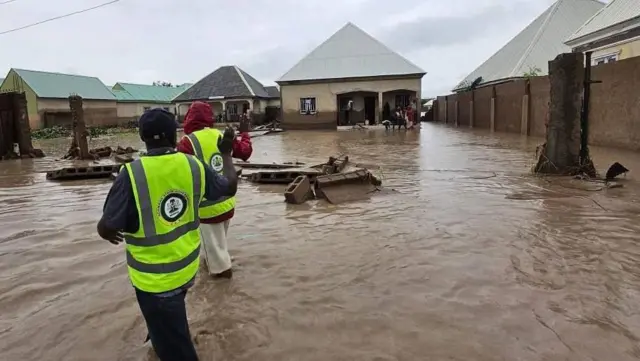
The Federal Government has issued a fresh nationwide flood warning, alerting residents in hundreds of vulnerable communities across Nigeria to prepare for possible flooding as heavy rainfall is forecast to persist between June 22 and July 5, 2026.
The warning was contained in a Flood Prediction Advisory released by the Federal Ministry of Environment through the National Flood Early Warning Centre under the Erosion, Flood and Coastal Zone Management Department.
Signed by the Director of the department, Usman Abdullahi Bokani, the advisory identified communities in more than 30 states and the Federal Capital Territory (FCT) as facing varying degrees of flood risk, urging residents and authorities to take immediate precautionary measures.
Over 30 states listed in flood advisory
According to the ministry, the states expected to experience flooding include Abia, Adamawa, Akwa Ibom, Anambra, Bayelsa, Benue, Cross River, Delta, Ebonyi, Edo, Ekiti, Enugu, Imo, Kebbi, Kogi, Kwara, Lagos, Nasarawa, Niger, Ogun, Ondo, Osun, Oyo, Plateau, Rivers, Taraba and the Federal Capital Territory.
The advisory warned that riverine settlements, coastal communities, floodplains, low-lying urban centres and areas with poor drainage infrastructure remain particularly susceptible to flooding if the anticipated rainfall intensifies.
Major cities identified as vulnerable include Aba, Umuahia, Uyo, Awka, Onitsha, Yenagoa, Makurdi, Calabar, Asaba, Abakaliki, Benin City, Ado-Ekiti, Enugu, Owerri, Lokoja, Ilorin, Lagos, Minna, Abeokuta, Akure, Osogbo, Ibadan, Port Harcourt, Jos, Jalingo and Abuja.
The ministry noted that the advisory was intended to provide early warning that would enable governments, emergency agencies and residents to prepare adequately before floodwaters begin to rise.
Adamawa, Lagos among high-risk areas
The Federal Ministry of Environment placed Adamawa State under a special high-risk category, warning that several communities could experience severe flooding during the forecast period.
The affected communities include Yola North, Yola South, Numan, Mubi, Song, Shelleng, Karewa, Jambutu, Ngurore, Ribadu, Yolde Pate and Wuro Hausa.
Authorities urged residents in these areas to activate emergency response plans immediately and remain vigilant throughout the forecast period.
In Lagos State, the ministry identified several flood-prone locations requiring close monitoring, including Agege, Alimosho, Apapa, Badagry, Epe, Eti-Osa, Ikeja, Ikorodu, Kosofe, Lagos Island, Lekki, Ojo and Surulere.
The ministry also advised heightened vigilance in riverine and coastal communities across Bayelsa, Delta, Rivers, Cross River and other states where rising water levels could trigger widespread flooding.
Heavy rainfall expected to trigger flash floods
According to the advisory, the increased flood threat is linked to forecasts of heavy rainfall capable of causing overflowing rivers, flash floods, waterlogging and the inundation of communities situated along floodplains, riverbanks, estuaries and poorly drained urban corridors.
The ministry warned that blocked drainage systems and uncontrolled development around waterways could further worsen flooding in many affected communities.
It stressed that residents should avoid dumping refuse into drainage channels, as such practices often contribute to severe flooding during periods of intense rainfall.
The government also encouraged continuous monitoring of weather updates and flood advisories issued by relevant authorities.
FG directs emergency preparedness
Communities classified as “Critical” were directed to immediately monitor water levels, identify safe evacuation routes, protect vulnerable residents and avoid residential or commercial activities within floodplains and drainage channels.
Those categorised as “High Risk” were advised to intensify the clearing of blocked drains and culverts, closely monitor nearby rivers and streams, and strengthen community-based reporting of heavy rainfall and rising water levels to facilitate rapid emergency response.
The ministry further urged state governments, emergency management agencies and local government councils to activate contingency plans, pre-position relief materials and intensify public awareness campaigns to minimise the impact of potential flooding.
It also appealed to residents in affected communities to cooperate with emergency officials, heed evacuation directives where necessary and take proactive measures to safeguard lives and property as the rainy season progresses.