

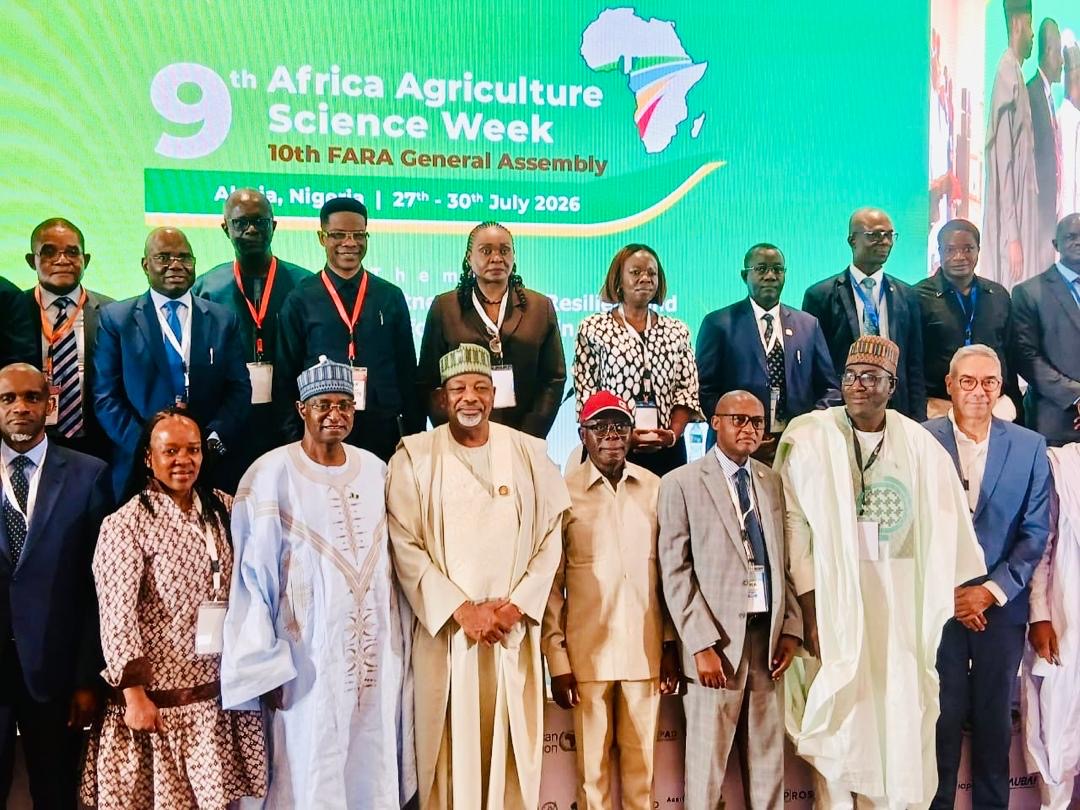
As escalating food prices continue to erode household purchasing power across Africa, the Nigerian Government has called on the continent to build indigenous agricultural technologies to scale up production and strengthen local economies.
Addressing stakeholders in Abuja on Monday, Minister of Agriculture and Food Security, Sen. Abubakar Kyari, affirmed that securing Africa’s agricultural future requires a commitment to science, innovation, and self-reliant strategies.
Persecondnews reports that the call to action unfolded in Abuja during the 9th Africa Agriculture Science Week (AASW) and the 10th FARA General Assembly, centered on the theme: “Innovations and Partnerships for Resilient and Sustainable Agrifood Systems in Africa.”
The event gathered a wide coalition of stakeholders—including government leaders, scientists, farmers, researchers, and development partners—all focused on forging science-driven strategies to fortify the continent’s agrifood sector.
Kyari said food security remains central to the Renewed Hope Agenda, stressing that it is inseparable from national security, economic prosperity and social stability.
He said knowledge has become agriculture’s most valuable resource, capable of driving the transformation needed to boost food production across the continent.
“Knowledge has become the most valuable agricultural resource of the twenty-first century. Our ability to harness this knowledge through science, technology and innovation will determine whether we achieve the agricultural transformation we all seek,” Kyari said.
The minister urged African countries to stop relying solely on imported innovations and invest in technologies designed for their own farming systems.
“Africa must not simply adopt innovations developed elsewhere. We must become a global leader in generating agricultural technologies that respond to our own ecological realities, production systems and development aspirations,” he said.
According to Kyari, the Federal Government is expanding investments in irrigation, mechanisation, digital agriculture, agro-industrialisation and agricultural financing to accelerate agricultural transformation.
Also speaking, Minister of Livestock Development, Idi Mukhtar Maiha, said ongoing reforms are creating opportunities for investment across Nigeria’s livestock value-chain.
“We invite the private sector, development partners and the scientific community to partner with us across the entire livestock value chain,” Maiha said.
He added that innovation would be critical to increasing livestock productivity and meeting the country’s growing demand for animal protein.
“Scientific innovation will be crucial in developing improved breeds, disease surveillance systems and climate-smart livestock production.”
On his part, Dr. Abubakar Adamu Dabban, Executive Secretary of the Agricultural Research Council of Nigeria, emphasized that sustained investment in agricultural research and innovation would strengthen food security and improve the livelihoods of millions across Africa.
“Through sustained investment in agricultural research, innovation and technology, we can build resilient agrifood systems, enhance productivity, ensure food and nutrition security, and improve the livelihoods of millions of Africans,” Dabban said.
Dabban said the Kampala Declaration, adopted by African leaders earlier this year as the continent’s new framework for transforming agrifood systems over the next decade, provides a roadmap for achieving food security through research, innovation and stronger partnerships.
In his remarks, Dr. Debisi Araba, Managing Director of AKADEMIYA 2063, said Africa must bridge the gap between innovation and implementation.
“Technologies exist, but adoption doesn’t. Africa must invest in institutions, capacity and shared learning,” Araba said.
Representing African farmers, Chief Executive Officer of the Pan African Farmers’ Organization, Dr. Babafemi Oyewole, called for farmers to be treated as partners in developing agricultural solutions rather than passive beneficiaries.
“Farmers must be recognised as equal partners in agricultural research, not passive beneficiaries, to drive Africa’s food systems transformation,” Oyewole said.
Chairperson of the FARA Board of Directors, Ms. Bongiwe Njobe, said science and innovation remain central to achieving Africa’s agricultural transformation goals.
“Science, technology and innovation will turn political commitments into measurable results for African farmers,” Njobe said.