

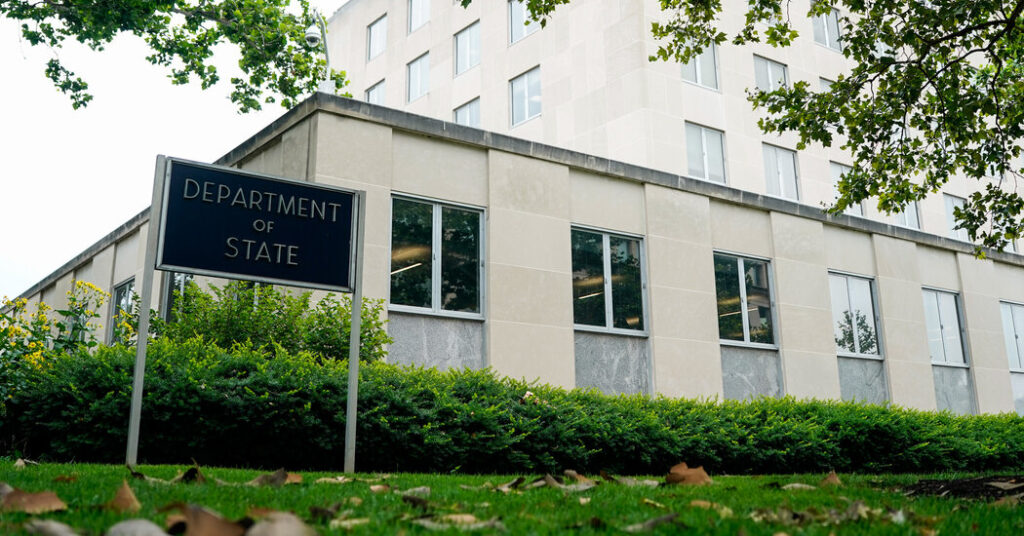
The Trump administration gave Iranian officials in Washington extraordinary access to Iranian asylum seekers being held in immigration detention in the months before the countries went to war, providing sensitive details about their reasons for fleeing the country, according to documents filed in a federal lawsuit on Wednesday.
The sworn accounts, submitted in Federal District Court in Washington, provide a detailed account of behind-the-scenes contacts that led the United States to deport more than 100 Iranians to Tehran between September 2025 and January 2026, not long before the initiation of U.S. military action against Iran in February.
A spokesman for the Department of Homeland Security, which oversees ICE, repeated an earlier statement denying the claims in the lawsuit, without addressing the new details in Wednesday’s filings. A spokesman for the State Department did not immediately respond to a request for comment.
The declarations were filed by the Iranian American Legal Defense Fund, a civil rights group, to support claims that the Trump administration had illegally shared confidential information with Iran’s government, exposing dozens of Iranians to persecution.
In one filing, Cyrus Mehri, a board member and lawyer for the group, described a phone call and meeting this March with an unnamed Iranian official, who disclosed that his office had maintained ongoing communications with Immigration and Customs Enforcement about the United States’ deportation efforts. Mr. Mehri stated that the contact had started with an “unsolicited and unexpected” call from the official, whom he had met previously, and who proceeded to share his views about the discussions to deport Iranians, even after Mr. Mehri informed him that they were working “on opposite sides” of the issue.
According to the filing, the Iranian official indicated that the Trump administration’s goal was to “get rid of all Iranians” held in immigration detention in the United States and that State Department officials had initially shared details about individuals who had fled the regime in Tehran.
A federal judge overseeing the case has yet to evaluate the claims or any response from the government.
Mr. Mehri, who helps run a Washington-based law firm focused on workplace discrimination, has previously represented clients in a number of high-profile discrimination cases, including one that led to a rule change at the National Football League requiring teams to interview minority candidates for head coaching or general manager jobs. The firm also previously sued over the travel ban enacted during Mr. Trump’s first term that initially affected people from Iran and six other countries.
The Iranian American Legal Defense Fund, which Mr. Mehri co-founded in 2025, describes itself as a nonprofit organization providing pro bono immigration and asylum legal services, and represents Iranians detained by ICE.
The United States and Iran have had no formal diplomatic relationship since 1979, and America has generally welcomed people seeking refuge from persecution by the Iranian government.
But the lawsuit claims that even as President Trump publicly denounced the violent repression of dissidents in Iran, U.S. officials courted the Iranian Interest Section, which represents Tehran through an unofficial presence at the Embassy of Pakistan in Washington, as part of its broader mass deportation efforts.
According to his sworn account, Mr. Mehri was told by the Iranian official that monthly, in-person meetings between the two governments to discuss possible deportations continued from an initial contact in March 2025 until the current war with Iran touched off in late February.
Mr. Mehri also stated that the Iranian official continued receiving regular dossiers on Iranian detainees from Immigration and Customs Enforcement for months, even after Mr. Trump directed the bombing of the country’s nuclear facilities in June 2025.
As of March, Mr. Mehri said he was told by the official that ICE continued to hold 400 to 500 Iranian asylum seekers in detention. The official said he had received information from the U.S. government about at least 300 of those people, Mr. Mehri said. The official claimed to have overseen the deportation of as many as 160 Iranian nationals, the filing said.
According to the account, the Iranian official told Mr. Mehri that around 80 percent of the Iranian detainees were newcomers to the United States, and that the Trump administration’s detention policy was “designed to demoralize detainees to the point that they lose hope and agree to self-deport.”
According to the filing, the Iranian official told Mr. Mehri that detainees were informed they could either return to Iran or be deported to a third country. In June, the Trump administration made arrangements to deport two Iranian women to the Central African Republic.
The new filings also include declarations from 11 Iranians, identified only by their initials, who said they were forced into interviews with Iranian officials while held in ICE detention. Almost all of those individuals remain in immigration detention, according to lawyers representing the Iranian American Legal Defense Fund.
Those allegations also have not yet been reviewed by a judge. The Department of Homeland Security had previously said the meetings were routine contacts, and that it regularly facilitates consular access to detained individuals it intends to deport.
In each case, the individuals said Iranian government representatives seemed to know their names and intimate details of their attempts to remain in the United States.
One individual, identified as C.Y., stated that an Iranian agent claimed to have their “whole case file in her hands,” including the “entire transcript” of an interview with U.S. immigration officials covering the individual’s fear of persecution in Iran.
The lawsuit argues that under longstanding federal regulations, U.S. officials were required to keep those details confidential. The suit asks a federal judge to suspend any agreement between the State Department and Iranian officials that could lead disclosures about detainees.
The detainees included at least seven Christian converts and several participants in demonstrations in Iran in 2022 that erupted after the death of Mahsa Amini, a Kurdish woman arrested by the country’s morality police for violating the hijab law.
According to legal filings, the detainees had been subjected to intense persecution in Iran, including being beaten and hit by rubber bullets during demonstrations, held in solitary confinement or having their phones and homes searched. One individual described being arrested after attending an “underground” Christian church, while another indicated they were a women’s rights activist.
The lawsuit argues the detainees faced elevated risk of persecution or torture if deported to Iran, especially women and L.G.B.T.Q. people. It cited a June report by the organization Iran Human Rights Monitor finding that the Iranian government had publicly executed nearly 900 people so far this year.
Early this year, while Mr. Trump encouraged Iranian demonstrators to overthrow their theocratic government, Tehran responded to anti-government protests that began in December with a violent crackdown that killed thousands.
Mr. Mehri told the court that the Iranian official would not offer assurances that, for instance, L.G.B.T.Q. asylum seekers would be safe upon return.
The new declarations also indicated that Iranian officials were allowed to make unsolicited visits to detainees at ICE facilities, urging them to repatriate. In two separate cases, detainees say in filings that Iranian representatives told them they “should be OK to go back unless there were judicial proceedings” against them and that “the regime is different now.”
The Iranian American Legal Defense Fund, which is being represented by the legal nonprofit Public Citizen, has said the policy made it impossible to provide the routine legal advice and immigration services it offers to the Iranian American community. The group said in filings that it works with Iranian clients located or detained in Arizona, Georgia, Louisiana, Mississippi, Colorado, New Jersey, Texas and California.