

Not so long ago, Germany bought most of its gas from Russia. Japan sourced almost all of its rare-earth minerals from China. And most of the oil and gas exported from the Middle East passed through the Strait of Hormuz.
Then Russia invaded Ukraine — and tried to exploit its role as Europe’s largest natural-gas supplier for leverage. Germany has since pivoted to Norway. China cut off Japan’s supply of rare-earth minerals during a territorial dispute; Japan has been determined to build a China-free supply chain ever since.
Iran still seems to be intent on exploiting its control over one of the world’s crucial waterways. But how long can it do so before countries begin turning to alternatives? Today, my colleague Amanda Taub writes about whether the strait could eventually become a wasting asset.
Playing the same card, over and over
By Amanda Taub
Iran has emerged from the war with the United States and Israel with at least one clear win. It has demonstrated the value of its control over the Strait of Hormuz, a vital waterway through which about 20 percent of the world’s oil transited before the conflict began.
Iran’s capacity to close the strait — and in doing so, bring parts of the global economy to a standstill — was its primary source of leverage during the war. Most analysts think it’s the reason President Trump was so intent on ending the conflict that he made a cease-fire deal on terms widely viewed as favorable to Iran.
In the weeks since that deal was signed, Iran has shown that it will continue to use the strait, both as leverage in ongoing peace talks — it staged new attacks on ships passing through the strait last month — and as a revenue generator. Last week, my colleagues reported that Iran and Oman are moving forward with plans to collect payment for ships moving through the waterway.
That’s a lot of times to play the same card over and over.
The importance of the Strait of Hormuz rests on its status as a choke point. Extremely important commodities such as oil, gas and fertilizer pass through it, and, having grown accustomed over decades to open waterways, the world currently has few alternatives.
But if Iran causes enough trouble, for a long enough time, that may change.
The question now is whether — after this year’s stunning demonstration of both Iranian power and global vulnerability — Iran can preserve the strait’s strategic value, or whether it will turn it into a wasting asset.
Iran’s Catch-22
To maintain the value of the strait, Iran must manage a balancing act so delicate that it almost sounds like a Catch-22.
The strait can only be a source of leverage if Iran shows it’s willing and able to close it again if its interests are threatened, said Emma Ashford, a senior fellow at the Stimson Center, a research institute in Washington. But the more that other countries believe Iran is likely to close the strait again in the future, the more they will invest in alternatives that make the waterway less essential, which would undermine its strategic value.
Can Iran give other countries enough confidence in the strait’s remaining open that they will return to relying on it? Or will they treat this period as a signal to find alternatives, even if they are expensive and inconvenient in the short term, in order to reduce risk over the long term? I spoke to Vidya Mani, an expert on global supply chains at the University of Virginia. She told me there were some signs that the second scenario was already underway.
Mani said that she expected to see countries turn more toward renewable energy and other sources of oil outside of the Middle East in order to reduce their risk and increase stockpiles. Before the war, China had already developed a substantial buffer against Iranian disruption by stockpiling large amounts of oil. Other countries will most likely follow suit.
The United Arab Emirates, which already had one pipeline that allowed it to bypass the strait, is fast-tracking a new one that will double that capacity by 2027. The European Union is exploring new pipeline options of its own. Iraq and the Gulf states are also beginning to transport oil and other goods overland in order to ship them out of Syrian ports.
But Mani said alternatives for some industrial products were harder. Commodities like naphtha, helium gas and fertilizer require heavy industrial equipment and large amounts of energy to produce. Diversifying away from the Middle East will require significant investments in new manufacturing operations — a much more difficult and expensive shift than scaling up other sources of energy.
That gives Iran a slightly longer runway, but the same principles still apply: Choke points that become weaponized don’t stay choke points for long, and countries that have been blackmailed once try their very best not to let it happen again.
The price of independence
After decades of globalization, in which the general trend was toward openness and reducing friction, countries are now waking up to the risks of relying on an interdependent system that can be turned against them.
Reducing interdependence comes at a cost: Higher prices at the gas pump and more expensive shipping. Before the war, many analysts didn’t believe Iran would actually close the strait because of the pain it would cause Iran. All parties bear the costs of a world with more friction. But in a dangerous world, many are increasingly deciding that friction is a price worth paying.
MORE TOP NEWS
Calls for revenge at the ayatollah’s funeral
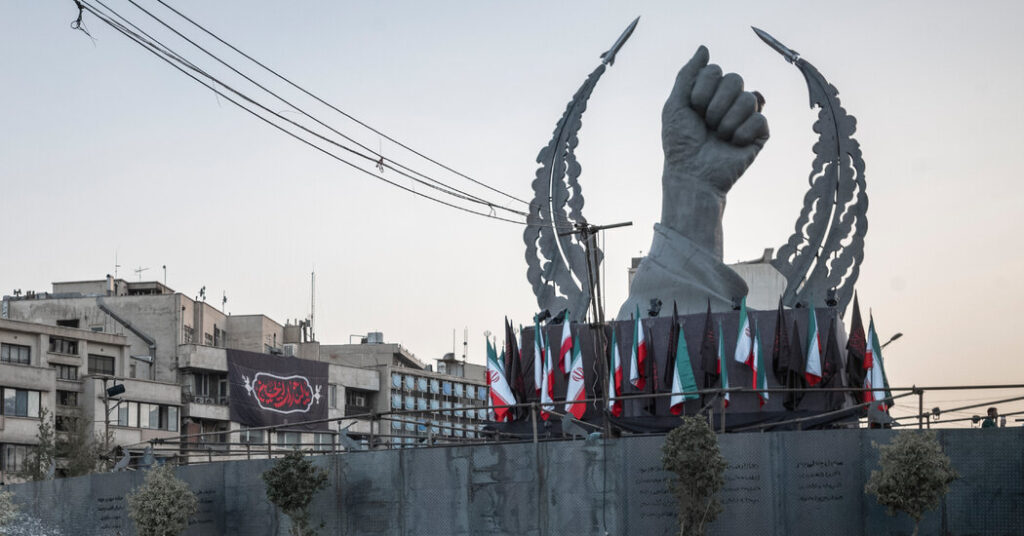
Tens of thousands of mourners packed Tehran yesterday for funeral prayers for Ayatollah Ali Khamenei, the supreme leader who was killed in late February. Conspicuously absent was his son and successor, Mojtaba Khamenei, who has not been seen in public since succeeding his father.
Crowds chanted calls for revenge. The funeral ceremonies taking place over several days are part farewell, part spectacle and part turning point, my colleague Abdi Latif Dahir writes. Abdi and the photographer Emile Ducke are the first New York Times journalists to visit Iran since the war with the U.S. and Israel.
OTHER NEWS
America’s 250th birthday party on the Fourth of July extended into the early hours of the fifth, with an enormous fireworks display and a patriotic but bluntly partisan speech by Trump.
Ukraine is hammering Crimea with drone attacks. Strikes on fuel facilities and the energy grid have caused widespread blackouts.
After earthquakes in Venezuela crumbled public housing buildings, many residents accused the government of building shoddy apartments for political gain.
China sent two ships to patrol the waters east of Taiwan in a new campaign to challenge the island’s control of crucial waters around it.
The impeachment trial of the Philippine vice president, Sara Duterte, is set to begin today.
Guam and the Northern Mariana Islands prepared for the arrival of Typhoon Bavi, which is equivalent to a Category 5 hurricane.
The pastor of an underground church in China who was detained last year as part of a crackdown on religious activity was released.
WHAT ELSE IS HAPPENING
TOP OF THE WORLD
The most clicked link in your newsletter on Friday was about a 15-year-old Ukrainian dancer’s prom.
WORLD CUP
The last 16
Norway was looking to upset Brazil and reach the World Cup quarterfinals. England is facing Mexico.
Trump’s request: The president asked FIFA to review the suspension of Folarin Balogun, the top goal scorer for the U.S. Balogun is now eligible to play.
A new obsession: Canada’s run ended against Morocco. But the host country embraced football with a fervor normally reserved for hockey.
MAP OF THE DAY
Nearly 200 identities are represented on this map showing how people in the U.S. describe their ancestry or family origin to the Census Bureau. The lines of American ancestry today are not neatly drawn, and groups overlap and spill into one another.
MORNING READ
To the list of indulgences now available to the wealthy, add one more: the snow room. As climate change raises temperatures around the world, some people are equipping their homes with cavelike spaces of ice and artificial snow.
A snow room is more or less the opposite of a sauna. In some, white flakes descend gently from the ceiling to create the feeling of being inside a snow globe. Read more and see a video of indoor snow flurries.
AROUND THE WORLD
A ‘digital pain reliever’ in China
For many young Chinese, the future doesn’t look so great: The job market is dire, wages are falling and competition seems endless. To cope, some are recreating nostalgic scenes from the early 2000s, when the economy was growing rapidly and the future felt bright.
The memes, animations and retro playlists they post online are part of a digital subculture that’s become known as Chinese Dreamcore. The genre serves as a “new type of digital pain reliever for young people in modern times,” one blogger said. Take a look at some of the posts.
RECOMMENDATIONS
Watch: The Netflix series “Human Vapor” is a remake of the 1960 Japanese sci-fi film from the “Godzilla” director Ishiro Honda.
Confront: Does an avoidant communication style make a breakup more complicated? A psychotherapist explains.
Read: The author Gillian McAllister recommends thrillers that blend escapist settings with pulse-pounding intrigue.
Cope: Here’s advice from glassblowers and firefighters on handling a heat wave.
RECIPE
These cottage cheese egg bites are a perfect, protein-rich snack for busy mornings. Load them up with whatever vegetables and cheese you have on hand. You can stash them in the fridge or freezer for grab-and-go breakfasts.
WHERE IS THIS?
Where is this fortress?
TIME TO PLAY
Here are today’s Spelling Bee, Mini Crossword, Wordle and Sudoku. Find all our games here.
That’s it for today. See you tomorrow! — Katrin
Amanda Taub was our guest writer today.
We welcome your feedback. Send us your suggestions at [email protected].