

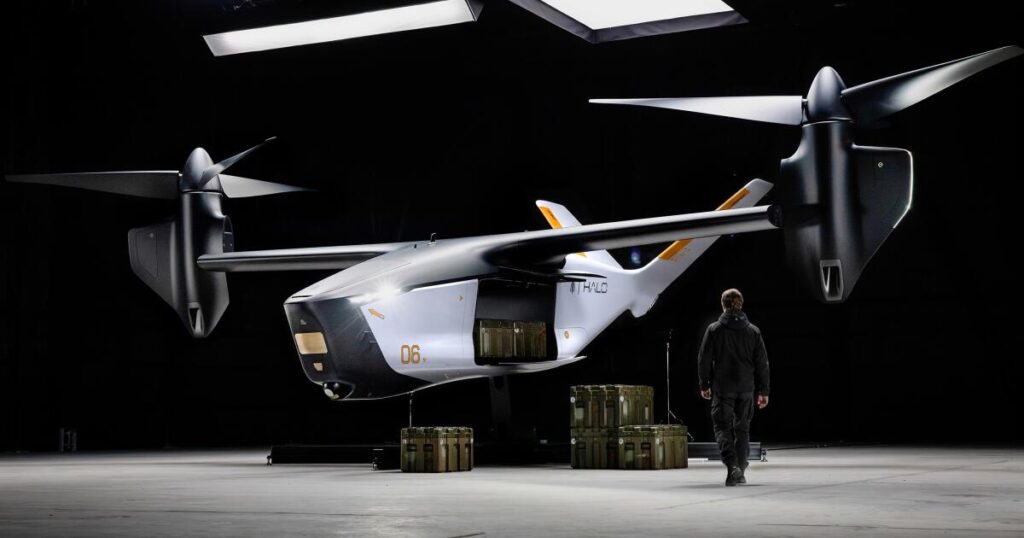
Two of California’s boldest aerospace innovators joined forces to unveil an autonomous attack aircraft Monday.
Anduril Industries, a military technology company based in Costa Mesa, approached the San José-based air taxi venture Archer Aviation two years ago with a concept for a dual-use, self-flying rotorcraft.
The jointly developed hybrid-electric aircraft is designed to serve both defense and commercial purposes. Anduril showcased the defense variant, dubbed Thunder, on the first day of the Farnborough International Airshow outside of London on Monday.
Archer plans to announce the first customers for the commercial variant later this week, the company said in a release.
Thunder is an autonomous attack aircraft that can carry missiles or rockets, patrol airspace and carry cargo. The aircraft uses vertical takeoff and landing, a technology essential to Archer’s air taxis, along with rotors and wings. The aircraft will be able to operate well above 18,000 feet, but is designed to work close to the ground in combat with human-piloted military vehicles.
“Maneuver warfare hinges on the ability to exploit an adversary’s weaknesses through principles like speed, agility, reach, and decisive mass,” Anduril said in a statement. “Thunder is purpose-built for the new geometry of battlefield maneuver.”
Anduril is targeting 2027 for Thunder’s first flight and has completed multiple test flights with a full-scale surrogate aircraft. It has not announced a price.
The aircraft’s autonomy is powered by Anduril’s core Lattice for Mission Autonomy, a software that “delivers the trusted, flight-proven formation behaviors, separation management, and flight logic necessary for Thunder to remain useful, predictable, and safe around crewed aircraft,” the statement said.
Archer shares surged on the news, rising more than 20% in midday trading Monday. The company’s shares have fallen 34% so far this year. Anduril is a privately held company.
Archer’s primary focus is the development of commercial air taxis that it says will function like flying Ubers to shuttle passengers over congested cities. It has promised to operate the taxis in Los Angeles in time for the 2028 Olympic Games, though some experts doubt how realistic that timeline is.
Archer’s main competitor in the air taxi space is Joby, a startup based in Santa Cruz that has been entangled in a bitter legal battle with Archer for more than a year. Archer says Joby is hiding its dependence on money and parts from China, while Joby alleges Archer stole its technology through corporate espionage.
Foraying into the defense space could give Archer an extra boost as it races to develop its air taxis faster than competitors.
“Our teams have been designing this aircraft together with the aim of making the most powerful vertical-lift platform ever developed,” Archer founder and Chief Executive Adam Goldstein said in an emailed statement on the collaboration with Anduril. “We took eight years of aircraft design, powertrain and manufacturing knowledge from our commercial air taxi program and put it into this program.”
Archer, which has already attracted criticism from public safety advocates over its role in the overcrowded airspace, will likely also ruffle feathers for advancing a violent technology.
Anduril said “Thunder is urgently needed today” and “brings the combination of capabilities necessary to achieve maneuver dominance on the modern battlefield.”
“The near-surface fight has become one of the most lethal,” the company said.