

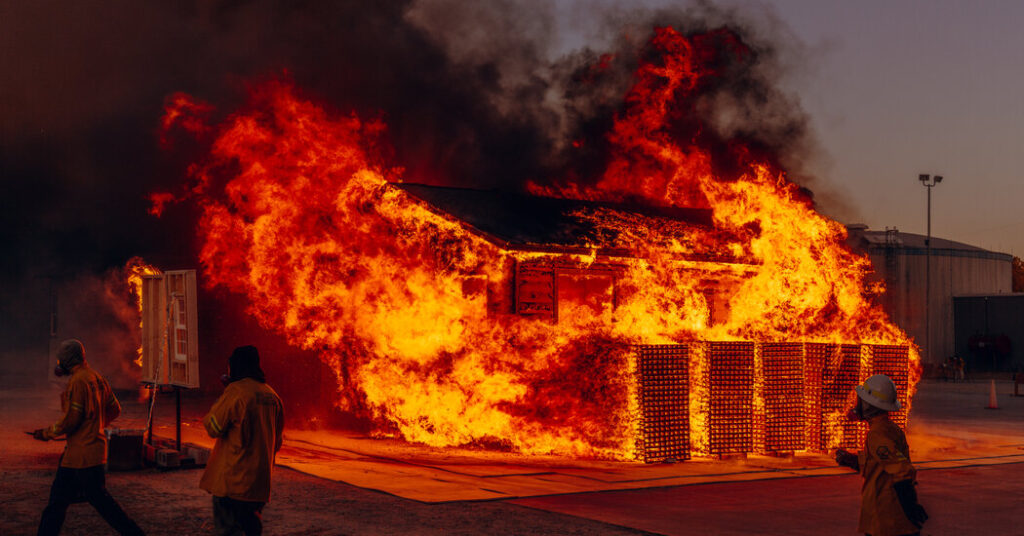
Earlier this year, I found myself standing with scientists, students and firefighters in the South Carolina heat, waiting for the right conditions to burn down a house. It was part of an effort to help reimagine homes and communities to make them more resistant to wildfire.
Climate change is intensifying wildfires in all kinds of ways. If you live in Central Canada, the Midwest or on the East Coast, you’re probably under a blanket of smoke today from blazes in Ontario and Northern Minnesota. And wildfires are driving record losses as they make the leap into dense urban neighborhoods, like the Eaton fire and the Palisades fire did last year in California.
The threat can feel overwhelming. But a growing body of research says that there are ways to make our communities safer. That’s what brought me to the unusual research institute in rural South Carolina.
Feeling the burn
It’s not easy to burn a house safely. The day I was watching, things got complicated quickly.
First, the researchers needed the afternoon breeze to die down. That’s because they wanted to make their own carefully controlled artificial wind, using a huge wall of turbines. Then, by late-afternoon, state officials announced that a fire ban would go into effect the next morning.
As a result the window for the test was shrinking, fast.
Finally, a little after sunset, the breeze settled down. They set the house on fire.
After hours of delays, it felt like only seconds passed before roaring flames wrapped themselves around the building. Moments later, I felt the most unbearable heat of my life and took a few steps back. Actually, many steps back.
The Insurance Institute for Business and Home Safety, which runs these tests, built this house to burn, just like 12 others before it. In each experiment, they tweak the materials, the wind speeds and other variables to learn how different factors influence the threat a fire poses to neighboring homes. A second building, downwind and outfitted with a half-million dollars worth of cameras and sensors, was built so researchers could learn as much as possible about how suburban fires spread.
The lessons learned
Experiments like these have revealed some valuable lessons: Use building materials and methods designed to withstand embers, heat and flames. And remove flammable things in the yard — propane tanks, plants, fences or anything else that could become fuel — especially within five feet of the building.
The tests also show that a home is only as safe as its weakest link. For example, a tempered glass window can withstand heat, but a vinyl window frame melts in mere minutes.
Wildfire scientists emphasize that this is true at the neighborhood scale, too. When homes are close together, they can become fuel for each other. To give a community the best chance at surviving a wildfire, multiple homes on a block need to be protected.
Hurricanes, hail and pounding rain
Pyrotechnics aren’t all the team does.
In the main turbine hall, they can conjure torrential rain and simulate the power of hurricane-force winds. In a separate building, a contraption cools and compresses water into perfectly round hailstones that they fire at a variety of roofing materials.
Just off to the side of the parking lot, a field of roofs, propped up on wooden stilts, are left to age. It lets researchers study how the elements can degrade the structures we rely on for protection.
Read more and watch a video from the scene.
Yellow skies and a ‘double whammy’ for your health
Dense smoke from wildfires in Canada was drifting across parts of North America on Thursday morning, from Ontario and the Midwest across to New England, New York City and beyond.
Air quality in several cities reached hazardous levels. And that, when combined with high temperatures in the same areas, poses special health risks.
A 2023 analysis of more than 20 million deaths around the world found that hot days and days with bad air quality both resulted in higher-than-normal mortality rates. But periods in which heat and pollution were combined were even more deadly.
The combination can be particularly stressful for children, older people or anyone with respiratory diseases like asthma. Dr. Mary Rice, director of the Center for Climate, Health and the Global Environment at the Harvard T.H. Chan School of Public Health, called the phenomenon a “double whammy” that can drive up hospital admissions. — Claire Brown and Christina Kelso
Read more.
Track the smoke conditions and temperatures in your area, and follow updates from around the United States.
More news from around the web
Read past editions of the newsletter here.
If you’re enjoying what you’re reading, please consider recommending it to others. They can sign up here.
Follow The New York Times on Instagram, Threads, Facebook and TikTok at @nytimes.
Reach us at [email protected]. We read every message, and reply to many!