

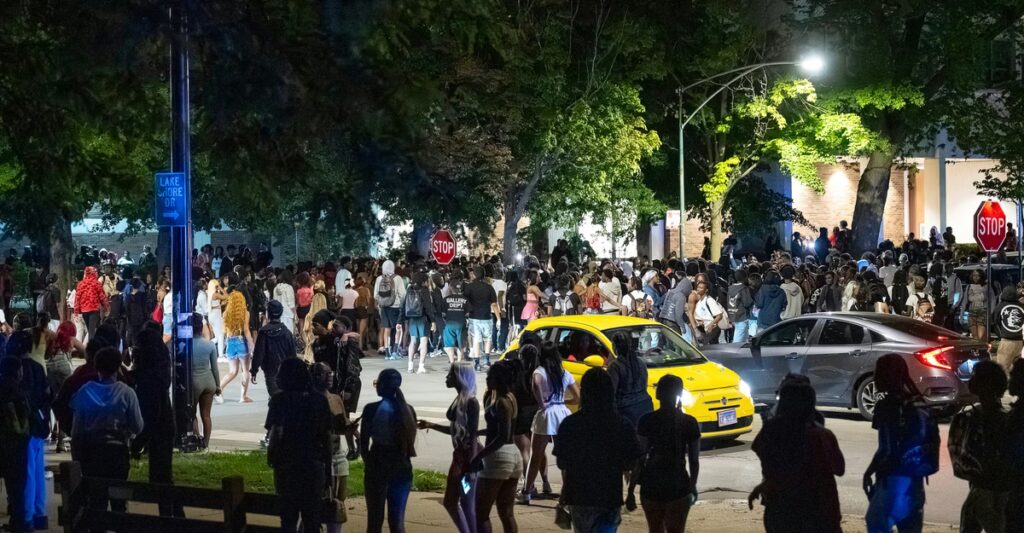
They usually start with a harmless-looking social-media post: a call for teenagers to “pull up” and “shake some ass,” as one online flyer put it. These get forwarded across the internet, and soon masses of young people are surging into an urban plaza or park, often terrifying any adult who happens to be nearby. Teen takeovers can be “amazing,” like an outdoor street party, I was told by one 17-year-old named Jaden who said he had attended many of them—“but only until the fighting starts.”
The fighting is what has made teen takeovers so polarizing in recent months. In Washington, D.C., they gained a new prominence in May, after a scuffle broke out in a Chipotle in the Navy Yard neighborhood. Within seconds, it flared into a violent rumble, with a group of young men in black hoodies throwing punches and hurling wooden high chairs at one another. The other customers cowered in the corners, while crowds formed at the windows outside, shrieking and recording the scene on their phones. By the time the police arrived, the combatants had fled and melted into a thick crowd of other young people in the darkness outside.
The phrase teen takeover became popular several years ago, when they began taking place in Chicago, Atlanta, Tampa, and a few other cities. The Chipotle brawl lasted less than a minute, and no one was seriously hurt. But its ferocity led right-wing broadcasters and influencers to start talking about a new kind of urban lawlessness enabled by liberal social policies. “Teen takeovers are plaguing Democrat-run cities across the country, including the nation’s capital,” reported The Daily Wire. Republican Senator Mike Lee of Utah has invoked “violence by teenage gangs” as a reason to withdraw D.C.’s right to govern itself. Donald Trump weighed in on Truth Social in May: “Teen takeover in Chicago. Five officers badly hurt. Mayor and governor are terrible. Should call for help!”
Clips of the Chipotle fight were shared tens of thousands of times, usually with pointed commentary urging the authorities to crack down hard. Some have tried: In May, Jeanine Pirro, the U.S. attorney for Washington, promised to “aggressively prosecute parents” of teenagers involved in takeovers (an idea that has been championed by liberals for the parents of children who commit gun crimes). The Chicago City Council drafted, but did not pass, an ordinance that would also allow the police to charge parents.
Some observers—especially on the left—dismiss the recent rush of commentary as vaguely racist media hype, or as the latest chapter in society’s vain effort to quell the permanent volcano of adolescence. “We are sensationalizing teenagers, often lower-income children of color,” Kristin Henning, the director of Georgetown Law School’s Juvenile Justice Clinic and Initiative, said in an interview with NPR in May.
[Quinta Jurecic: The coming D.C. crime boomerang]
But after a few weeks of hanging around in D.C.’s takeover zones, I came to believe that something a little more troubling is going on, at least in some places. The people who are closest to the problem—parents, security guards, local businesspeople, and community activists—say that the current generation of teens is growing up in a world where truancy is far more common and where the isolation imposed by the coronavirus pandemic and social media has left a legacy of frustration.
“Some things changed in our society during that year or two we were all locked up—some of us moved on, others not,” Emeka Moneme, an urban planner and the president of the business-improvement district in the Navy Yard, where many of D.C.’s takeovers have taken place, told me. “These kids think they can perform in everybody’s space, and it’s taking a toll. There may be a perception problem, but there’s also a real problem, and we need to do something about it.”
One night on U Street, I got my own little taste of the takeover experience when a huge crowd of very young-looking people began running back and forth, seemingly playing cat and mouse with a group of police officers who were shouting for them to go home. One subgroup of teenagers went racing down the street I was on, shouting and smashing into people, and a girl who looked about 14 years old stopped and began jabbing me in the gut with her fingers.
“Hey, take it easy,” I said, fending her off as gently as I could. “How old are you?”
She stared back at me, glassy-eyed. “I’m drunk as fuck,” she said.
This was pretty mild stuff, as takeovers go. In February, hundreds of teenagers stormed a mall in the Bronx as store and restaurant managers hid behind locked doors. In Chicago, two violent takeovers took place on successive days over Memorial Day weekend, with crowds of teenagers battling the police; more than 50 people were arrested.
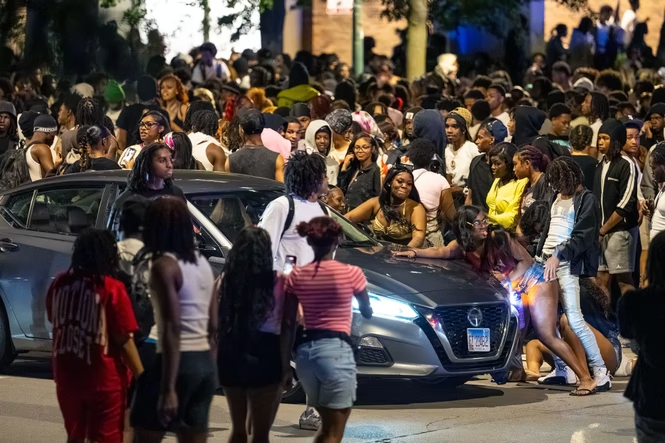
Most of the takeover participants I met in May and June were from D.C.’s poorest southeast wards, but that is not where takeovers happen. Instead, they usually occur in wealthier and more affluent urban areas, sometimes in restaurant hubs or public parks. That contrast can give takeovers the appearance of a spontaneous revolt, one that illuminates the extreme economic disparities of our era. One of the videos that trended on X a few months ago was filmed through the glass wall of an upscale restaurant, where diners recoiled at the sight of disheveled teenagers careening wildly through the street outside.
The teenagers I met told me that they organized on Instagram, usually at the last minute to prevent cops or anyone else from thwarting them. The same goes for the other herd activities that have become more common in recent years, such as spontaneous swarms of kids on scooters and “car meet-ups” where participants drive in circles or do doughnuts, sometimes hundreds strong—“so many, the police don’t know what to do,” Alan Henney, a veteran D.C. crime reporter, told me.
Takeovers are at once a timeless illustration of the volatility of crowds—perhaps especially adolescent crowds—and of the much newer potentialities unleashed by the internet a few decades ago. The first flash mob appears to have taken place in 2003, when the journalist Bill Wasik, then an editor at Harper’s,,began sending emails to friends to create what he called “inexplicable mobs” in various places in New York City. His prank, only later dubbed a “flash mob,” became a worldwide fad and was adopted for all kinds of purposes, including political protest and robbery.
Takeovers may be liberating, perhaps especially for kids who have been staring at a screen all day. But they have left a trail of bad feelings and economic worries in the neighborhoods where they recur. All of the local business owners I met at Washington’s Navy Yard told me that they had suffered a noticeable drop in customers, which they attributed in large part to takeovers.
Violent crime has fallen sharply in D.C. and other major U.S. cities since a post-COVID high in 2023. Although takeovers have resulted in brawling and occasional looting, they do not seem to begin with criminal intent, unlike the semi-mythical gangs of “wilding” teenagers that haunted the urban imagination in the early 1990s. Even so, they have created an atmosphere of impunity and chaos that looms much larger than any measurable criminal consequences.
“It’s honestly crazy,” one restaurant manager who had rocks thrown at the door and who has witnessed fights and even some shooting told me (she asked that her name be withheld so as not to draw attention to her restaurant). “We have regular conversations with staff about what to do if we get attacked—lock the doors; keep ourselves and the customers safe.” The servers I spoke with at several restaurants told me that they scan the social-media feeds of local crime reporters throughout their evening shifts, to be ready if something happens.
The takeovers seem to have affected the real-estate market too. One afternoon, near the Navy Yard metro station, I overheard two young men talking about the Chipotle brawl. When I spoke with them, they told me that they had been planning on moving to a new condominium in Navy Yard but were now having second thoughts because of the takeovers. Other people told me stories about local landlords offering months of free rent to keep tenants from leaving.
Most frustrated of all are the people tasked with policing the takeovers. In the videos that have circulated in recent months, you can see the exasperation on the faces of the cops and security guards who are struggling to hold back a tide of teenagers and are often reduced to shouting, “Go home!”
“I hate it,” a security guard at the Nationals ballpark—one of Navy Yard’s big tourist attractions—told me. She was a young Black woman who gave her name only as Danyelle. “I think it’s really bringing the community down. These kids don’t have respect for the elders, for authority, nothing.” She said that she had moved to an apartment building in Navy Yard a few years ago and is now leaving because of the takeovers.
This groundswell of complaints, along with the telegenic scenes of urban disorder cycling through the internet, made teen takeovers a central issue during the D.C. Democratic mayoral primary this spring. The democratic socialist Janeese Lewis George criticized teen curfews—a mild measure endorsed by her centrist rival and the current mayor—as “dangerous,” because the curfews might lead to encounters between teens and National Guardsmen or other federal officers.
[Henry Grabar: The great crime decline is happening all across the country]
Although Lewis George won the primary, progressives’ skepticism about takeovers—and law enforcement generally—is becoming “a ball and chain around the Democratic brand,” Chuck Thies, a Democratic political consultant in D.C., told me.
Teen takeovers have coincided with a sharp rise in truancy since the pandemic, and most of the people I spoke with saw a connection. As of 2024, chronic absenteeism rates were still 57 percent higher than pre-pandemic levels. D.C. has one of the highest rates in the country; in a quarter of the city’s public high schools, more than 70 percent of students are chronically truant, meaning they have 10 or more unexcused absences in a school year.
Derrick Johnson, a freelance crime reporter who grew up in Southeast D.C., told me that he has witnessed the rise of truancy and social-media use among teenagers and believes that both factors are at the root of the takeovers. Social media, he said, simultaneously isolates kids and provides a forum that can nourish beefs among them; disputes can turn hostile when teenagers post improvised raps to boast or threaten rivals. These feuds have been especially dangerous in D.C., where gang-style neighborhood rivalries in the city’s poorest wards can put teenagers who cross into enemy territory at risk. Such constraints can lead them into truancy and away from the authority figures in their life.
“There’s something different about this generation,” Johnson said. “They don’t want to listen to anybody.” Johnson can relate: He was once a “disengaged teen” (he is now 35), and it was reporting on his community that saved him, he said. But he and his peers would never have gone around in groups “messing up these establishments,” even though violent crime was far worse in those days than it is now. “It seems like the internet is preventing them from learning how to talk about problems,” Johnson said.
Unlike some of the policy wonks and academics who opine about teen takeovers, Johnson has dealt directly with these kids. “I sometimes post about missing teens,” he said. “They message me back: ‘I’m not missing.’” He asks them why they’re not in school, and many of them say they need to make money because their parents don’t provide much of a home.
Johnson has witnessed another trend that has shaped the takeover phenomenon: the transformation of crime reporting. He is one of a handful of holdouts against the decline of local news, as many small newspapers and channels go out of business. At the same time, reporters’ access has been limited by the encryption of police-radio transmissions, which once allowed generations of reporters and photographers from Weegee onward to get to crime scenes right after the cops did. There are alternatives—the firefighters’ radios are for the most part still on open channels—but they are less reliable.
The result is that much of our crime news tends to rely on two sources: official announcements from the authorities and sensational internet coverage, such as the viral posts that made the takeovers loom so large this past spring. There has been less reporting about the neighborhoods most affected by crime, which is where many of the kids involved in takeovers come from.
Early last month, I attended a meeting about teen takeovers and youth crime organized by a nonprofit called Together We Rise, in a church auditorium in D.C.’s crime-ridden Ward 7. The participants included a mix of parents and local activists, along with a local city-council member and a cop. There was widespread agreement in the room that the takeover issue had been reported in a sensational way that unfairly vilified teenagers. But most of the people I spoke with told me they believed that the problem was real.
There was far less unity about possible solutions. Several participants said that parents and community leaders needed to step up. “We all have to do more to reach these kids,” a 72-year-old retired teacher, who went on to lament the absence of teenagers at the meeting, said. Others called on the city to provide more activities for youth, saying that there are fewer places, outside of home and school, for teenagers to hang out than in the past.
This has been a common refrain about takeovers, especially on the left—that they represent a failure of local government rather than of parenting. Eric Goulet, a lawyer and school-board member who has worked in D.C. politics for two decades, told me that he thinks the city should “find a way to incentivize businesses that cater to youth: roller skates, bowling, that kind of thing.” Some cities have experimented with related measures—keeping parks open and staffed at night, say, or improving street lighting and urban design.
[Charles Fain Lehman: New York City has lost control of crime]
There is another possible remedy for teen takeovers: The authorities may get better at preempting them. D.C. already seems to have curtailed them in recent weeks by using localized emergency youth curfews, with large groups of officers patrolling frequent takeover zones and standing guard outside the nearest metro stops. The more effective avenue may be patrolling teens online. Police departments around the country are assigning more officers to monitor social media, with the goal of showing up at takeover sites before the kids do. AI could make the job easier.
“Teen takeovers were born of a change in technology,” Robert J. Sampson, a sociologist at Harvard and an expert on delinquency, told me. “It seems likely that technology will provide the solution as well.”
But the solution will depend on the root cause. If takeovers are ultimately about apps that help teenagers outwit their elders, better tech may be all we need. If takeovers are a symptom of deeper problems in the current generation of teens, they are likely to continue, even if under a different name.