

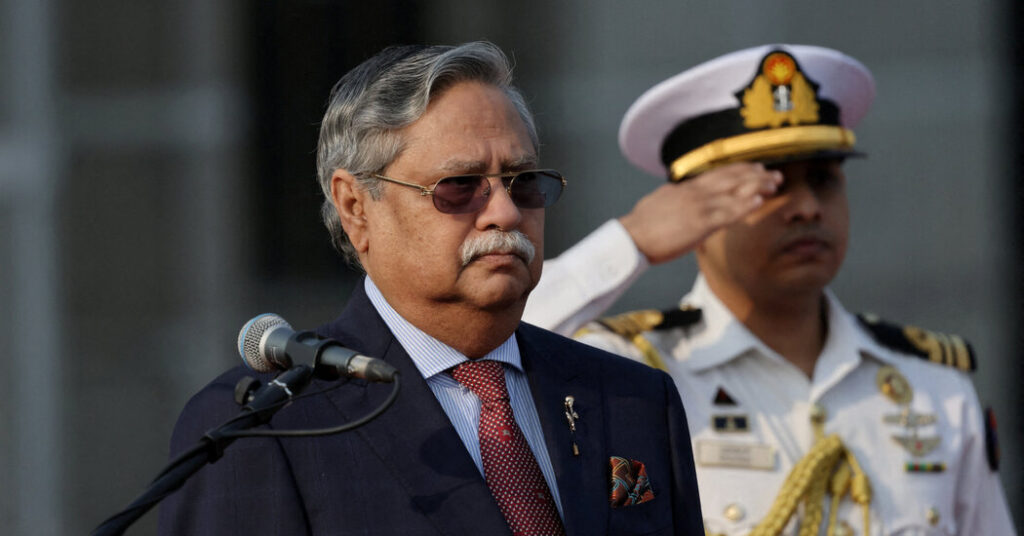
President Mohammed Shahabuddin of Bangladesh resigned on Friday as Bangladeshis anticipated the return and surrender of the ousted prime minister Sheikh Hasina, his onetime ally who fled to India before being convicted of crimes against humanity last year.
Mr. Shahabuddin, 76, who was halfway into his term in the largely ceremonial post of president, cited illness as the reason for his resignation. Hafiz Uddin Ahmad, the speaker of the country’s Parliament, announced at a news conference that he had assumed the role of interim president, in accordance with the country’s Constitution, which also states that an election to choose an official successor must be held within 90 days.
“It is not possible for me to perform the duties of an important constitutional post like the president,” Mr. Shahabuddin wrote in his resignation letter, which he submitted to Mr. Ahmad. “I need long-term treatment.”
Mr. Shahabuddin had been widely seen as hobbling along on borrowed time since the downfall of Ms. Hasina, whose government was brought down by mass student-led protests in August 2024. Last November, Ms. Hasina was sentenced to death, in absentia, for ordering the use of lethal force against the demonstrators.
Mr. Shahabuddin’s resignation comes only weeks after Ms. Hasina announced in an interview with Reuters that she planned to return to Bangladesh in December to face the charges against her, which she denies.
“My party leaders and workers are being subjected to tremendous repression,” she said. “If death comes, I want it to come on my own soil, where my parents are buried and where their blood was shed.”
Though she was once widely respected as a pro-democracy reformer who helped bring an end to Bangladesh’s military rule as a dissident politician in 1990, Ms. Hasina’s 15-year tenure as prime minister had increasingly been weighed down by accusations of corruption and authoritarianism.
The demonstrations, initially sparked by anger over longstanding quotas in civil service jobs, mushroomed into a wider protest against Ms. Hasina’s government, leading to violent clashes with security forces.
Around 1,400 people were killed in the government crackdown that followed, according to the United Nations. Ms. Hasina resigned and absconded in a military helicopter to India, where she remains.
The subsequent interim government banned Ms. Hasina’s party, the Awami League, from politics, and many of her allies went to jail or into hiding.
Mr. Shahabuddin was one of Ms. Hasina’s only allies to keep his position. Though he did not face any charges of his own in connection to the deadly protests, many nonetheless have viewed him as complicit in Ms. Hasina’s crimes, and he had been kept in office largely to avoid a constitutional crisis as the interim government transitioned into an elected one.
The current prime minister, Tarique Rahman, who was elected in February, had for a time kept up appearances, allowing Mr. Shahabuddin to address the country’s Parliament in March.
In his speech, Mr. Shahabuddin appeared to disavow Ms. Hasina, accusing her government of being “fascist.”
But following rumors that he had separately attempted to contact his old ally while she was in exile, the current government no longer sees him as trustworthy, an adviser to Mr. Rahman said.
The adviser asked not to be named because he was not authorized to comment publicly on the matter.
Mr. Shahabuddin himself had already expressed his wish to step down last year, telling Reuters that he felt “humiliated” by the fact that, following Ms. Hasina’s departure, his portrait had been removed from Bangladeshi embassies around the world.
“My voice has been stifled,” he said.
Nahid Islam, a lawmaker who led the protests against Ms. Hasina as a student activist in 2024, said at a political rally on Thursday that Mr. Shahabuddin should not be let off the hook for his role in Ms. Hasina’s government.
“We believe that Chuppu, an accomplice of fascism, should not only resign, but also be arrested after his resignation,” he said, using the former president’s nickname.