

As China’s leader, Xi Jinping, forges toward a fourth term in power, he confronts a dilemma common to aging autocrats: testing and recruiting a rising generation of loyal officials while ensuring his own dominance.
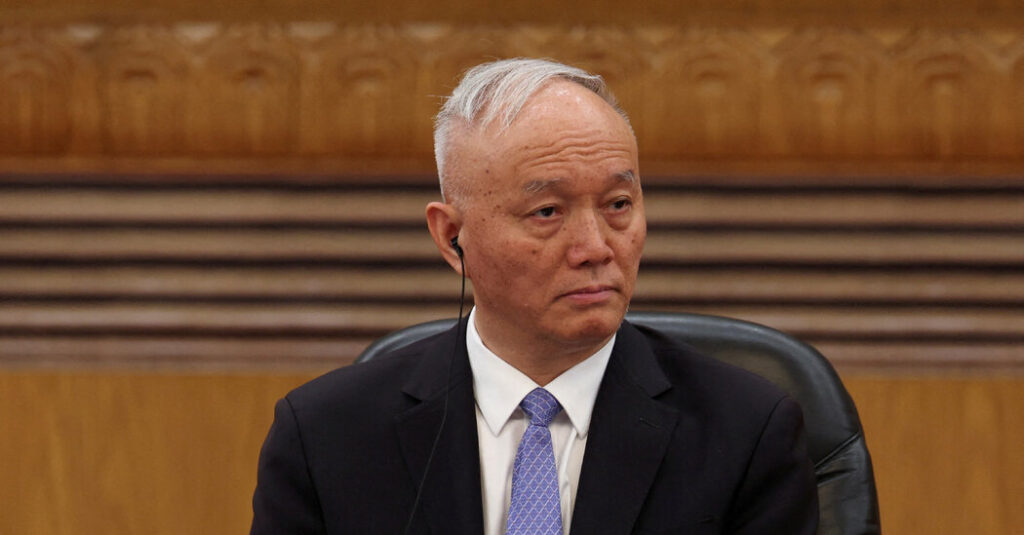
To manage this looming challenge, he is leaning on Cai Qi, a longtime deputy who is probably the most influential official in Mr. Xi’s inner circle.
Tall, silver-haired, and constantly at Mr. Xi’s side, Mr. Cai is a supercharged chief of staff to his leader. Mr. Cai holds multiple leading roles, including in national security and running the central office for Mr. Xi and other senior Communist Party officials.
Mr. Xi recently appointed him president of the Central Party School, the elite academy that trains rising officials. Mr. Cai is also overseeing a new campaign to instill Mr. Xi’s ideas about discipline and loyalty among cadres.
Mr. Cai’s new roles indicated that he might take an important role in vetting potential new senior officials and enforcing the strict ideological standards that Mr. Xi is likely to expect from a new cohort of potential leaders. Mr. Xi is expected to secure another five-year term at a Communist Party congress late next year, a feat that would extend his rule to at least 20 years and potentially well into the 2030s.
“The ability to speak on behalf of Xi Jinping is the rarest commodity in elite Chinese politics, and Cai Qi has that,” said Julian Gewirtz, who served as the senior director for China at the National Security Council during the Biden administration and is now a scholar at Columbia University.
He said that Mr. Cai’s leadership of the party school meant that he was “probably one of a very small number of people who can prepare the dossiers for Xi on those officials.”
Mr. Cai, 70, is among a cluster of senior officials who first worked with Mr. Xi when he was still a young official in eastern China in the 1990s and 2000s. In recent years, Mr. Cai appears to have risen to become Mr. Xi’s closest adviser and the tough enforcer of his vision. (Mr. Cai’s name is pronounced TSIGH Chee.)
“Into the second decade of his rule, Xi has come to value strict adherence to his stated desires, and Cai has been the official to ensure that,” said Victor Shih, a professor at the University of California San Diego who studies elite politics in China.
Mr. Cai did not always seem so stern. Back in the 1990s and 2000s, as an official in Fujian and Zhejiang provinces, he cultivated a reputation as an approachable, open-minded official.
He visited Taiwan in 2012 and wrote a travel diary that praised its many convenience stores. He opened a Weibo social media account that attracted millions of followers, with posts addressing residents’ complaints and presenting himself as an enlightened, open official.
“Openness is a good thing,” he wrote in one post. “For any political party, relying on self-restraint is not enough.”
But after Mr. Cai was transferred to Beijing by Mr. Xi, he shed his folksy demeanor and quickly transformed into a guardian of Mr. Xi’s draconian priorities. He erased his Weibo account. In 2014, Mr. Cai helped establish the secretive Central National Security Commission, which expanded Beijing’s control over domestic and external security risks.
Three years later, Mr. Xi promoted Mr. Cai to be the mayor and party secretary of Beijing, a sensitive role focused on ensuring stability and order in the Chinese capital. Mr. Cai waged campaigns to remake the city in line with Mr. Xi’s vision.
In late 2017, Mr. Cai launched a drive to expel hundreds of thousands of migrant workers from Beijing in the name of housing safety. The city government had long been trying to reduce the number of low-income migrants in Beijing and to attract more higher-paid, university-educated professionals.
In a combative speech, Mr. Cai used the imagery of battle to order officials not to flinch from enforcing the unpopular expulsions.
“At the grass roots, it’s about using real swords and real guns, putting blood on the blade, having the guts to clash head-on,” Mr. Cai said in a speech to Beijing officials that circulated online. Mr. Cai’s brutal approach ignited widespread criticism in the city, including petitions and a call for him to resign.
In 2022, Mr. Xi promoted Mr. Cai to the Politburo Standing Committee, the party’s top echelon. Mr. Cai also became the director of the party’s General Office and head of its Secretariat, putting him in charge of the paperwork, meetings, health, security and travel of senior officials, including Mr. Xi.
Official reports indicate that Mr. Cai also oversees cybersecurity policy and is a deputy head of the Central National Security Commission, which monitors threats at home and abroad, roles that are usually kept behind a veil of secrecy. But his importance to Mr. Xi is clear. When Mr. Xi hosted President Trump on a state visit in May, Mr. Cai was first in the line of officials whom Mr. Xi introduced to Mr. Trump at a welcome ceremony.
Now Mr. Cai’s role overseeing party affairs may give him a voice in choosing the officials who will help Mr. Xi achieve his goal of transforming China into a technological superpower and of bringing Taiwan, the democratic self-ruled island, under Beijing’s control.
In 2018, Mr. Xi abolished a limit on his tenure as president, opening the way to lead indefinitely. Analysts say they do not expect Mr. Xi, 73, to name his own successor for years, to maintain his unchallenged control of the state.
Even so, Mr. Xi will need to replenish the ranks of top officials. More than two-thirds of the officials on the Communist Party’s Central Committee — a leadership council that has about 200 full members — will retire next year if an age norm applies. That norm means that most senior officials who are 68 or older at the time of the party congress step down.
“When a political strongman like Xi Jinping reaches his late years, his sense of insecurity and distrust can rise, but he is not as familiar as he used to be with his new subordinates, which makes establishing that trust harder,” said Chien-wen Kou, a professor at National Chengchi University in Taiwan who studies China’s leaders.
But the opportunity to promote hundreds of officials carries risks. Mr. Xi has purged the People’s Liberation Army elite of many of the senior officers he had chosen to promote. Those accused of corruption and disloyalty and removed included General Zhang Youxia, whom Mr. Xi had kept on beyond the usual retirement age and appointed China’s top uniformed commander.
“Given all that has happened, Xi Jinping will be even more cautious in recruitment screening ahead of the 21st party congress,” said Deng Yuwen, a former editor at the Study Times, a newspaper published by the Central Party School. “Xi Jinping wants to make sure that the ideas of future party and government cadres stay totally aligned with his.”
Even if Mr. Cai also steps down from his other roles next year, which is possible given his age, he may stay as president of the party school, said Mr. Deng, who now lives in the United States. Mr. Cai could then serve as Mr. Xi’s eyes and ears, spotting and vetting officials for promotion in coming years.