

An evenly divided Senate. A senator disillusioned with the direction of his own party. A sudden party switch that shifts Senate control, sending shock waves through the institution and American politics itself.
That scenario unfolded in 2001, when then-Senator Jim Jeffords of Vermont stunned his fellow Republicans by bolting from the party to become an independent. He then aligned with Democrats, briefly handing them the Senate majority early in the first term of George W. Bush.
Now, with the possibility of a razor-thin Senate majority looming again after November’s midterm elections, the focus is already on the prospect of party-switchers upending the Senate equilibrium, with the most attention focused on Senator John Fetterman, Democrat of Pennsylvania.
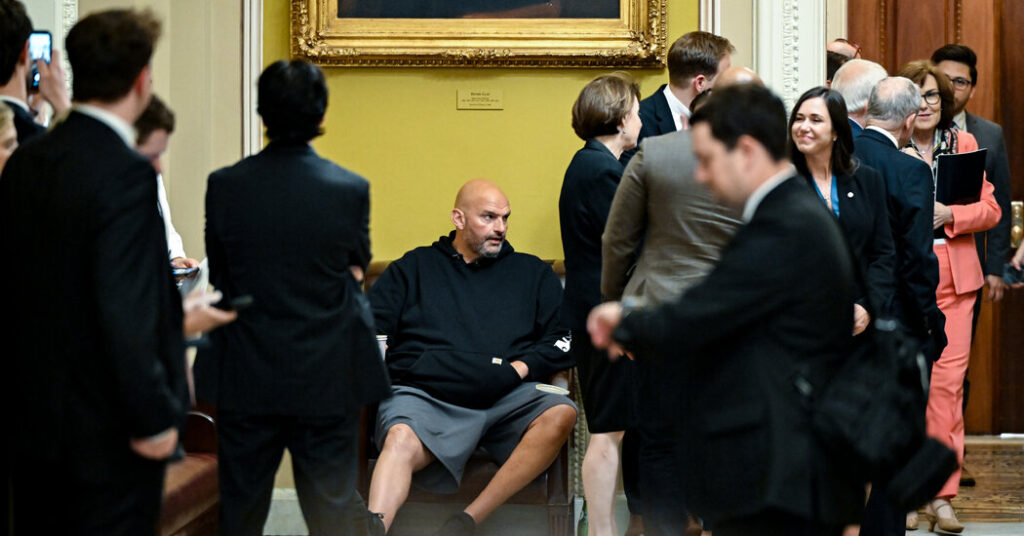
Mr. Fetterman, a Senate nonconformist right down to the hoodie-and-shorts uniform he often wears instead of a suit, has taken harsh aim at elements of his own party, broken with his caucus, avoided party gatherings, developed deep friendships across the aisle and even set up a joint fund-raising committee with his Republican Senate colleague from their home state of Pennsylvania.
He recently published an op-ed chastising his fellow Democrats for having tried to gut the filibuster a few years ago. And he has said that if his party officially turns against Israel, as some of its most progressive voices are urging, it would be a “red line” that would prompt him to leave.
Does all this activity signal that he intends to flee the Democratic Party, pulling the rug out from under Democrats if they manage to net the four seats that would give them the majority next January?
“Never,” Mr. Fetterman said in an interview, declaring that he has no intention of switching. “I’m not being cute. I vote 90-something percent with Democrats.”
That doesn’t mean that Mr. Fetterman is at all pleased with the trajectory of his party, which has shifted starkly away from decades of unequivocal support for Israel, and whose loudest voices are promoting proposals for reshaping government that many mainstream Democrats find extreme.
“These people aren’t Democrats,” Mr. Fetterman said. “We can have different views on certain things, but would you want to abolish the border, abolish prison, abolish the presidency, abolish the Senate? That’s just full-on communism.”
Despite his deep-blue Democratic voting record, Mr. Fetterman, who suffered a stroke during his drive in 2022 but returned to the campaign trail and won, has fueled discussion of a party switch because of his biting critique of some aspects of Democratic politics, not to mention his obvious disdain for some of the formalities and traditions of the Senate.
He also has plenty of friends on the Republican side of the aisle who would like nothing more than to win a new convert, and, regardless of how real the prospect of a Fetterman defection is, enjoy any discussion that highlights Democratic divisions. His unique new joint fund-raising committee with Senator David McCormick, the Pennsylvania Republican, has only fueled the chatter.
Republicans have certainly left the door wide open, along with a big welcome mat, though Senator John Thune, the South Dakota Republican and majority leader, said he hasn’t discussed the matter recently with Mr. Fetterman.
“I have had conversations with him in the past, as have many of my colleagues, about the challenges he faces in his caucus,” Mr. Thune said. “There are many of us who I think would welcome the opportunity to have him join the Republican conference. But, you know, ultimately that’s a decision that’s left up to him.”
Senate Democrats watched two members leave their ranks following the 2022 election, as Arizona’s Kyrsten Sinema announced she was an independent the month following the election, and Joe Manchin III of West Virginia became an independent two years later.
Both centrist senators were visibly frustrated with Democratic politics, broke from the party to prevent a weakening of the filibuster sought by their colleagues, and tried to push the caucus to the right on some issues. They remained aligned with Democrats in order to keep their majority committee membership status, but neither ultimately sought re-election in 2024.
Mr. Manchin said that his party had shifted in a way that made it untenable for him to remain a Democrat.
“I just came to a realization that they had moved into an area and I couldn’t move them back,” said Mr. Manchin, who said he also felt penalized for working with Republicans. “I like both sides and I wanted to be able to talk to my friends on both sides without being a threat to anybody.”
While Mr. Fetterman has broken with the party on some issues, such as the spending fights and efforts to rein in President Trump’s conduct of the war with Iran, he hasn’t yet been the legislative obstacle that Ms. Sinema and Mr. Manchin could sometimes be. And though some Democrats say they don’t know him well, they do see him as one of their own, and appear to be going out of their way not to make him feel shunned, as some previous party-switchers had.
“The people in our caucus very much like him and respect him,” Senator Chuck Schumer, Democrat of New York and the minority leader, said, noting Mr. Fetterman’s backing of most Democratic initiatives. “And we’re a big-tent party; we can have a lot of different views in that party.”
Mr. Fetterman isn’t the only senator who comes up in discussions about switching parties. Senator Lisa Murkowski, Republican of Alaska, has mused about taking the leap in the past, and come under harsh attack from President Trump over the years. After losing a primary re-election bid in 2010 to a G.O.P. challenger on her right, she held on to her seat as a write-in candidate, cementing her reputation for having an independent streak. But she has kept her Republican affiliation, despite expressing the view that the party was moving away from her.
The outcome of the midterm election could be the factor determining any defections. If the Senate ended up tied 50-50, as it did in 2001 and 2021, Republicans would remain the majority party by virtue of Vice President JD Vance’s tiebreaking power. A four-seat Senate pickup would put Democrats in charge, but a switch by Mr. Fetterman would restore Republicans to power. Conversely, a 50-50 Senate followed by a Republican switch would empower Democrats.
The switch by Mr. Jeffords of Vermont 25 years ago was an explosive moment in the Senate. It came after the senator, who chaired the health and education committee, concluded that the Bush administration and conservative Republicans were shortchanging special education and students with disabilities.
Republicans recaptured the majority in the 2002 midterm elections following the Sept. 11, 2001 attacks.
Mr. Fetterman appears to be in a far different frame of mind.
“I would say to John, he has to be the person he is,” Mr. Manchin said, noting that his decision would carry major political implications for both Mr. Fetterman and the Senate. “He believes a little bit in both sides. He has strong convictions to the progressive side, which is where he comes from.”
In an essay in The Washington Post in May, Mr. Fetterman wrote that he would be a “terrible Republican.” In other interviews, he has also insisted he has no intention of switching. But the speculation persists and is likely to continue despite his denials.
In the interview, he suggested that any future change of heart on the matter would be worthy of an exclusive story in this newspaper.
“Like, if I ever decide to change, and I won’t, I will seek you out and give that to you,” Mr. Fetterman said.