


President Bola Ahmed Tinubu has reaffirmed his administration’s uncompromising stance against kidnapping and terrorism, declaring that the federal government would neither negotiate with criminal groups nor pay ransom for the release of abducted victims.
He also announced major security reforms, including plans to establish state police with constitutional safeguards against abuse, expand the Nigerian military from eight to 12 divisions, and strengthen the operations of forest guards as part of a broader strategy to tackle terrorism, banditry and other violent crimes.
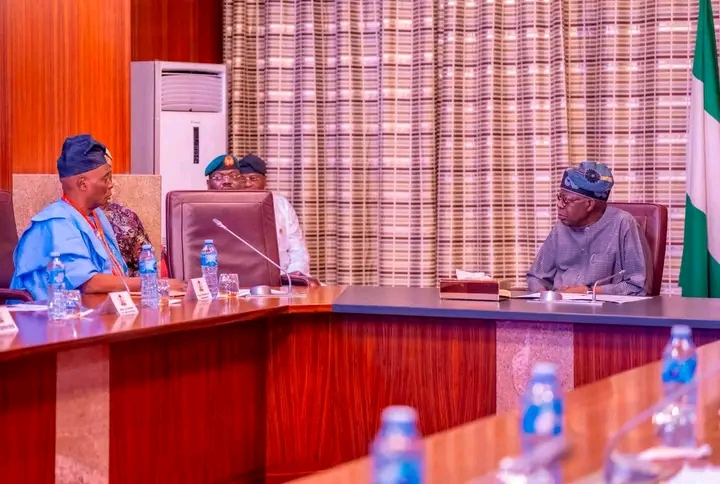
President Tinubu said this at the Presidential Villa Abuja, while receiving a delegation of traditional rulers from Oyo state, led by the Olubadan, Oba Rashidi Adewolu Akanmu Ladoja.
The president disclosed that kidnappers involved in the recent abduction in Oriire local government area of Oyo state demanded not only ransom but also the release of members of their criminal gang already in government custody.
He said the administration rejected the demands without hesitation.
“We refuse to negotiate for ransom. These criminals wanted us to release from detention members of their criminal gangs that had already been arrested, and we said no deal. We are not going to negotiate with criminals,” he said.
Tinubu described the successful rescue of the victims as proof that Nigeria’s security agencies were making progress through coordinated operations rather than concessions to criminal groups.
Congratulating the security forces, the president said the success of the operation reflected the dedication of the armed forces as well as the support and prayers of Nigerians.
“Congratulations on the Oriire rescue. I think we succeeded with your support, prayers, and I agree that we should commend the men and women of the armed forces for their excellent performance,” he said.
As part of efforts to intensify the war against terrorism and banditry, the president announced that the armed forces were expanding their operational structure from eight to 12 divisions to improve deployment and reduce response time during security emergencies.
According to him, the expansion is aimed at giving security agencies greater operational reach and faster intervention capability.
“We have the geography of the forest. We know what it is. From eight divisions, we are now moving to 12 divisions to shorten the response time and give that response the teeth needed to defeat terrorism and banditry,” he said.
The president said that every security challenge provides valuable lessons that help government continually review and improve its security architecture, operational strategy and deployment.
The president said the federal government remained committed to establishing State Police but stressed that adequate legal and institutional safeguards would be built into the system to prevent abuse by state authorities.
“There will be State Police, and that State Police will have guardrails against abuses. We will protect it from abuse, and you traditional rulers too will have a greater role to play,” he said.
The president also announced plans to strengthen the country’s forest guards by expanding both their capacity and mandate.
He said the forest guards would become an integral part of efforts to flush out terrorists, kidnappers and other criminal elements hiding in forests across the country.
“We are enhancing the capacity and capability of the forest guards. They are not just to chase antelopes and animals. They will also chase criminals and deal with them in our forests,” he said.
The president called on traditional rulers to mobilise their communities to become more vigilant and actively support security agencies through timely intelligence.
He urged Nigerians to monitor activities within their communities and promptly report suspicious movements to the appropriate authorities.
“I want you to take this message to our people to be extra vigilant. Know your neighbourhoods, know your communities and report strange people,” he said.
President Tinubu observed that the security crisis in neighbouring Mali, Burkina Faso and the Niger Republic had compounded Nigeria’s internal security situation, with armed groups and criminal elements crossing into the country.
“Some of them are non-Nigerians. The insecurity in Mali, Burkina Faso and the Niger Republic is adding more fuel to our challenges,” he said.
The president challenged state governments to utilise increased federal allocations more prudently by investing in road networks and infrastructure that would improve security, connectivity and economic development.
He said many states were now receiving between four and five times their previous allocations and no longer needed to borrow simply to pay salaries or pensions.
“The money we are pushing to the states has increased significantly. Nobody is borrowing to pay salaries now. Pensioners are receiving their entitlements. They should invest more in roads and transport networks instead of constructing flyovers where there is little traffic,” he said.
The president also announced plans to convene periodic meetings with traditional rulers from across the country to obtain grassroots perspectives on governance, security and national development.
“I will be calling meetings of traditional leaders from across the country to listen to you and receive your suggestions,” he said.
While acknowledging that insecurity remains one of the country’s most pressing challenges, the president expressed optimism that ongoing reforms and military operations were producing measurable results.
He said his administration accepted both the achievements and the challenges inherited from previous governments and remained committed to restoring peace across the country.
“The immediate challenge is enormous. It is not an easy task, but I asked for the job and I got it. I accept both the assets and liabilities of my predecessor.
“The security challenge is getting better. We are gaining a better handle on it. Whenever you come across our soldiers and police officers, please appreciate them. They are doing a good job,” he said.