

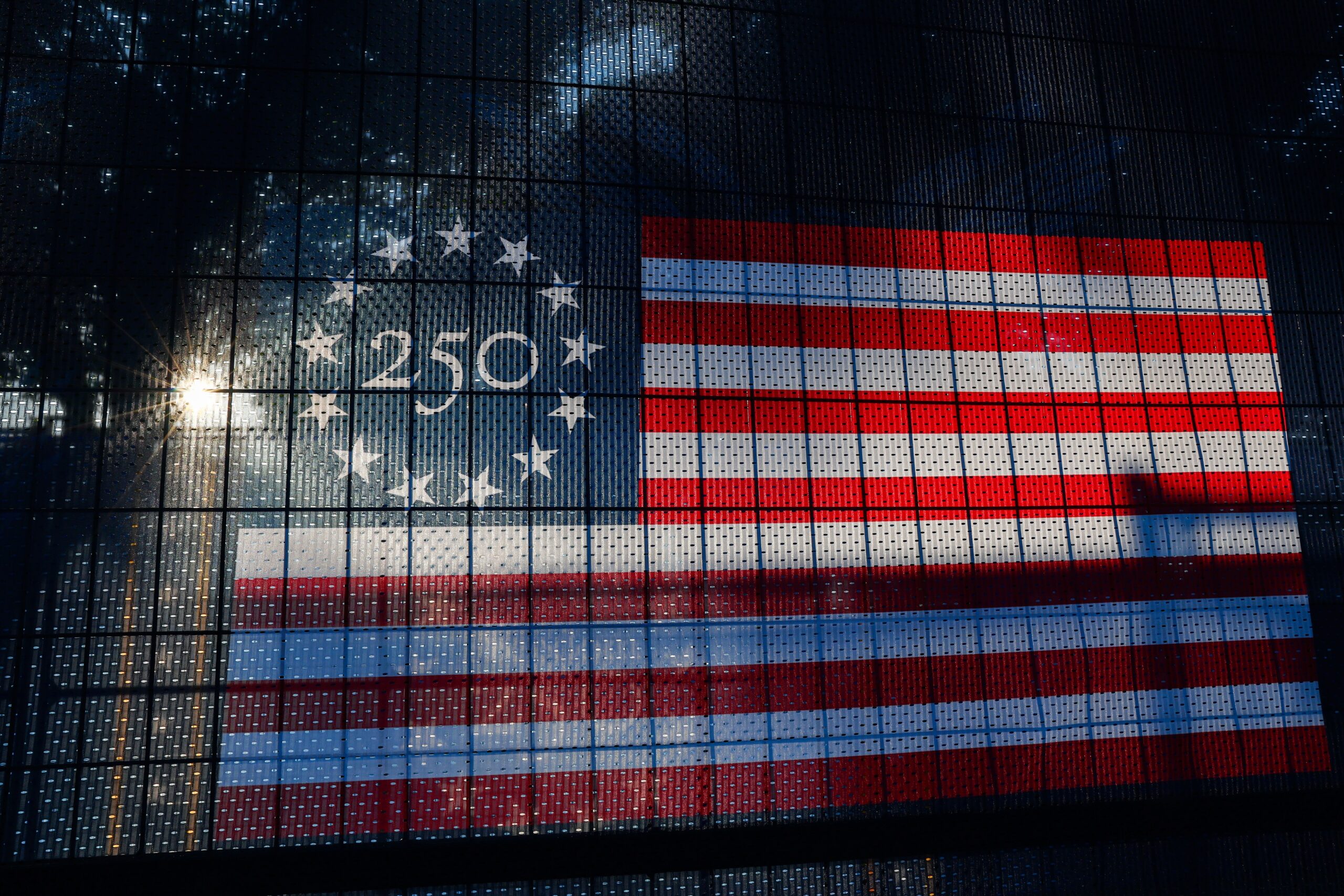
Dawn had just cracked on America’s 250th birthday when a couple from Texas jogged past a sign outside the U.S. Capitol that read “POLICE LINE — DO NOT CROSS.” It was the start of a day that did not go according to plan.
Visitors in red, white and blue darkened with sweat stood in lines for hours, sometimes screaming in frustration and other times collapsing from exhaustion. The Independence Day parade was canceled and the Great American State Fair delayed. Steel fences and closed roads made photos of iconic monuments hard to capture. Both white supremacists and liberal activists marched through the city, each demanding their country back.
And a severe weather warning in the early evening, just before Air Force One flew over, prompted Secret Service officials to order thousands of people to evacuate the Mall, forcing a chaotic scramble for shelter in nearby buildings.
“Show is over. Please keep moving,” one officer shouted to stragglers. As exits backed up and it became unclear where the remaining crowd should head, the evacuation grew increasingly tense. Officers from several agencies ordered people to leave, while some Trump supporters refused to go, chanting “USA!” from the risers.
Dean Twilly, dressed in a red Make America Great Again shirt, said she was frightened when she saw a Secret Service officer throwing chairs in an effort to get people to leave. “They were mad because people weren’t moving out fast enough,” said Twilly, who had waited six hours to get into the event after traveling 700 miles from Cullman, Alabama.
Just after 9 p.m., officials said that the gates would reopen at 9:45 p.m. and that President Donald Trump would speak at 11 p.m.
Many hours before all that, Diane and Bill Riggs, the Texas couple whose foreheads were beaded with perspiration, decided not to let the barriers, physical or meteorological, spoil their run on this landmark occasion.
Diane wore a shirt with a slogan she proudly described as obnoxious: “Sorry I can’t hear you over the sound of my freedom.”
That ideal, Diane said, is what makes this day and this place special.
“That was the establishment of the greatest country in the world — the one that decided to take a stand and end slavery, and did it, followed through. Who decided to put a man on the moon and did it, followed through,” she said. “I’m allowed to say things like this … allowed to be Jewish, Buddhist, Presbyterian, whatever I want. … Very few other countries have those.”
It was not Diane’s first time in D.C. for an important birthday. As a 6-year-old, she’d visited for America’s 200th anniversary, just after the end of the Vietnam War. That, too, was a tumultuous time, but in her mind all she could see were families sprawled across blankets on the lawn and, in every direction, the colors of patriotism she’d come to glimpse once again.
Like Diane and Bill, thousands of Americans in pursuit of some happiness, or at least some history, arrived this week in their broiling capital to celebrate the anniversary of an indivisible nation that remains deeply divided. At a time when national pride has reached its lowest point since Gallup started asking people about it 25 years ago, awaiting the crowds in D.C. was the promise of a spectacle intended to allay the disunity: rodeos, concerts, reenactments, speeches, parades, a sprawling fair, burgers and dogs and $12 Bud Lights, ear-popping flyovers and, for the planned late-night finale, some 850,000 fireworks.
Not all of it happened at Washington’s semiquincentennial commemoration, largely thanks to an oppressive heat wave that pushed temperatures beyond 100 degrees.
All over the eastern half of the country, the ill-timed summer swelter forced cities, small and large, to abandon plans. From Madison, Alabama, (in Madison County, named for Founding Father James Madison) to Philadelphia (the site of the Declaration of Independence’s signing), parades to celebrate those rich pasts were scuttled.
In hundreds of other communities, though, celebrants appeared undeterred.
In small-town New Pekin, Indiana, residents still pulled a 50-year-old time capsule from the earth, and in big-city Boston, the Pops still planned to perform along the Charles River. On stages in Nashville, some of the country’s most popular performers were ready to take stages for a free show, and on nine buildings along the Las Vegas Strip, rooftops were loaded with pyrotechnics.
For the first time in New York’s history, the iconic Times Square Ball dropped on a day other than New Year’s Eve, drawing thousands at midnight. Later, beneath a cloudless sky in New York Harbor, tall sailing ships from around the world cruised past the Statue of Liberty.
America250 — the bipartisan group tasked by Congress with planning the day’s festivities before Trump started his own effort — pressed ahead with events around the country, anchored by a benefit concert at the Los Angeles Memorial Coliseum.
In Washington, where most of the revelry has been organized by Trump’s Freedom 250 team, many visitors found that the robust security didn’t help the mood. Dozens of roads were closed, and the National Mall was largely impenetrable this morning. Tourists who wanted one of those iconic, golden-hour photos at the Lincoln Memorial had to snap them through fences.
“Can we pass through here?” a woman, dressed in a shirt with red and blue glitter and rhinestones, asked a National Guard member at the corner of Constitution Avenue and 14th Street.
“No, ma’am,” he said, “Only volunteers and authorized personnel.”
In a nearby line to get into the fair, where some people shuffled toward security for more than two hours, a sudden sense of indignation swept through the crowd when they caught would-be cutters trying to slip by.
“We live in a society,” a blond man in a “Stop Hate” shirt hectored the violators. “Americans wait in line.”
But for all the frustration, thousands of the president’s supporters would not give up or flee to air-conditioned Smithsonians, embracing the upbeat view from his midafternoon Truth Social post.
“The love of our Country has never been stronger!” Trump wrote.
On the edge of the Mall, Monica Horvath slid her shoes down and peeled off her socks.
She longed to get into the area where she could see the fireworks. But now everything was sore, so she sat on an empty patch of sidewalk. Her friend, Scott Williams, crumpled next to her, holding a cigarette in one hand and trying to fan her with the other.
“I’ve waited overnight to hear Trump. I’ve slept in my car to see him. But this is hard,” Horvath said, dabbing her face with a damp cloth she had borrowed from her hotel bathroom. Williams nodded.
The duo, both 63, had driven from Staten Island. Her parents emigrated from Europe, teaching themselves English with the help of television and radio. They believed in the American Dream and she wanted to, too.
She remembered the bicentennial and how it seemed like there was a party on every block, decorations on every street. “Everywhere you looked, it was all patriotism,” said Horvath, a court stenographer. The country didn’t feel like that anymore.
Now she craned her neck to spot the hourly flyover slicing through the bright blue sky.
“That’s what I came to see,” she said. “The president, the planes and the fireworks.”
On the other side of the fences, past a scaled-down version of the 250-foot-tall arch that Trump hopes to construct near the Potomac River, those who had cleared security sat on a small set of bleachers overlooking “Rodeo 250″ to vape and snack and get a better view of the jets that drowned out the country music.
On the other side of the Anacostia River, a far smaller crowd gathered on a Southeast Washington hilltop to remember a divergent take on what it means to be free in America.
“I say it with a sad sense of the disparity between us. I am not included within the pale of this glorious anniversary,” a 13-year-old girl from Canada read, quoting from Frederick Douglass’s 1852 address. “What to the Slave is the Fourth of July?”
“The blessings in which you, this day, rejoice,” Saanvi Jahagirdar read, “are not enjoyed in common.”
Outside the National Archives, where hundreds had gathered to watch the annual reading of the Declaration, organizers’ sudden decision to move the ceremony inside infuriated many in the crowd who feared they wouldn’t get to witness a historic retelling of a historic moment.
“Whoever is responsible for this mess should be fired,” said a woman in an American flag bucket hat who identified herself only as Regina R.
After more demands, she was removed by security.
Among those quietly suffering were Noël Bitner, 79, and her daughter, Tabitha Frawley. Noël, from New Orleans, had waited for three hours but didn’t regret coming. In a way, she’d been waiting much longer to witness the reading.
In 1977, she longed to come to D.C. on July Fourth, but with two young children and all of the upheaval in the city, her husband wouldn’t let her. Now that her daughter, who serves in the U.S. Coast Guard, lives in D.C., she got another chance.
“The reading of the Declaration — that performance was excellent,” she said. She had one additional note, though: “They had a few too many politicians speak.”
Small protests popped up throughout the day. One group lugged a 700-foot banner that read “We the People” down Pennsylvania Avenue, condemning the president. About 50 people with another group, “Refuse Fascism,” marched toward the White House, demanding that Trump leave office.
The earliest signs of dissent bubbled up in the morning, when hundreds of uniformed members of Patriot Front, a white-supremacist group, marched toward the U.S. Capitol. Their faces covered in white masks, the men beat drums and carried flags — some upside down, others Confederate — as they chanted, “Reclaim America!” Many gripped combat shields as they passed the Capitol building.
At Union Station, they stopped for a demonstration.
“The only way to secure our existence is to become all that we aspire to be,” declared founder Thomas Rousseau. “Our national independence was seized by a natural aristocracy of our people, the best of our Anglo-Saxon blood.”
Around 9:45 a.m., Jennifer Wood was working at a book shop in the Eastern Market neighborhood when she saw the Patriot Front members marching down Pennsylvania Avenue. Enraged, she ran outside.
“Go away!” she shouted, demanding that they uncover their faces. “Cowards!”
Twenty miles south, a very different vision of America’s future unfolded at Mount Vernon.
Ahmed Ajghiouan, a federal contractor originally from Morocco, hoisted his 17-month-old daughter, Assil, onto his hip, whispered good luck to his wife, and took off after his 6-year-old, Yakoub. Fatema Ezzahrae Zouhri, 33, brushed rivulets of sweat from her forehead. Someone with a microphone told her to stand, and she rose alongside 149 strangers from 50 countries, gathered for a naturalization ceremony at George Washington’s former home.
She had felt sure this moment would never come.
After nearly seven years in this country, Zouhri still called her English “broken,” but she knew enough to follow the basics of Trump’s attempts to limit birthright citizenship. The president, she understood, wanted to make it harder to become an American citizen.
As the stay-at-home mother slogged through the nearly nine-month application process, she thought about her children. Yakoub could become a pilot someday, Zouhri hoped. And Assil, in a pink princess dress for her mother’s special day, might become a doctor.
But not, Zouhri believed, if the family had to return to Morocco, where opportunities were few.
Now, right hand aloft, Zouhri repeated the words, swearing allegiance to the Constitution and laws of the United States.
“America is ours,” Doug Bradburn, president and CEO of George Washington’s Mount Vernon, told Zouhri and the other new citizens. “Let’s make the best of it together.”
So — after the last warbling notes of “God Bless America,” after she’d found her husband and children amid hundreds of milling, dripping spectators — Zouhri headed toward the station where, she’d been told, she could register to vote. As soon as possible, she planned to cast her ballot for anyone who opposed the president.
Walking faster, Zouhri gripped Yakoub with one hand and her citizenship papers with the other. No one, she thought, could take it away from her now.
Stella Canino-Quiñones, Maegan Vazquez, Myla S. Roundy, Ela Jalil, Taylor Swinton, Scott Nover, Cole Reynolds and Hannah Knowles contributed to this report.