

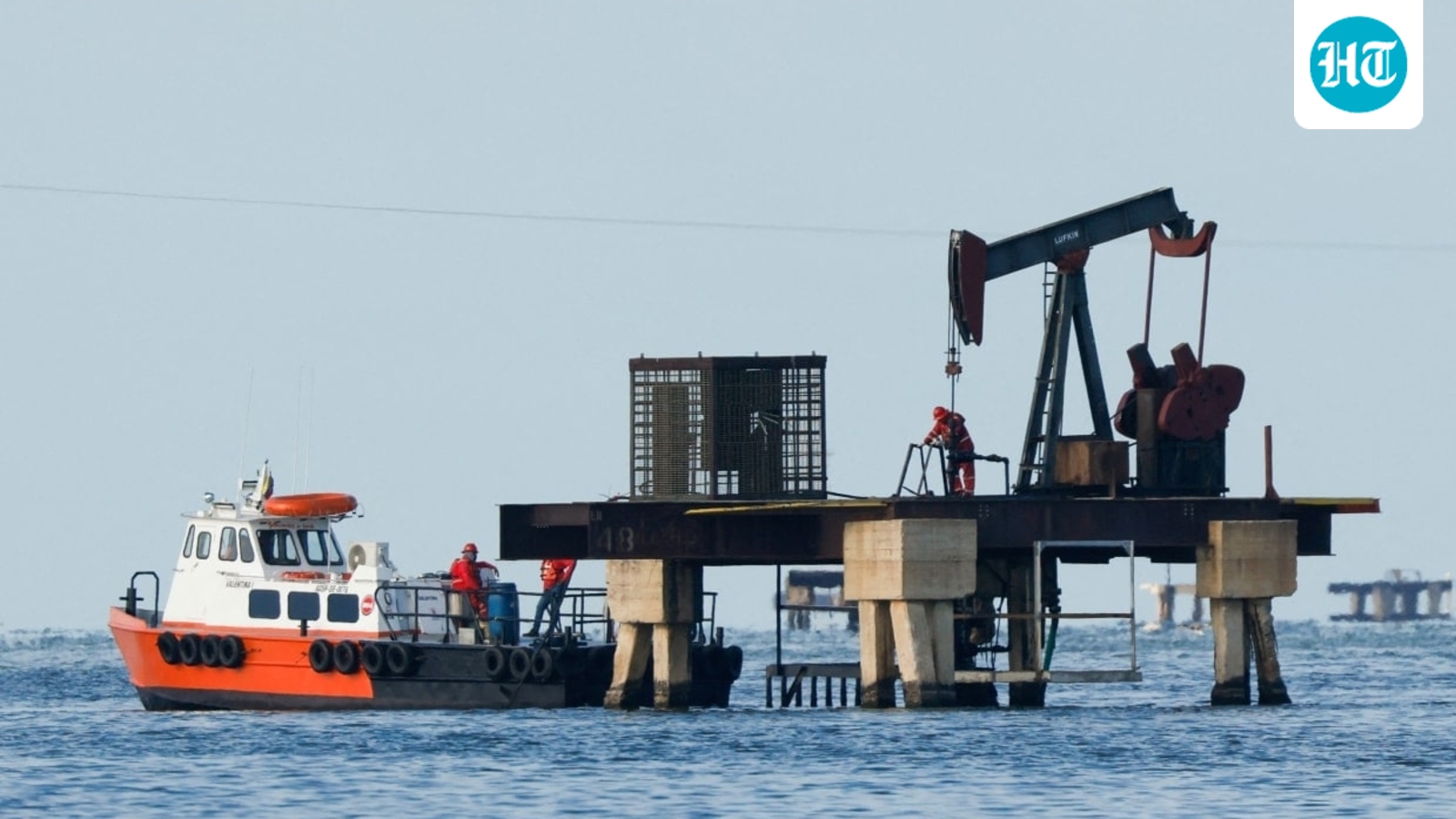
Seven months after the U.S. deposed strongman Nicolás Maduro, Big Oil has yet to make any big moves in Venezuela.
ExxonMobil, Chevron and other major oil companies are fighting for a small number of the country’s most attractive drilling spots, but some of the talks with Venezuelan leaders recently hit an impasse, according to people familiar with the negotiations.
President Trump and his lieutenants had high hopes that big U.S. oil companies would quickly sign investment deals to kick-start production in Venezuela, home to some of the world’s largest reserves. They see the country’s rising oil exports as a boon to U.S. supplies while Iran hobbles shipping lanes in the Middle East that typically carry 20% of the world’s oil and gas.
The administration is also putting pressure on interim President Delcy Rodriguez to boost Venezuela’s production quickly—before the end of Trump’s second term.
Among the issues that have handicapped any big deals: Major U.S. oil producers are interested in many of the same prized assets, including fields in eastern Venezuela’s Orinoco Belt and the northeastern state of Monagas—and they want to secure the most favorable fiscal and regulatory terms possible. The devastating earthquake that shook the country last month also slowed the progress.
“Few of them are really jumping into the water,” said José Ignacio Hernández, a law professor and consultant at advisory firm Aurora Macro Strategies. “It’s like when you’re trying to sell your house. You have a very successful open house with 100 people attending, but then nobody calls.”
The negotiations are largely being led by state-run Petróleos de Venezuela, which is holding separate meetings with companies and making private offerings. Some of the American companies, which are more accustomed to public bidding processes, have requested U.S. officials intervene. So far, the administration has let the process play out without choosing any winners.
Some U.S. executives worry their long-term investments could be undermined by political instability in the future and say PdVSA isn’t in a position to assuage those fears, the people familiar with the talks say. In some cases, debt repayments, tied to the expropriation of their assets two decades ago under Hugo Chávez, have yet to be resolved.
White House spokeswoman Taylor Rogers said the Energy Department is “facilitating unprecedented investment in Venezuela to restore its energy infrastructure.”
Despite their reluctance to move quickly in Venezuela, many executives say the potential prizes are huge, particularly for companies that typically drill in places that can pump oil for decades.
Among the sites Exxon, Chevron and others are studying most closely is the Carabobo oil region in the Orinoco Belt, the people said. The area has massive reserves of heavy, viscous crude that U.S. refineries greatly prefer over other kinds of oil.
In the state of Monagas, the companies are vying for access to two fields—one near the town of El Furrial and another near Punta de Mata—that produce a type of lighter crude that they could use as a diluent to blend with the heavier crude produced across Venezuela.
Exxon, whose CEO Darren Woods called Venezuela “uninvestable” in January, has run both hot and cold in Venezuela deal talks, the people said. The company pursued acquiring rights to several attractive fields but pulled back when Venezuela offered only a few of the fields it wanted to invest in, one of the people said.
Exxon has run into myriad challenges. It found devastating damage to Cerro Negro, the project it operated before 2007 when its infrastructure was nationalized. Restarting the field is projected to cost billions of dollars.
Meanwhile, Chevron—the only U.S. oil major currently active in Venezuela—is advocating that the country keep pushing to create a more competitive landscape for foreign investments. It has boosted production to a record of nearly 300,000 barrels a day since Maduro’s ouster but is doing so via efficiencies within its reach, rather than new billion-dollar investments.
In total, Venezuela’s production climbed to 1.07 million barrels a day in June, up from 937,000 barrels on average last year, according to the Organization of the Petroleum Exporting Countries. It peaked at 3.4 million barrels a day in 1998, according to Rice University’s Baker Institute for Public Policy.
Senior Trump administration officials say they still believe Big Oil will play an important role in boosting Venezuela’s production long term. Meanwhile, though, they are turning their attention to a group of smaller private companies that they think can get oil pumping more quickly.
Some of those are companies led by fierce allies of Trump, such as billionaires Harold Hamm, Jeff Hildebrand and Ross Perot Jr. Perot’s HKN Energy signed a preliminary deal to invest in Venezuela, as did privately held Hunt Oil and Crossover Energy.
For Venezuela’s interim government, those wildcatters are seen as being able to offer what it needs most: quick access to cash.
Administration officials seem “open to the idea that anyone who wants to do it should do it,” said Schreiner Parker, an analyst at consulting firm Rystad Energy. “The issue is these Orinoco Belt heavy oil projects are like deep water developments. They are capital intensive and require long-term planning, and an ability to hold your breath for a while.”
PdVSA recently circulated among industry participants a list of two dozen production-sharing agreements it was deliberating with foreign oil companies, according to a person close to the situation. Such deals are more attractive to smaller wildcatters than big oil companies, which are more interested in securing reserves.
Among those on the list was Pacific Coast Energy, a little-known California firm that invests in mature onshore fields. The arrangement would give Pacific Coast Energy access to several oil fields, including some identified as among the country’s most prized, the person said.
For Big Oil, the past still looms large. Exxon and ConocoPhillips sued Venezuela after the country nationalized their assets. Conoco is still seeking $12 billion in restitution; Exxon, $1 billion. Venezuela also nationalized Exxon’s assets there in 1976.
“They have been burned twice,” said Francisco Monaldi, director of the Latin America energy program at the Baker Institute. “I imagine this getting to the board and people saying, ‘Didn’t we learn our lesson here?’ The only way management can sell this is if, you know, you’re getting the asset that nobody thought they could get.”
Write to Collin Eaton at [email protected] and Kejal Vyas at [email protected]