

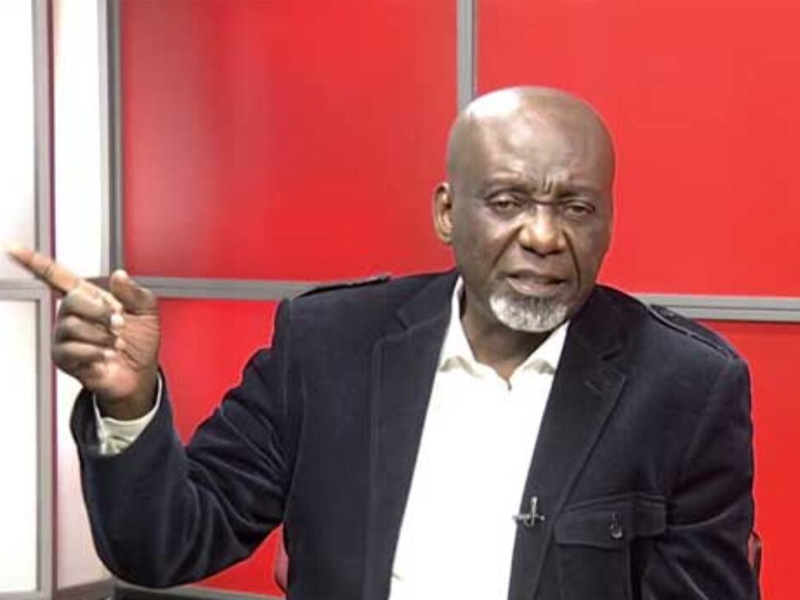
Author and retired assistant director of the Department of State Services, (DSS), Dennis Amachree, has defended his account of the death of former Head of State, General Sani Abacha, saying it is intended to put an end to longstanding conspiracy theories.
He said this while speaking during an interview with ARISE NEWS on Monday. According to Amachree, his version is based on an eyewitness account he personally investigated and forms part of the DSS’s conclusions into Abacha’s death.
This follows the release of his memoir, DSS @40: My Journey Behind the Shield, in which the retired intelligence officer offers his account of the circumstances surrounding the death of former Head of State, General Sani Abacha, and argues that it dispels long-standing conspiracy theories.
He said, “I think my account is there to put to rest all the conspiracy theories of how the former head of state died. It is not a case of waiting 27 years; this information was ready right on the day he died.”
“My colleagues and I were laughing when we saw news about Indian ladies with poisoned apples and all the rest. That was the imagination of either somebody or some journalist who wanted to manufacture a story.
“You have to know that when you want to find out something, the most reliable account of any event is an eyewitness account. This particular lady was right there when it happened. I interrogated her myself, and I don’t have any doubt that what she was telling me was true,” he insisted.
Responding to questions about whether his account reflected his personal recollection or the official findings of the DSS investigation, Amachree said his conclusions formed part of the agency’s investigative outcome.
“My conclusion is part of the DSS conclusion of the investigation. After I finished interrogating her, she was sent back to Abuja with the interrogation report. They looked at the circumstances of his death, she was kept for a while, and then released because her story about the last minutes of what happened rhymed with what I’m telling you now. If it were different, I think she would have been arrested, prosecuted, and maybe jailed,” he said.
Declining to discuss or produce the DSS’s final investigative report, Amachree said he was only sharing “a snippet” of his interrogation report and would not disclose official files, while dismissing suggestions that details surrounding Abacha’s death remain classified, arguing that there is “nothing classified” about the death or illness of a president.
“We don’t do that. I am giving you just a snippet of the interrogation report. I’m not going to open the files and bring the report to you. Let me clear this up: some people have said that it might be classified. There is nothing classified about the death of a president, or a sickness of a president—any president at all,” he stated.
Amachree further said his memoir was intended to counter competing narratives about Abacha’s death, while noting that Nigeria’s intelligence agencies have traditionally operated under a “code of silence” and rarely disclose operational details to the public.
“Security agencies don’t come around to start telling you details about their job or what happened. This is one of the first memoirs—or the second, actually—that has been written by retired officers of the DSS. In other climes, you see security agencies write a lot about their operational activities; here in the United States, they even make films about them.
“In Nigeria, we’ve had a code of silence where the organization hasn’t been saying anything until now. It’s a welcome idea. Nigerians need to know what their intelligence agency is doing. You can see that gradually, we are discussing things that happen in intelligence circles. I think this is a welcome idea, and I thank the Director General of the DSS for allowing this to come to the public,” Amachree remarked.
Challenging alternative accounts of Abacha’s death, Amachree said there were gaps in the versions presented by some individuals, including former Chief Security Officer Major Hamza Al-Mustapha. He urged Al-Mustapha to produce the footage he claims to possess and questioned why such material would remain in his custody. Amachree also referred to the arrest of two women following Abacha’s death, suggesting their detention was relevant to the investigation, but declined to elaborate, saying he did not wish to “join issues” with Al-Mustapha.
“All these people were giving their own versions of the story. But from their own accounts, I know there is a window of what they don’t know. Major Al-Mustapha could say that I am lying, but I would want him to bring the footage he claims to have and show it. I don’t know why he would be holding official footage in his possession.
“If you have a chance to talk to him, please ask him: Were two ladies arrested after the death of Abacha? Was one arrested in Lagos and one in Abuja? If he says yes, then ask him why they were arrested,” he said.
Turning to Nigeria’s security vetting process, the former DSS assistant director said intelligence agencies provide background reports on prospective appointees but do not determine whether they are appointed.
“When it comes to vetting, that’s one thing the DSS does for the government: anybody who is going to be appointed will be vetted by the DSS, and all the information about that person is deposited with the DSS. The government itself is given a vetting report, but it does not have to take the report of the DSS, the police, or anybody else. Intelligence reports are given to government, and government then decides what to do about it,” he disclosed.
Referring to former Minister of Communications and Digital Economy, Isa Ali Pantami, he said he believed the DSS had submitted its vetting report to the government, which ultimately decided to proceed with the appointment. According to Amachree, intelligence reports are advisory, with the final decision resting with the government after weighing various political and administrative considerations.
“In the case of Pantami, I think it was The Punch that interviewed me. They asked why Pantami was appointed minister when his background shows he has sympathies with terrorist organizations. They asked whether that was an intelligence failure or if the DSS had failed in reporting to government. I told them very clearly: the DSS can never dictate to government whether to appoint somebody or not.
“I believe strongly that Pantami’s report was sent to government, and government decided what they wanted to do with it,” he maintained.
Urging the the government to place greater reliance on intelligence agencies in policymaking, Amachree argued that bodies such as the DSS and the National Intelligence Agency (NIA) provide objective assessments free from political, ethnic, or religious considerations.
He said Nigeria already possesses the information needed to address its challenges, but urged leaders to prioritise intelligence over partisan and regional interests.
“FG should listen to the DSS, the NIA, and the intelligence community. They will give you exactly what you need as a roadmap to success because they are the repository of information of national interest, devoid of emotion, religion, or ethnicity. We have it already. Government should look at that rather than party affiliations or regional nuances. That is what is holding us back,” he concluded.
Favour Odima
Follow us on: