

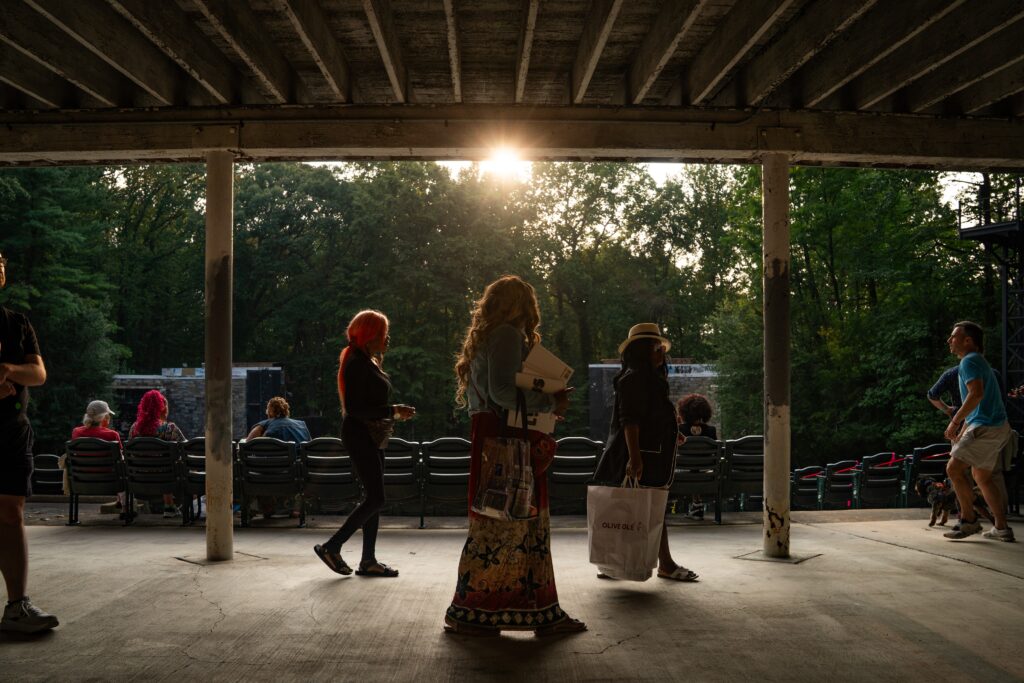
For a decade, the Carter Barron Amphitheatre has been silent. In 2017, the stage where Ella Fitzgerald, Bruce Springsteen and Earth, Wind & Fire had performed, tucked into a wooded glen in Rock Creek Park, was declared structurally unsound, unable to support musicians and equipment. It has been off-limits ever since, with an estimated $40 million projected for restoration and rebuilding of the entire site.
But for three days next month, the sounds of jazz and go-go and gospel will again fill the air at the Northwest Washington venue during the Summer in the Parks concert series. The lineup includes the Prelude to the D.C. Jazz Festival, with saxophonist Paul Carr and the Jazz DC All-Stars (Aug. 20); a night with Sylver Logan Sharp, best known as the lead vocalist of Chic for two decades (Aug. 21); and the pairing of Black Alley, a D.C. group acclaimed for its fusion of go-go and rock, with the gospel sounds of Chester Burke Jr. & Company (Aug. 22).
For Dan Puskar, the executive director of the nonprofit Rock Creek Conservancy, which supports Rock Creek Park, the catalyst for the new series was last August’s celebration of Carter Barron’s 75th anniversary. The National Park Service, which manages the venue, and the Rock Creek Conservancy invited the community for an evening of music and storytelling.
“We opened the doors and hundreds of people streamed through on a Thursday, even though there wasn’t a performance of any kind there,” Puskar says. “The reception, the desire to get back there was so palpable.”
Yet, he admits, “a lot of work is needed — and remains needed — for the site to truly come back to the amazing venue that it was.”
The lack of a functional stage is the biggest reason the venue has been closed for so long, so the experience over these three concerts won’t be the same as during Carter Barron’s heyday, or even 10 years ago.
“We have to construct our own temporary stage on top of the aisle and seating area closest to the stage, because we can’t use the one that was built in 1950,” Puskar says. “We won’t be able to open the gates to 4,000-plus people, because there are no regularly working restrooms.” (Expect to find “a ton” of portable toilets.)
There may or may not be concession stands, so attendees are encouraged to bring a picnic to enjoy before the show, though alcoholic beverages, glass bottles and coolers are among the items not allowed into the amphitheater.
Summer in the Parks is a collaboration between the Rock Creek Conservancy, the Park Service, the D.C. Jazz Festival and Washington Performing Arts. The latter two are members of the Carter Barron Alliance, a group of arts organizations dedicated to restoring the amphitheater. The series draws its name from the Park Service’s Summer in the Parks series, created in 1968 to bring communities together after the riots that tore through D.C. that spring.
There’s a lot of history in these woods. The Carter Barron Amphitheatre, then called the Sesquicentennial Amphitheatre, opened in 1950. It hosted outdoor dramas, ballet and productions such as “Show Boat” before becoming a popular outdoor concert venue, with such headliners as Louis Armstrong, Diana Ross and the Supremes, Harry Belafonte, Richard Pryor and Kris Kristofferson over the decades. Unlike other concert halls, it was always integrated.
The Park Service’s official history of Carter Barron says that the venue faced challenges beginning in the 1970s, thanks to competition from Merriweather Post Pavilion and Wolf Trap. But it kept reinventing itself: From 1991 through 2009, it was the home of the Shakespeare Theatre Company’s “Free for All,” an annual staging of free Shakespeare plays that attracted thousands. In 1999, the STC told The Washington Post that more than 40,000 people attended 13 performances of “The Merry Wives of Windsor.” From 1993 to 2015, The Post sponsored free concerts, including a series called “Weekend’s Weekends,” featuring local reggae, rock and neo-soul artists.
Black Alley was one of those bands. The group headlined a Post-sponsored show in August 2014, which, its members say, people are still talking about more than a decade later.
“We had only been a band for maybe four years,” says vocalist Kacey Williams McClain. “It sounds like a long time, but now that we look back, I think that’s when we really felt like we had a fan base.”
The group performed its signature “hood rock” — deep grooves melding go-go, rap, traditional rock instruments and soulful vocals — with help from friends, including Tre of UCB and Weensey of Backyard Band.
“One thing I remember in particular is just the applause,” says drummer Danny “Animal” Henderson. “At that point in time, I don’t think I’d ever heard applause that loud. That was really, really awesome to me, that so many people cared about us at that time, in our younger stages, and came to the Carter Barron to see us.”
The group credits that experience, in front of thousands of people, as a foundational moment that helped them grow as artists, and one they’re looking forward to repeating.
“Performing at the Carter Barron again makes it full circle,” Henderson says. “It has been a real cornerstone in Washington, D.C. It’s a special place, when you talk about bands like Earth, Wind & Fire and people like Roberta Flack. It’s just awesome that we get to be a part of the reopening, and this history.”
More than any one act, though, the small festival is about the experience of revisiting Carter Barron. Newer residents haven’t experienced the ritual of walking from the bus stop at 16th Street and Colorado Avenue over to the park and entering a trail into the woods. Then walking through a shaded picnic grove, deeper into the trees, until Carter Barron emerges, a true theater in the woods, with the stage and semicircle of seats surrounded by nature on all sides, including a canopy of leaves overhead. It’s hard to believe that you’re so close to one of the city’s busiest thoroughfares.
“We hope that by creating more Carter Barron experiences, by giving people the chance to not just rely on the memories they have from more than a decade ago,” Puskar says, “that we’ll keep that passion alive for this place as we wait for all of the processes and challenges related to the full-fledged revitalization and major construction work getting done.”
Of course, this festival is just three nights, while the old Summer in the Parks programs ran for weeks or months. Nothing is finalized, but if this “pilot” program goes well, music and other arts could possibly return more often in 2027.
Right now, though, Puskar is excited for the return of a piece of “the historic fabric of our city,” noting that the venue was built to celebrate the 150th anniversary of the nation’s capital.
“I’m very excited that in the year we’re celebrating America 250, that we can bring back to the people, at least for a couple of nights, a place that was a gift to Washingtonians to celebrate what they are, and all that entails,” he says. “And to do it for the first time in a decade — it’s amazing.”
Tickets are available now for Summer in the Parks, Aug. 20-22. Gates open at 5 p.m. each night, with shows from 6 to 9 p.m. Carter Barron Amphitheatre, entrance at 4850 Colorado Ave. NW. rockcreekconservancy.org. $16.54; Children age 2 and younger do not need a ticket, but must sit on an adult’s lap.