

A rope stretched across a bridge. That was all Uganda needed to show that its border with the Democratic Republic of Congo was closed.
Until recently, the bridge over the Lamia river bustled with activity. Ugandan farmers crossed to tend their crops in Congo, where land is cheaper. Every morning, Congolese children in bright uniforms walked across the bridge to attend village schools in Uganda.
But traffic across the bridge came to a standstill in May, as Uganda declared its border of more than 500 miles with Congo was closed, days after the World Health Organization declared a new outbreak in eastern Congo.
A soldier seated on a plastic chair was the only sign of life on the Ugandan side on a recent afternoon. On the Congolese side, a group of women washed clothes in the river and laid them on rocks to dry.
“People used to cross into Congo to get cassava and bananas and carry them on their backs,” said Mugaazu Philip, a Ugandan intelligence official who sat in a hut scanning the river recently. “But since the closure, nobody has come across.”
The Ebola outbreak has particular resonance in Bundibugyo, a small Ugandan town near the Lamia. In 2007, scientists here discovered the first appearance of an unusual Ebola species and named it after the town.
This year, the Bundibugyo virus returned, this time in eastern Congo. The species is so rare that it caught health officials off guard. They had been testing for more common types of Ebola. Those initial tests came back negative. It wasn’t until later that they learned Bundibugyo was responsible for the outbreak.
Uganda hastily closed its border with Congo. The World Health Organization said this month that the virus has killed more than 1,000 people and infected at least 2,400 in Congo but warned the country’s real numbers may be two to four times higher.
The new outbreak has revived painful memories for health workers in Bundibugyo, who watched their colleagues die nearly two decades ago of a disease that was only identified as Ebola weeks after it first appeared.
Ezekiel Kisughu, a nurse at Bundibugyo’s hospital, was infected in October 2007 while treating the head of the local Red Cross, who had been brought to the hospital desperately ill.
“People thought it might be poison,” he said. “We called it the ‘unknown disease.’” None of the nurses had protective gear and there was no information, he recalled. The patients died and one by one the nurses started to fall sick and perish. Then came Mr. Kisughu’s turn.
He said he barely survived and that the illness was so traumatic that he remembers the exact date he was discharged: Dec. 7, 2007. The W.H.O. announced that the town was dealing with an Ebola outbreak while he was still in the hospital, he said.
For months after his release, he said the town treated him as a pariah because of the stigma of the disease.
Much has changed in the town since then. Uganda has developed a global reputation for its efficiency in containing infectious diseases, including H.I.V., Covid-19 and Ebola. While the disease is raging through communities in Congo, Uganda appears to have it under control.
There have been 20 confirmed Ebola cases in Uganda thus far, but the country has not registered a new case in more than a month. Fifteen of those patients came across the border, some to seek treatment in Ugandan hospitals. Aside from two patients who died, the rest have recovered. The others were quarantined and released, the authorities said this month. Bundibugyo has not recorded a single infection in this outbreak.
“They know how to handle it,” said Dr. Wessam Mankoula, who leads the country’s Ebola response unit at the Africa Centers for Disease Control and Prevention, referring to Ugandan health officials.
The effect of that expertise in Bundibugyo is to see life carry on as normal, despite the threat just across the river, which is often shallow enough to ford.
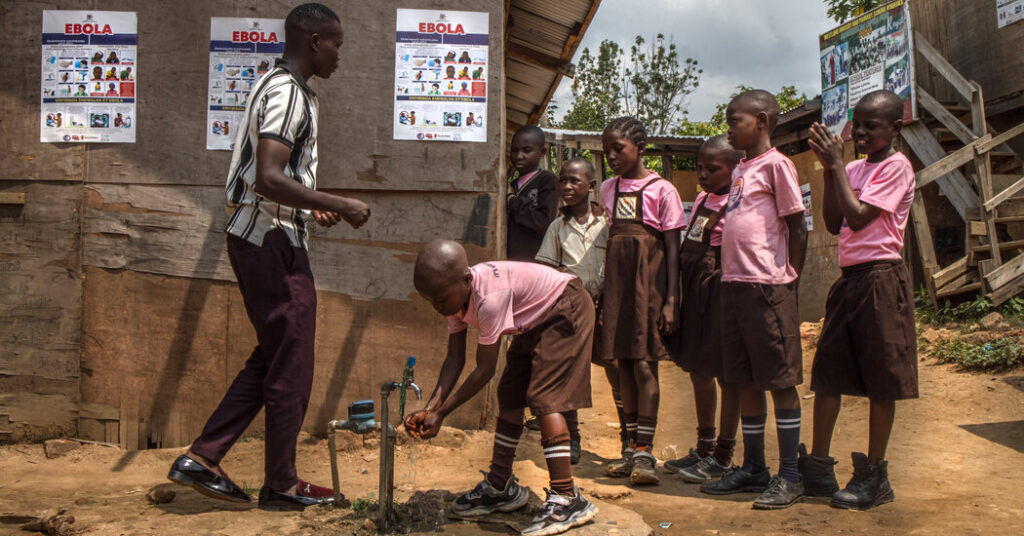
Schools, shops and offices here remain open, though hand-washing stations have been set up at the entrances to public places. Teams play soccer on the field beside the town’s government offices every evening. No one in the town wears a mask.
Christopher Kiyita, the top health officer in Bundibugyo, said that in his 15 years on the job he had faced down several Ebola outbreaks, supported by the national government. He said he regularly drives the nine hours to the capital to attend important meetings.
But the border closure has hit families and businesses in other ways.
International public health experts say that border closures are counterproductive during outbreaks because they penalize countries for coming clean about the virus. The closure remains state policy, even though several residents said it was hurting the economy.
Mirembe Marvin, the head teacher of one modest village primary school, said it was getting difficult to keep the place open. Parents who used to make money across the border are now struggling to pay school fees.
“They are used to trading in Congo, but now they can’t,” he said. One day this month, teachers at the school showed the children how to watch out for signs of Ebola and how to thoroughly wash their hands. They stood in a semicircle in the schoolyard, smearing soap on their fingers and rubbing it under their nails.
Swizen Kyomuhendo, a professor who was born in the town and returned after retirement to open a primary school, said he had at least 70 relatives just across the frontier in Congo who he now cannot see. “Those guys have had decades of ruin,” he said. “There is no evidence of a state.”
But infectious disease is not the only challenge facing the town. There has also been tension between the townspeople in Bundibugyo and inhabitants of the heavily forested lower slopes of the Ruwenzori Mountains, which straddle the border. Rebels who live in the mountains have led deadly raids into Bundibugyo.
Since the initial Ebola outbreak nearly two decades ago, Bundibugyo has been changing.
People are abandoning subsistence farming in favor of cocoa, residents said, driving more people into the cash economy. Cocoa trees, with their distinctive big leaves and bulbous pods, now dominate the landscape around Bundibugyo.
The shift may help explain why people have stopped eating wild animals in the town, including bats and monkeys, the residents said. In addition, the establishment of two nearby national parks has made it harder for people to hunt such wildlife.
Scientists say that fruit bats are the likely reservoir host for Ebola viruses, which can then spread to other animals, including monkeys, and into the human population.
For all the changes, Mr. Kisughu, the nurse, said that proximity to Congo leaves the town — and Uganda — vulnerable.
“The nature of our border is very tricky,” he said. “It is porous and we are dependent on one another.”
Musinguzi Blanshe contributed reporting from Bundibugyo