

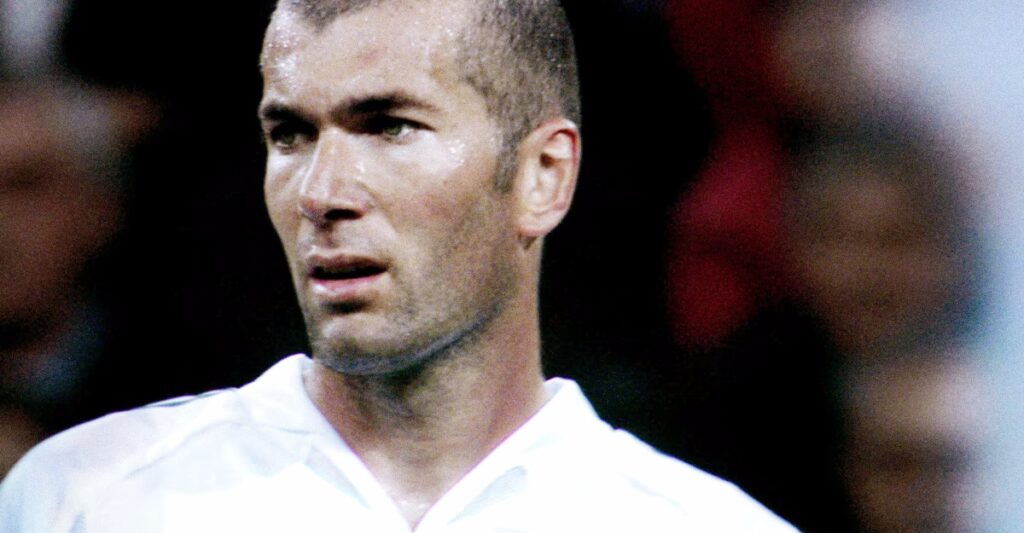
Last week, as I settled into my seat in the dark and blessedly cool basement theater of New York’s Guggenheim Museum to watch an experimental film, I was conscious that in just a few hours, people all over the planet would be turning on TVs and streaming from laptops and phones to see that night’s lineup of World Cup matches. This knowledge was partly what had primed me to view the film Zidane, a 21st Century Portrait; more important was the giddy expectation that I would be closer to one of the legends of the sport than any televised spectacle would allow.
Zinedine Zidane—or Zizou, as he is often called—ranks with Pelé, Diego Maradona, and Lionel Messi as one of the greatest players of all time. I’d last seen Douglas Gordon and Philippe Parreno’s film about him—which the Guggenheim had the good idea of screening this summer—soon after it was made, almost 20 years ago, and I’d found it riveting, if slightly perplexing. This time, I saw clearly: It’s a deeply humane masterpiece.
Most soccer games (allow me a moment to state the obvious) come to us in a standardized format: The camera shows the field from an elevated perspective at the halfway line. Replays in slow motion show the action from different angles, including from overhead or (an unhappy recent innovation) the referee’s body camera. But much of the footage is steady and consistent, designed to maximize our understanding of the game’s patterns and the way one action leads to another. The camera, above all, follows the ball—because the ball is ultimately what tells the story.
Zidane, a 21st Century Portrait is different. Instead of following the ball, the cameras—17 of them, set up around the pitch—follow the man. They follow Zizou. And through this simple switch of focus, the experience of watching soccer is totally transformed. Suddenly, you have no connection with the story of the game, no way to grasp its ebb and flow—the distinctive, dynamic equilibrium of attack and defense that is at the center of every match. All you’re seeing is Zizou.
Gordon and Parreno understand that soccer is spectacle. Their split-screen video work presents a magnetic individual performing in a massive, televised spectacle—a contest between Zidane’s celebrated team of Real Madrid Galácticos and Villareal FC. The game took place at Madrid’s Bernabéu stadium in the spring of 2005, but the film doesn’t really follow the game. Instead, it invites us into a totally fresh relationship with Zizou. It systematically breaks down the aura of legend around Zidane until you, the viewer, begin to identify with him on a level that only great art makes possible.
[Read: When France plays soccer, you can’t look away]
Sometimes the camera focuses on his feet. Other times we see his shadowy, sweat-soaked face in close-up. Here he is walking, now jogging, now running backwards. Very occasionally, he explodes into a brief sprint. The other players (including his legendary teammates Luís Figo, Roberto Carlos, and David Beckham) count for nothing; they flit in and out of the picture like pilot fish in a shark documentary.
If this is spectacle, it’s weirdly illegible (the one thing spectacle is never supposed to be). Parreno and Gordon’s collage aesthetic is designed to undercut the coherent, accessible narratives served up by televised sport. The split screen allows them to show synchronized footage from different perspectives. Like a Cubist painter integrating fractured, shifting views of the same café table, the filmmakers want us to see this very familiar phenomenon with fresh eyes.
So they mix it up. They zoom in and out. Sometimes the footage is blurred, as if Zidane is briefly underwater; other times it’s crisply focused. To keep our attention, Parreno and Gordon splice in snippets of overhead shots or official TV footage. One camera pans up to show us the stadium lights. Another shows us the dark and empty spaces beneath the stands. And the viewer sees the crowd too—sometimes as a great, heaving body, other times as individual figures, each with their own rapt expression.
The film’s sounds are as striking as its visuals. The microphones pick up the rhythmic thwack of leather on leather as Zizou executes a series of short passes with teammates. The audio then switches to the crowd’s chants, the swell of excitement as a promising move is executed, the applause after a missed attempt on goal or a desperate tackle. There’s also a soundtrack by the indie-rock group Mogwai, a sonic emulsion of dreamy, amplified guitars and semi-industrial drones, but this music cuts in and out, so the mood remains fractured.
Parreno and Gordon’s strategy of defamiliarization is so successful that, as you watch, Zidane, instead of being Zizou the legend, the god, slowly takes on the aura of an ordinary man going about his business. And quietly, improbably, the film generates a feeling that its subject could have been anyone—or maybe no one. As Zidane himself said (the quote appears on-screen at the end of the film), “Magic is sometimes very close to nothing at all.”
[Read: Something incredible every single game]
The filmmakers’ approach is counterintuitive because, on the field, Zizou was not at all like you or me. He walked like someone who’d spent most of his life on a horse, but he ran like a lioness, low to the ground, with power and preternatural balance. He seemed to pivot on the spot about three-tenths of a second faster than anyone else. Whereas Messi appears to have the ball on a string, Zidane had it orbiting in the air around him. This was helpful because he played in midfield, where his job was to receive the ball under high pressure and then distribute it to the wings or move it upfield. He was always improvising novel ways of getting out of impossible situations, and many of these escapes (you can see them in any number of highlights reels) had a sleight-of-hand quality.
Because of all this, I’ve started to think of Zidane, a 21st Century Portrait as contemporary art’s equivalent to Albert Camus’ The Stranger. It’s an exercise in existentialism. This association comes with pungent irony because the central act of The Stranger is the killing of an anonymous Arab on a beach in Algiers; Zidane, whose parents came to France from Algeria in 1953, is a protagonist, not a victim, and very close to being the least anonymous man in France.
Even when the ball was nowhere near him, Zizou was charismatic. He grew up in a housing project in La Castellane, a tough, working-class part of Marseilles. He began balding early, so he played for much of his career with something resembling a monk’s tonsure. His furrowed brow could make him look permanently angry. But he has a terrific, high-wattage smile that transforms his shadowy, hunted-looking eyes into mirthful slits. It was that smile that made so many fans love him instantly and deeply. (He finally cracks it near the end of this film, in response to something said by a teammate, and it arrives like a gift.)
Zidane had a 17-year playing career, representing his country and two of Europe’s greatest clubs, Juventus and Real Madrid. He went on to coach Real Madrid to three Union of European Football Associations Champions League trophies. But if you first heard of him only after this film was made, it was probably because of a headbutt—the astonishing eruption of violence that earned him a red card during the 2006 World Cup Final against Italy. Zizou stuck to his plan to retire after that World Cup, so the headbutt was his final act as a player.
If the filmmakers present Zidane as an Everyman equivalent to James Joyce’s Leopold Bloom or Camus’ protagonist Meursault, their approach is fertile because the same questions that hover around Meursault also surround Zizou. Why did Meursault kill the Arab? Why did Zizou headbutt Marco Materazzi? In both cases, the act was an impulsive, existential response with no single cause. Explanations exist, but none feels sufficient—by itself or even combined.
[Read: The other celebration of America]
These speculations are less incidental than they may sound, because the wild thing about Zidane, a 21st Century Portrait is that, although it was filmed more than a year before the World Cup Final fiasco, it ends with Zidane running to join a sideline scuffle and, for his trouble, receiving a red card.
I first went to this film thinking that it would be about the heroism of playing a high-level sport. But its meanings are both deeper and simpler than that. It’s about the heroism and pathos of being authentically human. Watching it, I felt as I do in front of Francis Bacon’s best portraits. Like Parreno and Gordon, Bacon (who studied pictures of cricketers and soccer players) used strong doses of artifice to lead us toward a deeper reality. He distorted his subjects’ features with lurid, lavishly expressive brushstrokes to bypass illustration, which he described as “a long diatribe through the brain,” and hit the nervous system directly.
Embrace the spectacle, Bacon seemed to be saying: Show the figure on the cross, the pope on his throne, the sportsman in the arena. Because only in intense, rarefied states will our illusions finally drop away, like redundant scaffolding, freeing us to perceive life on a more visceral level.
Zidane, a 21st Century Portrait does something similar, just in a different medium. It’s both a portrait of a specific man at work and a portrait of each of us. We get up every morning and go to work. We run around a lot, mostly to little effect. Things happen, or they don’t. People applaud, or they don’t. Someone says something funny, and you laugh. Maybe you run to support a friend only to end up headbutting someone. Suddenly (it was all so beautiful and baffling), your time is up, and you leave the arena.