

It stinks in St. Mary’s. It stinks by the school and its playground. It stinks by the town hall and the post office.
This small town in southeastern Newfoundland, Canada, simply stinks.
How does it stink? “Take the worst rotten fish you’ve ever smelled in your life and times it by 100,” Stephen Ryan, the two-term mayor, said in an interview.
Now a plant is finally getting cleaned up decades after it was abandoned, and the 300 citizens of St. Mary’s will soon be able to breathe free.
The Atlantic Seafood Sauce Company plant, built in 1989-90, stopped operating in the 2000s after Canadian food inspection authorities shut it down, Mr. Ryan said.
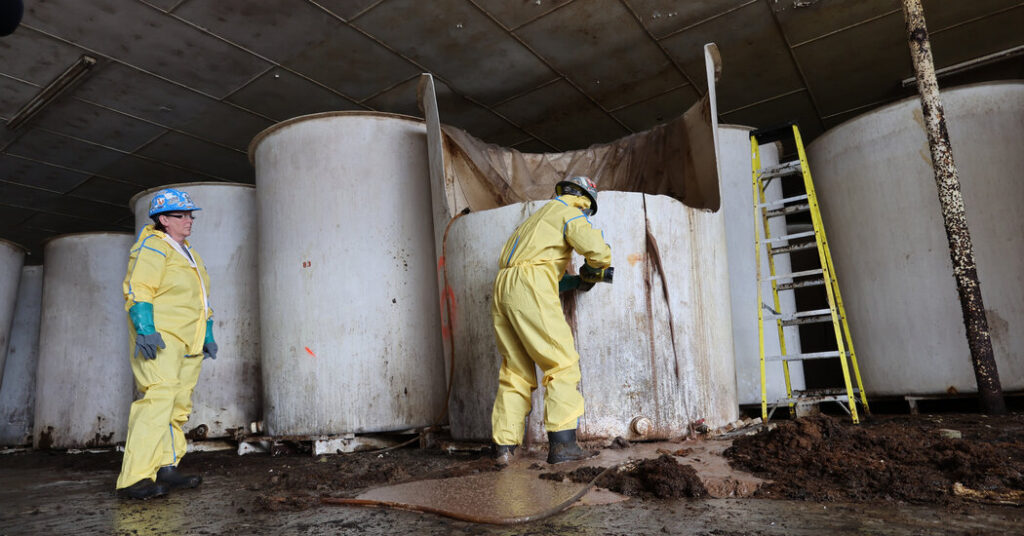
Left behind were 150 3,000-gallon tanks filled with, unfortunately, fish sauce. Those vats have now been sitting at the plant for more than 20 years, their contents fermenting. And fish sauce does not start to smell better with time.
People in the town have been playing a long-running daily lottery on whether they would smell the stench. “Some days you can, some days you can’t, depending on prevailing winds,” Mr. Ryan said.
A plan was hatched a few years ago to dump the tanks into the ocean, and 40 of them were removed. But the federal government put a halt to it.
That left 110 tanks. And things were getting worse: Over the last 10 or 15 years, parts of the plant’s roof have blown open. At the start of this year, a major storm damaged some of the plant’s walls. There was less between the fish sauce and the people; the smell grew worse.
Efforts to fix things stalled. The sauce company couldn’t do it; it was out of business. “Nobody wanted to take ownership,” Mr. Ryan said. “Nobody knew what the ownership would consist of.”
Finally the town government stepped in, a year ago, with a verbal commitment from the province to supply 1.7 million Canadian dollars ($1.2 million U.S.).
The cleanup got underway on Tuesday. First, the tanks are cut open, and the fish sauce — well, more like fish sludge at this point — leaks onto the floor. Peat moss is added to absorb and solidify the goop.
It will then be trucked to a waste disposal area, sealed in rubber liners and buried in the ground. The waste will fill about 200 trucks in all, and the process is expected to take two to three months.
Mr. Ryan, 55, a supermarket owner who serves as the mayor on a volunteer basis, said the beginning of the cleanup was “very rewarding — it’s been almost like a crusade.” He added, “People said you’ll never get it done.”
And in surely one of the more unlikely statements ever made by a public official, Chris Tibbs, the Newfoundland minister of environment, declared, “We couldn’t be more proud than to be standing here today and watching this fish sauce leave this community.”