
Years of Netanyahu crying ‘bomb’, hostage crises and assassinations: Finally, the US and Iran move towards a peace deal

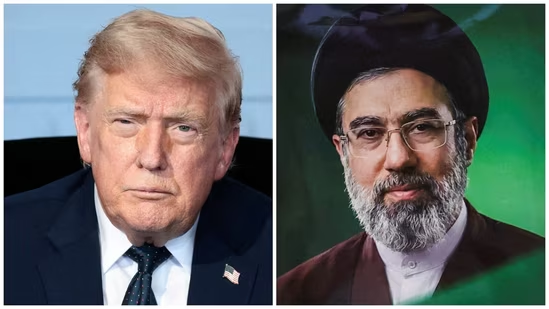
The United States and Iran have reached a tentative peace deal aimed at cooling the long-running war and reopening the Strait of Hormuz, a critical global oil route. A formal signing is expected on Friday in Switzerland. That said, announcements before this have fallen apart and key details of the deal were still being disputed as of Monday. Track live updates
The agreement comes after decades of tension over Iran’s nuclear programme, regional wars, and direct US and Israeli bombardment. For over three decades, Israeli Prime Minister Benjamin Netanyahu has consistently warned that Iran was only months away from developing nuclear weapons. An existential threat to Israel, he called it.
These warnings, going back to the 1990s, have often differed from US intelligence assessments and the International Atomic Energy Agency (IAEA), both of which said Iran stopped its nuclear weapons programme in 2003.
A history of Iran’s nuclear programme:
Early nuclear era (1967-2006)
In 1967, Iran received the Tehran Research Reactor from the US under the “Atoms for Peace” programme. This was the early foundation of its nuclear ambitions.
Things changed in 1979 when the Islamic Revolution overthrew the US-backed Shah Mohammad Reza Pahlavi. Ayatollah Ruhollah Khomeini returned to power, and militants seized the US Embassy in Tehran. It led to a 444-day hostage crisis. Iran’s nuclear programme slowed under international pressure.
In 2002, Western intelligence and an Iranian opposition group exposed a secret enrichment site at Natanz. This raised alarm bells globally.
Negotiations followed in 2003 involving Britain, France and Germany, leading Iran to temporarily suspend uranium enrichment. But by 2006, after Mahmoud Ahmadinejad’s election, Iran resumed enrichment and talks collapsed.
Rising mistrust (2009-2015)
Iran’s disputed 2009 election led to the Green Movement protests and a harsh government crackdown. Around the same time, Washington and Tehran began quiet backchannel talks through Oman.
By 2012, US and Iranian officials were holding secret direct talks.
Those efforts eventually led to the 2015 Joint Comprehensive Plan of Action (JCPOA), a landmark nuclear deal between Iran and world powers. Iran agreed to curb its nuclear programme in exchange for sanctions relief.
Then-US President Barack Obama backed the agreement as a way to prevent Tehran from getting a nuclear weapon without going to war.
Deal collapse (2018-2022)
In 2018, the US under Donald Trump withdrew from the JCPOA, famously calling it a “flawed” agreement. Iran gradually stopped complying and reportedly restarted higher-level enrichment activities.
Tensions boiled over after the US killed Iranian commander Qassem Soleimani in 2020. It was followed by retaliatory Iranian missile strikes on US bases.
Sabotage and cyberattacks hit Iran’s nuclear facilities in 2020 and 2021. Israel was reportedly behind them. On another page, attempts to revive the JCPOA under US President Joe Biden, failed.
By 2022, Iran had significantly expanded its nuclear enrichment and deepened military cooperation with Russia during the war on Ukraine.
Israeli genocide in Gaza
The latest continuous Israeli onslaught in Gaza after the October 2023 Hamas attack drew Iran directly into the fray. Iran, a key backer of Hamas, a Palestinian militant group against Israeli occupation, became heavily integrated into a fast escalating offensive.
By 2024, the regional tinderbox ignited. As Israel squeezed Gaza, Yemen’s Houthi rebels choked vital Red Sea shipping lanes with escalating assaults. In April, Iran attacked Israel in retaliation for Palestine. The Benjamin Netanyahu-led government responded with covert and open strikes on Iranian-linked targets.
Senior Hamas and Hezbollah figures were assassinated. By late 2024, Israel was openly striking Iranian military infrastructure inside the country.
Trump’s return (2025)
With Trump returning to office in January 2025, Washington adopted a more aggressive stance towards Iran.
Indirect talks resumed via Oman and Europe through 2025, involving multiple rounds in Muscat and Rome. Progress remained limited despite repeated meetings.
The US escalated strikes against Houthi forces, and Iran warned against new negotiations.
The 12-Day Israeli war on Iran
In June 2025, for over 12 days, Israel began bombing Iran and infrastructure. Netanyahu said this was due to Iran being very close to making a nuclear weapon.
Trump joined the war and struck major Iranian sites like Natanz, Isfahan and Fordow. Iran responded with missile attacks on a US base in Qatar. The US announced Iran’s nuclear sites were destroyed at the time.
A ceasefire was announced on June 24, 2025, but the region remained unstable. Later diplomatic attempts in Istanbul and Europe failed to produce lasting agreements. Sanctions pressure returned through a “snapback” mechanism by late 2025.
US-Israeli war on Iran (2026)
Indirect talks continued even as tensions peaked. On February 28, Israel and the United States jointly bombed Iran and assassinated their Supreme leader and many top officials in the opening phase.
A US Tomahawk missile also struck an elementary school in Minab where nearly 170 school girls were killed. The two countries again cited Iran being close to building a nuclear weapon as reasons for attacking.
The war spread, and Israel began bombing Lebanon actively. On April 8, a fragile ceasefire was announced, though Israel continued to strike Lebanon.
US-Iran talks resumed in April in Islamabad but ended without agreement. Fighting and regional military activity continued into May before an interim deal was reached on Monday.
(With inputs from Al Jazeera, Reuters, AP)