

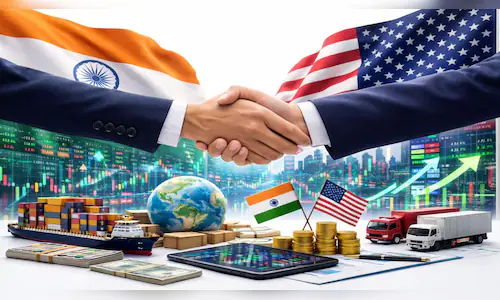
Rules of origin determine how much of a product must be manufactured within a country to qualify for tariff benefits under a trade agreement. Goyal said the proposed deal is likely to cover preferential tariffs, rules of origin and investment provisions, while both countries continue discussions on defence, critical minerals and investment cooperation. Critical minerals such as lithium, cobalt, nickel and rare earth elements are essential for electric vehicles, batteries, semiconductors and defence technologies.
Goyal said he would be “the happiest person” if the first tranche of the trade deal is signed before July 24. However, he noted that negotiations had to be revisited after a US Supreme Court ruling altered the tariff landscape by declaring certain tariff measures illegal.
He said the government is working to conclude a trade agreement that benefits Indian exporters, industry and farmers through preferential market access compared with competing countries. Indian exporters have been seeking improved access to the US market in sectors such as textiles, gems and jewellery, engineering goods, pharmaceuticals and agricultural products. Goyal added that any agreement must be mutually beneficial, stressing that a one-sided deal would not be sustainable.
Meanwhile, the Global Trade Research Initiative (GTRI) said the negotiations are taking place amid a broader shift in US strategic thinking. According to the think tank, Washington increasingly appears to view India more as a market for American goods, energy, aircraft and defence equipment than as a central pillar of its Indo-Pacific strategy.
GTRI Founder Ajay Srivastava pointed to proposals to rename the US Indo-Pacific Command back to the US Pacific Command as evidence of this shift. The command was renamed from Pacific Command to Indo-Pacific Command in 2018 to reflect Washington’s broader strategic focus on the Indian and Pacific Oceans and India’s growing role in regional geopolitics. He noted that the command’s renaming in 2018 was intended to place India at the centre of US strategy in Asia and recognise the growing importance of the Indian Ocean in balancing China’s rise. Reversing the move, he argued, would suggest that Washington no longer views India as central to its regional security architecture.
According to GTRI, India’s changing position reflects a broader reassessment of China. The think tank said the Indo-Pacific strategy, the Quad and efforts to elevate India as a strategic partner were built on the assumption that China could be constrained through a coalition of regional powers led by the United States. The Quad comprises India, the United States, Japan and Australia and has become a key platform for cooperation on security, technology and supply-chain resilience in the region. However, it argued that despite years of tariffs, technology restrictions, sanctions and military pressure, China has continued to expand its economic, industrial, technological and military capabilities.
China remains the world’s second-largest economy and the largest trading partner for many countries, making efforts to economically isolate or contain it increasingly challenging. Recent developments in Ukraine and West Asia have reinforced the perception that China possesses the economic scale and geopolitical reach to safeguard its interests despite US opposition, GTRI said.
“For Washington, the lesson is increasingly clear: China cannot be contained in the way the Soviet Union once was. The US now considers China an equal, hence the G2 concept,” the report said. The term “G2” refers to the idea that the United States and China are the two dominant powers shaping the global economic and geopolitical order.
GTRI also described the proposed bilateral trade agreement (BTA) as becoming “neither balanced nor stable”. A bilateral trade agreement typically aims to reduce tariffs, improve market access and establish rules governing trade and investment between two countries. It said the US is seeking long-term commitments from India on market access for agriculture, energy, defence equipment, aircraft, digital services and advanced technologies. The think tank added that Washington is also encouraging India to purchase up to $500 billion worth of American goods over five years, limit digital regulations and align more closely with US economic and security objectives.
According to GTRI, the primary US concession offered in return was a reduction in reciprocal tariffs from 25% to 18%. However, it argued that this concession lost its legal basis following the Supreme Court ruling and noted that similar arrangements could potentially be offered to other trading partners, including the European Union, Japan and South Korea.
India and the US have set an ambitious target of raising bilateral trade to $500 billion by 2030. The outcome of the ongoing negotiations could have significant implications for sectors including agriculture, automobiles, pharmaceuticals, digital services, defence manufacturing and energy trade.