

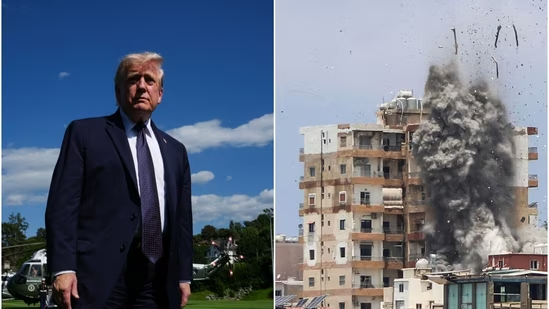
When US President Donald Trump attacked Iran on February 28, he outlined a set of goals – overthrow Iran’s regime, end the country’s nuclear programme, “raze its missile industry to the ground”, “annihilate its navy”, and curb its support for regional armed groups.
Many of Trump’s original objectives remain unresolved, deferred to future negotiations or absent altogether from the Memorandum of Understanding agreed to by the US and Iran, going by reports on deal.
In fact, Trump’s own stated objectives and goalposts shifted as the war progressed. Take for example the reopening of the Strait of Hormuz, which closed only as a result of the war and was open before the US-Israeli strikes. Also the need to eliminate Iran’s stockpile of highly enriched uranium, which did not exist before Trump in 2018 collapsed the 2015 nuclear deal.
Track Live Updates on US-Iran war here
Regime change absent from deal
At the start of the conflict, Trump openly called on Iranians to rise up against their government.
Yet there is no indication that the Memorandum of Understanding (MoU) includes provisions related to political change inside Iran. Tehran’s theocratic establishment remains in power, and no mechanism for regime transition forms part of the ceasefire framework.
Far from weakening politically, Iran continued to mount retaliatory attacks throughout the conflict despite sustaining significant military losses.
Also read: What US-Iran peace deal means for India
Nuclear programme remains unresolved
The dismantling of Iran’s nuclear programme was perhaps Trump’s most frequently repeated war aim.
However, the issue remains under discussion rather than settled. Reports indicate that the MoU leaves questions surrounding Iran’s nuclear activities to future negotiations.
Iran has consistently maintained that its nuclear programme is civilian in nature and that it is not seeking to develop nuclear weapons.
Missile programme dropped from agenda
Trump also vowed to “raze” Iran’s missile industry and demanded the dismantling of its ballistic missile capabilities.
But Iranian media reports cited by AFP news agency suggest that the missile issue has been removed entirely from the negotiating agenda.
Regional allies remain untouched
Another central US and Israeli objective was curbing Iran’s support for allied armed groups across the region, including Hezbollah.
Yet here too, reports indicate little progress. AFP reported that Iranian media said support for what Tehran calls “resistance groups” has also been removed from negotiations.
Also read: Why Iran stands largely alone in its war with Israel and the US
As a result, one of the war’s key strategic objectives appears to have been deferred rather than achieved.
Hormuz reopens, but not on pre-war terms
The most visible economic consequence of the conflict was the disruption of shipping through the Strait of Hormuz, through which roughly a fifth of global oil supplies transit.
The closure triggered a dramatic collapse in maritime traffic and sent commodity prices soaring. According to figures compiled during the conflict, the number of ships transiting the strait plunged after hostilities began, while prices of crude oil, natural gas and several industrial commodities rose sharply.
US officials have presented Iran’s agreement to reopen the waterway as a major achievement.
However, Iranian officials have said the strait will not necessarily return to its previous operating status. Tehran has indicated it intends to maintain a larger role in regulating maritime traffic through the chokepoint.
Heavy costs, limited gains
The war inflicted significant military damage on Iran.
According to strike estimates compiled during the conflict, US and Israeli forces targeted 700 ballistic missile force sites, 500 command-and-control facilities, 450 launchers, 250 air-defence systems, 250 UAV assets and 155 naval vessels, among other targets.
Yet Iran continued launching attacks across the region. Iranian missiles and drones struck Israel, the UAE, Kuwait, Bahrain, Qatar, Saudi Arabia and Oman during the conflict.
The economic consequences were also substantial. India, one of the countries most dependent on energy supplies moving through the Strait of Hormuz, experienced a spike in inflationary pressures. Wholesale price data showed a 46.5% increase in mineral oils and a 48.1% increase in crude petroleum and natural gas prices between February and May.
Global equity markets reflected the uncertainty. Japan’s Nikkei 225 rose 17.8% during the conflict and South Korea’s KOSPI gained 36.9%, while Germany’s DAX fell 1.3%, China’s SSE Composite declined 1.6%, the UK’s FTSE 100 dropped 3.9% and India’s Sensex fell 6.2%.
Also read: The Economics of Victory in Ukraine and Defeat in Iran
Timeline: 15 weeks that changed the world
February 28: US-Israel strikes killed supreme leader Ayatollah Ali Khamenei, senior commanders and scientists. Iran launched drones and missiles at Israel and US military positions across West Asia and blocked the Strait of Hormuz.
March 1: Three Indians were killed after Iran struck two tankers in the Gulf. Iran killed six US soldiers in Kuwait. Hundreds of flights were cancelled and thousands of Indians were stranded across West Asia.
March 4: Iranian Navy ship IRIS Dena was sunk by a US torpedo off Sri Lanka.
March 8: Iran named Mojtaba Khamenei as Supreme Leader. A projectile struck a residential area in Saudi Arabia, killing an Indian national.
March 11: An Indian was killed when a vessel was struck by an Iranian ship.
March 13: The US bombed Iran’s Kharg Island oil export hub. Two Indians were killed in Iranian drone strikes in Oman.
March 18: Israel attacked Iran’s South Pars gas field. Iran retaliated by striking Qatar’s Ras Laffan Industrial City.
March 27: An Iranian strike injured 12 US troops in Saudi Arabia. A missile attack in the UAE killed an Indian national.
April 3: Iran shot down a US jet carrying two crew members.
April 7: The United States announced a two-week ceasefire. Trump warned that “whole civilisation will die tonight” if Iran rejected a deal.
April 11: Vice president JD Vance travelled to Islamabad for talks. After negotiations failed, the US began a naval blockade of Iran.
April 18: The IRGC boarded the Indian tanker Samrar Herald after it had received clearance to transit the Strait of Hormuz.
April 19: US Marines boarded and seized an Iranian cargo ship accused of attempting to evade the blockade.
May 6: Secretary of state Marco Rubio announced Operation Epic Fury. Trump also suspended Project Freedom, the initiative aimed at reopening the Strait of Hormuz.
May 7–26: The United States carried out strikes on Bandar Abbas and Qeshm Island, targeting missile launch sites.
June 10: The US attacked a Palau-flagged tanker, killing three of the 24 Indian sailors aboard.
June 14: Trump praised Israeli Prime Minister Benjamin Netanyahu for conducting strikes that he said were delaying a peace deal with Iran.
June 15: Trump announced that a deal had been finalised to end the war. US officials said the MoU had been digitally signed by Trump, Vance and Iranian Parliament Speaker Mohammad Bagher Qalibaf.
The ceasefire may have halted active combat, but it has not delivered many of the objectives Trump identified when the war began.
Regime change has not occurred. Iran’s nuclear programme remains unresolved. Restrictions on missile development appear absent from negotiations. Support for regional allies is no longer on the agenda.