
Designed in one weekend, deployed for 70 years: The ‘BUFF’ B-52 US Air Force bomber that crashed

Eight people, including military personnel and contractors — died on Monday when a B-52 Stratofortress crashed and burst into flames shortly after take off from Edwards Air Force Base in California’s Mojave Desert. The aircraft went down at 11:20 am local time, leaving behind a charred scar larger than a football field and virtually no recognisable wreckage. The US Air Force has opened an investigation that could take up to six months.
All about the B-52 — what it is, what it has done across decades, and why an old combat aircraft is still being flown, and still being tested.
The aircraft that crashed
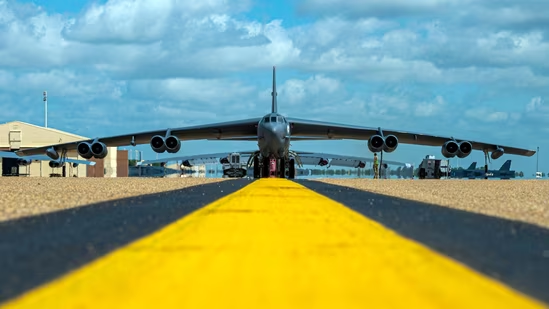
The bomber that went down at Edwards on Monday was a Boeing B-52H Stratofortress assigned to the 412th Test Wing — the unit that runs Edwards and handles developmental testing of all air force aircraft, weapons systems and components.
In December 2025, Boeing had ferried a B-52 to Edwards from its San Antonio, Texas, facility, where the plane had been fitted with a new AN/APQ-188 Active Electronically Scanned Array (AESA) radar system as part of the air force’s B-52 Radar Modernisation Programme (RMP), Boeing had said in a press release at the time.
Monday’s flight was described as a “routine test sortie” in support of that programme, the air force said, but it did not specify if the plane was the same one delivered late last year.
An AESA radar, the kind used on fighter aircraft, uses thousands of tiny transmit-receive modules instead of a single rotating dish, giving it faster target acquisition, better performance in poor weather, and greater resistance to electronic jamming. The APQ-188 fitted to the B-52 is derived from the radar used on the US Navy’s F/A-18 Super Hornet, The Aviationist, a news and analysis website, had reported.
The crash is the first involving a B-52 since May 2016, when one went down at Andersen Air Force Base in Guam, a US territory in the Pacific. All seven crew members survived that incident.
Monday’s incident is also the deadliest B-52 crash since 1982, when nine crew members died at Mather Air Force Base near Sacramento, California, according to the Bureau of Aircraft Accidents Archives, a Geneva-based organisation that collects global aviation accident data.
Col. James Hayes, deputy commander of the 412th Test Wing, said at a press conference Tuesday that the crash was “deemed unsurvivable” after reviewing footage. He declined to name the victims pending notification of families. Boeing confirmed two of its employees were among the dead.
Aviation safety expert Jeff Guzzetti, who has investigated crashes for both the Federal Aviation Administration (FAA) and the National Transportation Safety Board (NTSB), said the manner of the crash — low, fast, shortly after takeoff — pointed to a controllability problem, possibly a flight-control malfunction, a catastrophic engine failure, or a failure of the equipment being tested.
“A flight test is always riskier than normal operations,” Guzzetti told the Associated Press.

A decades old bomber
The B-52 Stratofortress was born over a weekend.
In late October 1948, a Boeing design team was told at a meeting with the US Air Force in Ohio’s Dayton that the force wanted to scrap a straight-wing turboprop design the company had been developing, and produce a jet-powered strategic bomber instead.
Over the following weekend at the Van Cleve Hotel in Dayton, an Air and Space Forces magazine reported, the engineers scrapped a six-engine propeller design they had been working on and produced the outline of what became the B-52.
Boeing won the contract in June 1946 for a long-range, high-altitude strategic bomber to replace the propeller-driven Convair B-36. The XB-52 prototype first flew on April 15, 1952. The B model entered service with the US Air Force in February 1955.
A total of 744 B-52s were built across ten variants — from A through H — with the last, a B-52H, delivered in October 1962. Production ended after just ten years. All 102 B-52H models were delivered to the Strategic Air Command between May 1961 and October 1962.
Today, only the H model remains in the Air Force inventory — 76 aircraft in all, operated by the 5th Bomb Wing at Minot Air Force Base, North Dakota; the 2nd Bomb Wing at Barksdale Air Force Base, Louisiana; and the Air Force Reserve Command’s 307th Bomb Wing, also at Barksdale.
Also read: What did Trump actually achieve in Iran? A deep dive into his unmet ‘objectives’
What it looks like, what it carries
The B-52H is enormous. Its swept wings span 56.4 metres — wider than the Wright Brothers’ entire first flight (which covered a distance of 36.6 metres in 1903) — and its fuselage stretches 48.5 metres from nose to tail. It stands 12.4 metres tall.
Fully loaded, B-52 weighs up to nearly 2,21,000 kilograms. Eight Pratt & Whitney TF33 turbofan engines, each producing up to 17,000 pounds of thrust, equivalent to approximately 75.6 kilonewtons (kN), are mounted in four twin pods under the wings.
A typical B-52 crew needs five members: an aircraft commander, a pilot, a radar navigator, a navigator, and an electronic warfare officer. Two jump seats bring the maximum occupancy to eight — accounting for the full complement on Monday’s flight.
It flies at high subsonic speeds — up to 1,046 km/h (Mach 0.84) — and can reach altitudes of up to 15,240 metres. Its combat range, unrefuelled, exceeds 14,080 km. With aerial refuelling possible, its range is limited only by crew endurance.
The payload capacity is 31,500 kg of mixed ordnance: gravity bombs, cluster bombs, precision-guided missiles, joint direct attack munitions (JDAMs), anti-ship missiles, mines and air-launched cruise missiles, including nuclear-capable variants. The H model can also carry up to 20 air-launched cruise missiles.
The unit cost of a B-52H is about $84 million.
The airframe earned an affectionate nickname during the Vietnam War: the BUFF. In official US Air Force fact sheets, this is decoded as “big ugly fat fellow”, though The National Interest, a US defence and foreign policy publication, notes that the F originally stood for something considerably more emphatic.
The name came from Operation Arc Light, the first B-52 bombing campaign in Vietnam, when crews flying too high to be seen or heard became, in the words of the Strategic Air Command’s own history, one of the weapons most feared by the Viet Cong, The National Interest reported.

Wars it fought
Vietnam (1965–1973)
In June 1965, B-52s entered combat for the first time, flying conventional bombing missions over South Vietnam. By August 1973, they had flown 126,615 combat sorties and lost 17 aircraft to enemy action, according to the Museum of Aviation Foundation of the US Air Force.
The peak of B-52 combat power came in December 1972 with Operation Linebacker II — the “Christmas bombings”. After peace talks with North Vietnam didn’t work out, then US President Richard Nixon ordered what is considered the most intensive bombing campaign in military history. More than 200 B-52s flew 730 sorties and dropped over 20,000 tonnes of bombs on targets in Hanoi and Haiphong over 12 days.
The Air and Space Forces magazine said in an article in 2005 that on the first night of the operation, 129 B-52s took off from Guam and Thailand, and came under fire from over 200 surface-to-air missiles launched by North Vietnam forces.
Three B-52s were brought down that night.
Over the entire campaign, 16 B-52s and 43 crew members were lost, according to the Military Officers Association of America (MOAA), a US organisation that advocates for military personnel.
It was during this operation, the 11th day (December 29), while the last wave of 60 B-52s was still over Hanoi, the North Vietnamese signalled the White House they were ready to return to the negotiating table, the magazine and former US Air Force man Robert O Harder wrote in his 2009 book, Flying From the Black Hole.
One electronic warfare officer aboard, R.J. Smith — credited with more than 500 Arc Light and Linebacker combat missions — is said to have hacked into the North Vietnamese ground control intercept network during a particularly intense moment and blew a whistle over the radio frequency, shouting “Time out!”. Whether it worked or not, his crew completed their bomb run, Harder wrote in the book.
Operation Desert Storm (1991)
Seven B-52s took off from Barksdale Air Force Base in Louisiana on January 16, 1991, flew 22,530km in 35 hours without landing, launched conventional air-launched cruise missiles at Iraqi targets, and returned.
The Military Officers Association of America says it was the longest combat mission in the history of aerial warfare at that time
Over the course of Desert Storm, B-52s flew 1,741 sorties, logged 15,269 combat hours, and dropped approximately 24,500 metric tonnes of munitions. The aircraft struck wide-area troop concentrations, fixed installations, and bunkers. The psychological effect on the Iraqi Republican Guard, which faced carpet bombing from aircraft flying too high to see, was documented in post-war assessments, the air force says.
Afghanistan and Iraq
In 2001, B-52s contributed to Operation Enduring Freedom, providing close air support to ground forces in Afghanistan — loitering at high altitude and dropping precision-guided munitions on request. In 2003, during Operation Iraqi Freedom, B-52s launched approximately 100 conventional air-launched cruise missiles in a single night.
Against ISIS (2016)
B-52s returned to the Central Command area of operations in 2016 for the first time in a decade, flying approximately 1,800 combat sorties against Islamic State forces in Syria and Iraq.
Iran (2026)
The most recent combat use of the B-52 is ongoing. In Operation Epic Fury, launched by US Central Command on February 28, 2026, at President Trump’s direction, B-52s have been deployed alongside B-1B Lancers and B-2 Spirit stealth bombers. In the first 72 hours, CENTCOM said it had struck over 1,700 targets across Iran. By the first 13 days of the campaign, approximately 6,000 targets had been struck.
Also read: From patrol to rescue: US Navy’s Corsair sea drone just rewrote the rules of unmanned warfare
Russia has the closest model
The B-52 has never been operated by any nation other than the US; Nasa separately flew B-52s for aerospace research missions.
The closest comparative aircraft is Russia’s Tupolev Tu-95, designated “Bear” by the North Atlantic Treaty Organization (NATO) — a four-engine turboprop strategic bomber that first flew in 1952 and entered Soviet service in 1956, one year after the B-52, Special Operations Forces Report (SOFREP), another US military news and analysis website said.
Where the B-52 uses eight jet turbofan engines, the Tu-95 relies on four massive Kuznetsov turboprop engines driving contra-rotating propellers, making it one of the loudest aircraft ever built and exceptionally detectable by radar — a liability for a bomber.
Both aircraft were built as nuclear delivery platforms for the Cold War. Both have been extensively upgraded and are still flying. The Tu-95 is expected to remain in Russian service until at least 2040.
The B-52’s combat range exceeds 14,080 km; the Tu-95 can fly up to roughly 15,125km, though much of that depends on variant and configuration. In terms of technological upgrades, modernisation investment, and operational versatility, the B-52 has maintained an edge.
China and Russia are developing next-generation strategic bombers — the Xian H-20 and the Tupolev PAK DA, neither of which has entered service.
The primary US stealth bomber successor is the Northrop Grumman B-21 Raider, which completed its maiden flight in November 2022 and has since been delivered to Edwards Air Force Base for developmental testing. It has not yet entered operational service, according to 19FortyFive, another US defence and national security publication.

Records, near-disasters, and a tailless landing
The B-52’s biography is full of moments that passed into aviation lore.
On January 18, 1957, three B-52Bs completed Operation Power Flite — the world’s first non-stop round-the-world flight by a jet aircraft. The 39,147km journey took 45 hours and 19 minutes, with three aerial refuellings.
According to the Smithsonian Magazine, the mission was intended to demonstrate that the US could drop a hydrogen bomb anywhere on Earth.
General Curtis LeMay, then commander of the Strategic Air Command, was among the 1,000 people on the tarmac when the bombers returned and personally awarded all 27 crew members the Distinguished Flying Cross.
A year before the round-the-world flight, in 1956, a B-52 dropped the first airborne hydrogen bomb over Bikini Atoll in the Pacific, as part of a series of tests.
Then, in January 1964, Boeing civilian test pilot Chuck Fisher and a three-person crew took off from Kansas aboard a B-52H to test the aircraft’s response to severe turbulence at low altitude over mountainous terrain. As the aircraft flew over the Sangre de Cristo Mountains in northern New Mexico, a sudden five-second blast of clear air turbulence ripped off the vertical fin — the bomber’s entire tail. Only about 15% of the fin remained, the 1981 book Boeing B-52: A Documentary History recorded.
Fisher, unaware of how much damage had been done, slowed to 220 knots (407kmph) and said he was going to “handle it pretty carefully”. A chase pilot in an F-100 who had flown up to survey the damage replied: “That’s a good idea. All of your rudder and most of your vertical fin are gone.” Fisher purportedly asked: “Don’t I even have 50%?”
The pilot replied, “No, you don’t have 50%.”
The crew flew the aircraft for nearly five hours without a tail before landing safely at Blytheville Air Force Base in Arkansas. The incident led Boeing to strengthen the airframe, local media reported.
A 70-year-old aircraft with a 2050 deadline
The US Air Force currently projects B-52H service life extending to 2050 — and potentially beyond. When the last B-52 is retired, the airframes will be close to 90 years old.
Two major modernisation programmes for the aircraft are underway, including the Radar Modernisation Programme (RMP).
The second one, the Commercial Engine Replacement Programme (CERP), will replace the TF33 engines with newer, more fuel-efficient commercial turbofans. The combined package, sometimes referred to as the B-52J, is estimated to cost $48 billion.
The fate of the test programme now depends on how the investigation into Monday’s crash unfolds. Col. Hayes confirmed all operations at Edwards were suspended through at least Tuesday.