

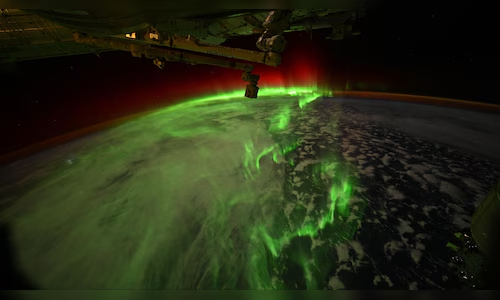
The video, posted on social media, offers a rare view of the Southern Aurora, or Aurora Australis, from space as charged particles from the Sun interacted with Earth’s magnetic field, creating vivid light displays over the Southern Hemisphere.
Watch the Southern Aurora From Space
Sharing the timelapse, Meir described the experience as unlike previous auroras she had witnessed from orbit.
“A timelapse view from our SpaceX Dragon of the spectacular southern aurora seen in yesterday’s post, a result of a recent solar event,” she wrote on X. “As opposed to the previous aurora I’ve seen, this one danced and snaked its way directly below us, putting on quite a show.”
She added that the phenomenon left her “in awe” because of its beauty and emotional impact.
The footage shows bright green auroral bands moving across Earth’s atmosphere beneath the spacecraft, creating a striking visual display rarely seen from the ground.
A timelapse view from our @SpaceX Dragon of the spectacular southern aurora seen in yesterday’s post, a result of a recent solar event. As opposed to the previous aurora I’ve seen, this one danced and snaked its way directly below us, putting on quite a show. I am in awe of this… pic.twitter.com/ReztjH3x9H
— Jessica Meir (@Astro_Jessica) June 7, 2026
Solar Flare Triggered the Light Show
The aurora followed a recent solar eruption monitored by the U.S. National Oceanic and Atmospheric Administration (NOAA).
According to NOAA’s Space Weather Prediction Centre, active region AR 4461 produced an M1.8-class solar flare at 06/1401 UTC. The event was linked to a filament eruption and a subsequent coronal mass ejection (CME), with analysis still underway.
NOAA said an Earth-directed component of the CME is currently anticipated and could reach Earth around June 8, based on preliminary estimates.
The agency noted that solar flares are bursts of energy from the Sun that can sometimes affect radio communications and contribute to auroral activity when solar particles interact with Earth’s magnetic field.
AR 4461 produced an M1.8 flare at 06/1401 UTC. This event was associated with a filament eruption and subsequent CME of which analysis and modeling is currently underway. An Earth-directed component is currently anticipated and would likely arrive on June 8th by rough estimates. pic.twitter.com/bSWGEyCPez
— NOAA Space Weather Prediction Center (@NWSSWPC) June 6, 2026
Aurora Seen Amid Ongoing ISS Operations
The aurora sighting came during a period of heightened attention around operations aboard the International Space Station (ISS).
In an earlier social media post, Meir said the crew was safe despite ongoing activity on the orbiting laboratory and highlighted the Southern Aurora as one of the remarkable sights visible from space.
“There is a lot going on right now on the ISS, but fortunately, we are all safe and witnessed a spectacular southern aurora show yesterday thanks to a recent solar event,” she wrote.
There is a lot going on right now on the @Space_Station, but fortunately we are all safe and witnessed a spectacular southern aurora show yesterday thanks to a recent solar event. pic.twitter.com/25XaoMw2Rk
— Jessica Meir (@Astro_Jessica) June 6, 2026
NASA recently confirmed that astronauts aboard the station temporarily sheltered inside their docked spacecraft while teams assessed an air leak in the Russian segment of the ISS. The precautionary measure was later lifted after further evaluation by NASA and Russia’s space agency, Roscosmos.
Why Auroras Look Different From Space
Auroras occur when charged particles from the Sun collide with gases in Earth’s upper atmosphere, producing colourful displays near the polar regions.
While people on the ground usually see auroras from below, astronauts aboard spacecraft and the ISS can observe them at eye level as they pass over Earth’s poles. This unique vantage point often reveals the full scale and movement of the glowing atmospheric curtains.
Meir’s latest timelapse offers a striking example of that perspective, capturing the Southern Lights flowing directly beneath the spacecraft as the Sun’s activity continues to influence space weather around Earth.
(Edited by : Priyanka Deshpande)
First Published: Jun 8, 2026 3:48 PM IST