

Economy, Featured
By Anthony Isibor
WHEN President Bola Tinubu addressed Nigerians on Democracy Day, June 12, 2026, there was a deliberate attempt to frame his administration’s economic journey as one driven by necessity rather than political convenience.
“The reforms we are undertaking were not chosen for ease, but for necessity,” Tinubu said. “Three years ago, our public finances were under severe strain, investment was discouraged, and economic uncertainty threatened our future.”
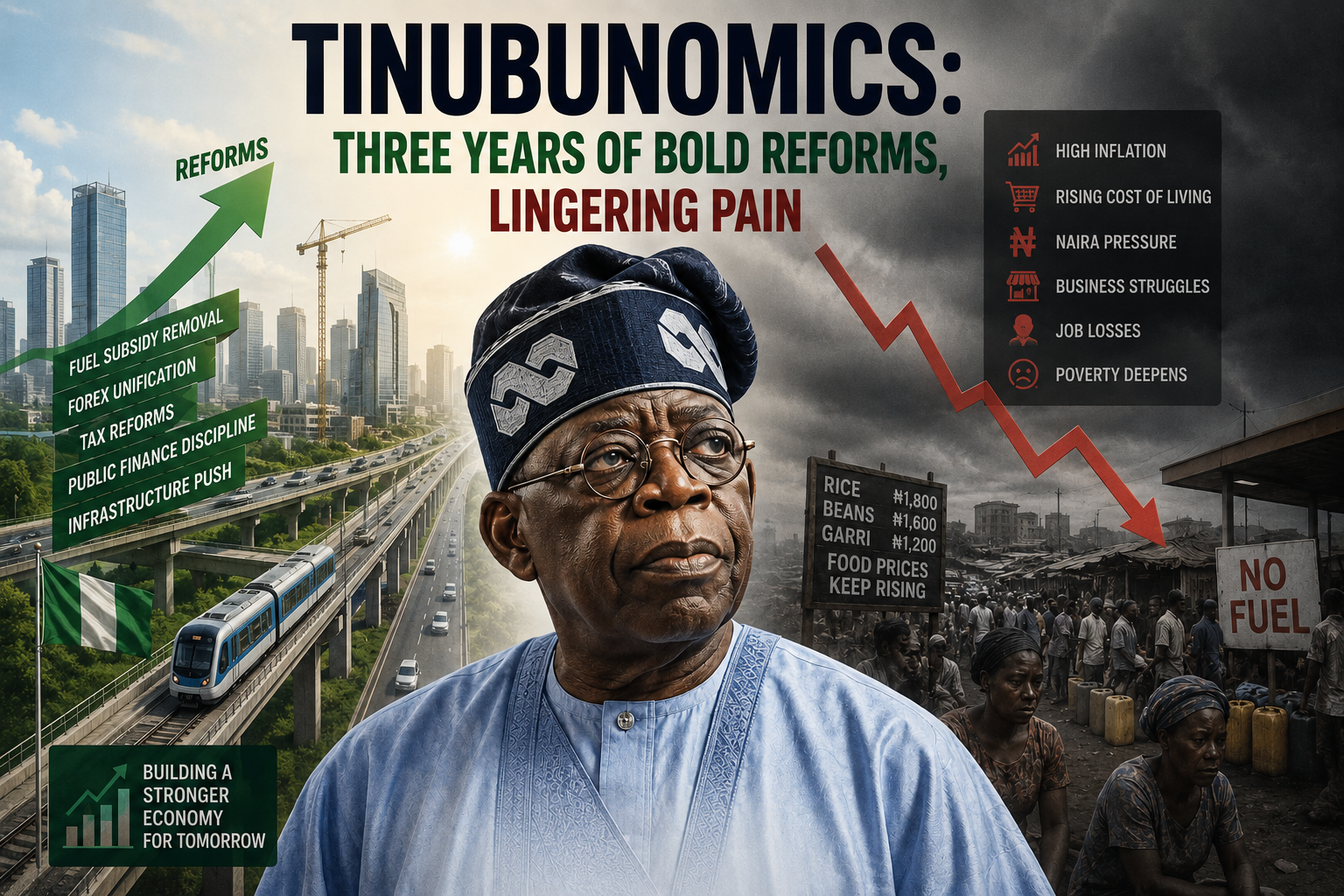
The speech, delivered exactly three years after he assumed office, offered perhaps the clearest summary yet of the mindset behind Tinubu’s economic policies; what can be known as “Tinubunomics”, a package of market-oriented reforms centred on fuel subsidy removal, exchange rate liberalisation, fiscal restructuring, tax reforms and efforts to attract investment.
Yet, three years after those reforms began, the central question remains unresolved: Has Tinubunomics moved Nigeria forward or backward?
For international financial institutions, the reforms have largely been welcomed. For millions of ordinary Nigerians struggling with rising cost of living, however, the reforms have brought more hardships.
Tinubu inherited an economy weighed down by inflated subsidy costs, a heavily managed foreign exchange system, dwindling investor confidence and mounting fiscal pressures, prompting him on his inauguration day, May 29, 2023, to announce the removal of petrol subsidy, which immediately triggered one of the most consequential economic shifts in Nigeria’s recent history.
The naira was subsequently floated, leading to a sharp depreciation against major currencies. Electricity tariffs were adjusted. Interest rates rose as the Central Bank pursued inflation control measures.
While supporters argued that these were difficult decisions previous administrations had avoided for decades, the International organizations have continued to praise the government for these reforms.
For example, the International Monetary Fund, IMF, has repeatedly praised the reforms, noting that Nigerian authorities have implemented “major reforms” that improved macroeconomic stability, removed costly fuel subsidies, improved the functioning of the foreign exchange market and strengthened investor confidence. The IMF noted that the reforms helped Nigeria improve fiscal performance and increase foreign reserves. However, it also acknowledged that poverty and food insecurity worsened during the reform period and that the gains had yet to benefit most Nigerians.
The World Bank has also expressed a similar view.
According to the Bank, Nigeria’s macroeconomic reforms since 2023 have improved policy credibility, stabilised inflationary pressures, strengthened public revenues and enhanced exchange-rate flexibility. The institution believes that if sustained, the reforms could lay the foundation for long-term growth and structural transformation. Yet it also acknowledged that improvements in macroeconomic indicators have not translated into significant improvements in living standards for millions of Nigerians.
These endorsements have become central to the government’s defence of its economic agenda.
Tinubu himself highlighted what he described as evidence of progress during his Democracy Day address. He pointed to rising federation revenues, improved fiscal transparency, increased domestic refining capacity, growth in non-oil exports, renewed investor confidence and expanding investments across sectors.
The administration argues that states now receive significantly more allocations than before subsidy removal and that the economy is becoming less dependent on oil revenues.
Economic analysts generally agree that some of the distortions in the Nigerian economy needed to be addressed.
Bismarck Rewane, Managing Director of Financial Derivatives Company Limited, has consistently argued that fiscal discipline and realistic economic planning are essential for sustainable growth. While acknowledging ongoing challenges, he has pointed to improving growth prospects and the need for policies that reflect economic realities rather than political optimism.
Other economists have similarly argued that subsidy removal was inevitable because the policy had become fiscally unsustainable, consuming resources that could otherwise be deployed to infrastructure, healthcare and education.
But economic theory and economic reality often do not agree because for millions of Nigerians, the immediate impact of Tinubunomics was felt not in improved fiscal indicators but in transport fares, food prices, school fees and rent.
Inflation surged to levels not seen in decades, following subsidy removal and exchange-rate reforms. The cost of basic commodities climbed sharply while wages failed to keep pace.
Many small businesses faced rising operating costs due to higher fuel and electricity prices. Manufacturers struggled with currency volatility and increased production expenses. Households saw their purchasing power eroded.
The IMF itself has acknowledged this contradiction. While commending the reforms, it observed that poverty and food insecurity increased and that the benefits of economic stabilisation had not yet reached a large segment of the population.
What is very obvious however, is that Nigeria’s poverty rate rose to 63% in 2025 despite falling inflation, with 140 million Nigerians affected, as the World Bank warns slow income growth is worsening living conditions.
This information is part of a report from the World Bank titled “Nigeria Development Update (April 2026): Nigeria’s Tomorrow Must Start Today: The Case for Early Childhood Development,”.
According to figures in the publication, the proportion of Nigerians below the poverty line rose from 56 percent in 2023 to 61 percent in 2024 and 63 percent in 2025.
About 140 million Nigerians, the number getting into poverty, rose to 63 percent, even when inflation was softening, which implies price moderation was not translating to real income growth.
According to reports, Nigeria’s headline inflation rate declined sharply from 34.80 per cent in December 2024 to 15.15 per cent in December 2025, representing a drop of 19.65 percentage points, according to data from the National Bureau of Statistics.
In a like manner, the decrease in food inflation was from the level of 39.84 per cent in December 2024 to 10.84 per cent in December 2025, which implies a decline by about 29 percentage points during the period.
Both headline and food inflation decreased sharply, which indicates that price pressures were loosening and base effects were working, among other factors, a CPI rebasing. But the consummation of a rise before the spike had already taken away the purchasing power of the households.
Beyond inflation, the structure of Nigeria’s economic growth has also constrained poverty reduction. The report observed that growth has been largely driven by services and industry, while agriculture which employs more than half of the poor has lagged.
The disconnect between macroeconomic progress and household hardship has become the defining feature of Tinubunomics.
Critics argue that the administration implemented shock therapy without first establishing sufficient social safety nets.
Many point out that while subsidy removal may have improved government finances, the expected palliatives and social interventions were either inadequate or poorly coordinated.
The Nigerian Bar Association, NBA has also expressed concerns about aspects of the government’s broader economic reform agenda, warning that policy uncertainty and implementation controversies could affect investor confidence and public trust.
Even among economists who support the reforms, there is recognition that stabilisation alone is not enough.
Growth remains modest relative to Nigeria’s population expansion. Job creation has not matched the needs of millions of young Nigerians entering the labour market annually. Food inflation continues to strain household budgets, while insecurity in farming communities remains a major obstacle to agricultural productivity.
However, the government’s response has been that economic transformation requires patience. Tinubu has repeatedly argued that previous administrations postponed difficult decisions, leaving his government with little choice but to act.
Indeed, some international observers see the reforms as a correction of decades of economic distortions. The IMF noted that subsidy removal, exchange-rate reforms and tighter monetary policy have improved resilience and strengthened Nigeria’s ability to withstand external shocks.
For stakeholders like Peter Obi, Presidential candidate of the Nigerian Democratic Congress, NDC, Tinubu’s economic reforms look good on paper (rising GDP figures, IMF/World Bank praise), but did not match what the ordinary Nigerians experience day to day. In a March 2026 statement, citing an Agora Policy study, he stated that the poverty rate has surged from roughly 40% before the reforms to over 63% now, meaning more than 140 million Nigerians live in poverty
Obi argues that an economy can’t be described as improving when most people are getting poorer, and contrasted that hardship with the continued lavish spending of the people in power.
On what reform “should” look like versus what’s happening, he insisted that true reform must be people-centred, protecting the most vulnerable, while pursuing fiscal sustainability and that reforms which deepen poverty, widen inequality, and force small businesses to close can’t be called successful.
He made a similar point using World Bank data from October 2025, noting that poverty rose from 87 million Nigerians in 2023 to about 139 million, which he called a “heartbreaking reflection” of policy failure, blaming poor planning and implementation rather than the goals of the reforms themselves.
Although a policy group, IMPI, has pushed back, on Obis postulations, arguing that his analysis is simplistic and that World Bank data actually supports. Similarly, Reuters recently reported that the administration believes the reforms have restored investor confidence, strengthened public finances and improved the country’s economic outlook despite the hardship experienced by the citizens.
Yet politics rarely rewards promises of future benefits when present suffering dominates public perception.
That is perhaps why Tinubu’s Democracy Day speech repeatedly returned to the theme of “economic freedom.”
“The heroes of June 12 secured political freedom. Our challenge is to secure economic freedom,” he said.
Whether Tinubunomics ultimately succeeds may depend on whether the administration can bridge the widening gap between positive macroeconomic indicators and the daily experiences of the ordinary Nigerians.
Three years on, the scorecard remains mixed.
The economy appears more stable than it was in 2023. Public revenues have improved. Investor confidence has shown signs of recovery. Foreign exchange market distortions have reduced.
At the same time, poverty remains widespread, inflation continues to bite, unemployment and underemployment remain significant concerns and many Nigerians still struggle to see how the promised gains affect their lives.
The first phase of Tinubunomics has largely been about stabilisation. And for the second phase to succeed, it must focus on inclusion.
For now, the verdict on Tinubunomics remains inconclusive, as it is praised by international institutions, defended by its architects, debated by economists and criticised daily by the ordinary Nigerians.
A.I
June 14, 2026
Tags: Bismarck Rewane Peter Obi President Bola Tinubu