
America's ‘Most Successful Immigrants’: 26 Indian-origin leaders including Sundar Pichai, Satya Nadella | See full list

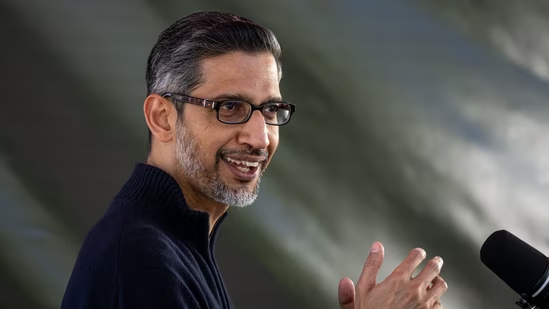
Forbes has released its “America’s Most Successful Immigrants” list, ranking 250 living foreign-born individuals who have made significant contributions across business, technology, science, culture, and public leadership. The ranking was published as part of America’s 250th anniversary coverage.
Among the most prominently represented groups are Indian-origin leaders, who feature across Big Tech, venture capital, enterprise software, and global corporations.
Sundar Pichai
Sundar Pichai is among the most influential names on the list. After joining Google in 2004, he rose through the company by leading major product initiatives, most notably Chrome, which became one of the world’s dominant browsers.
Since becoming CEO of Google in 2015 and later Alphabet, Pichai has overseen the company’s expansion into artificial intelligence, cloud computing, and hardware ecosystems.
Under his leadership, Google has positioned itself as a central player in the global AI race, integrating generative AI across search, productivity, and enterprise tools.
Satya Nadella
Satya Nadella has led one of the most widely cited corporate turnarounds in modern tech history. Since taking over in 2014, he has reshaped Microsoft around cloud computing and AI, with Azure emerging as a major competitor to Amazon Web Services.
Nadella also oversaw major strategic acquisitions, including LinkedIn and Activision Blizzard, strengthening Microsoft’s position across enterprise software, gaming, and professional networks.
Vinod Khosla
Vinod Khosla co-founded Sun Microsystems, a foundational company in the early Silicon Valley computing era. He later transitioned into venture capital, founding Khosla Ventures.
Today, he is known for backing high-risk, high-impact startups in clean energy, healthcare, and artificial intelligence, often focusing on technologies with long-term transformative potential rather than short-term returns.
Also Read: Entrepreneur blocked Vinod Khosla’s number after a dinner. Indian-origin billionaire responds to viral allegation
Indra Nooyi
Indra Nooyi served as CEO of PepsiCo, where she led a strategic shift toward healthier product lines while expanding the company’s global reach. Her tenure is regarded as a benchmark for balancing commercial growth with long-term sustainability in the consumer goods sector.
Nikesh Arora
Nikesh Arora leads one of the world’s top cybersecurity companies. With prior leadership roles at Google and SoftBank, Arora has played a key role in scaling Palo Alto Networks as demand for enterprise security and cloud protection continues to grow globally.
Also Read: World’s richest people list 2026: Elon Musk leads rankings; who joins him in top 10?
Full list: 26 Indian-origin leaders in Forbes’ ranking
Below is the complete list of Indian-origin individuals featured in Forbes’ “America’s Most Successful Immigrants” list:
- Vinod Khosla
- Naval Ravikant
- Hemant Taneja
- Sanjay Mehrotra
- Sundar Pichai
- Abhijit Banerjee
- Padma Lakshmi
- Satya Nadella
- Bharat Desai
- Neerja Sethi
- Jay Chaudhry
- Romesh T. Wadhwani
- Jyoti Bansal
- Neha Narkhede
- David Paul
- Jitendra Mohan
- Arvind Krishna
- Shantanu Narayen
- Premal Shah
- Rakesh Gangwal
- Indra Nooyi
- Nikesh Arora
- K.R. Sridhar
- Aman Narang
- Anu Hariharan
- Jayshree Ullal
US immigration
The current US immigration stance is characterized by tighter enforcement and more restrictive visa scrutiny, especially around skilled migration and border control.
Under the Trump administration, policies have focused on reducing both illegal and certain categories of legal immigration, increasing vetting standards, and expanding deportation and compliance enforcement mechanisms.
At the same time, there remains strong economic dependence on high-skilled foreign workers, particularly in sectors like technology, healthcare, and engineering, which has kept programs such as the H-1B visa system politically and economically significant.